QUESTION IMAGE
Question
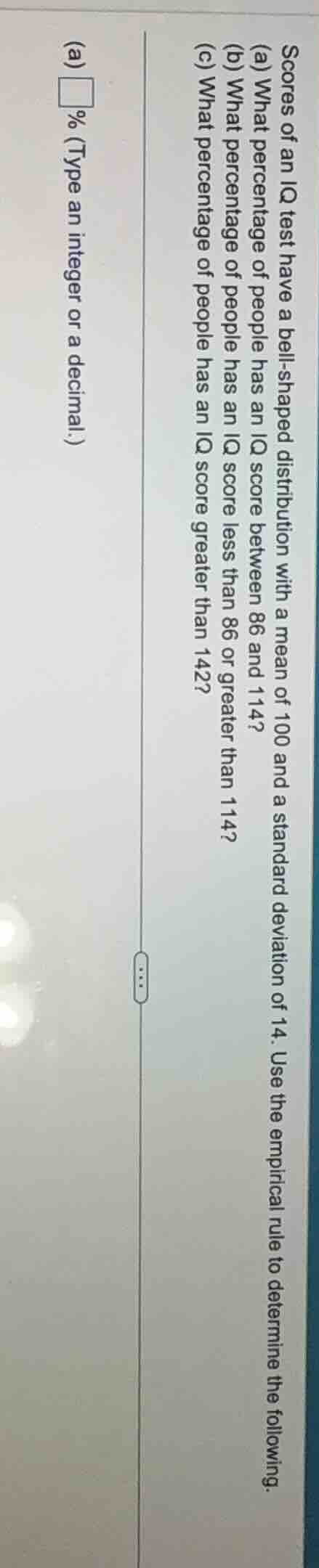
scores of an iq test have a bell - shaped distribution with a mean of 100 and a standard deviation of 14. use the empirical rule to determine the following.\\(\text{(a)}\\) what percentage of people has an iq score between 86 and 114?\\(\text{(b)}\\) what percentage of people has an iq score less than 86 or greater than 114?\\(\text{(c)}\\) what percentage of people has an iq score greater than 142?\\(\text{(a)}\\) \\(\square\\)\\% (type an integer or a decimal.)
Step1: Identify z-scores for (a)
First, calculate z-scores for 86 and 114:
$z_1 = \frac{86-100}{14} = -1$, $z_2 = \frac{114-100}{14} = 1$
Step2: Apply empirical rule for (a)
Empirical rule: 68% of data lies within $\mu\pm\sigma$ (z=-1 to z=1).
Step3: Calculate (b) using complement
Percentage outside $\mu\pm\sigma$ is $100\%-68\%=32\%$.
Step4: Identify z-score for (c)
Calculate z-score for 142:
$z = \frac{142-100}{14} = 3$
Step5: Apply empirical rule for (c)
Empirical rule: 99.7% of data lies within $\mu\pm3\sigma$. Percentage above z=3 is $\frac{100\%-99.7\%}{2}=0.15\%$.

Snap & solve any problem in the app
Get step-by-step solutions on Sovi AI
Photo-based solutions with guided steps
Explore more problems and detailed explanations
(a) $68\%$
(b) $32\%$
(c) $0.15\%$