QUESTION IMAGE
Question
sedimentary rock forms after sediment undergoes several processes.
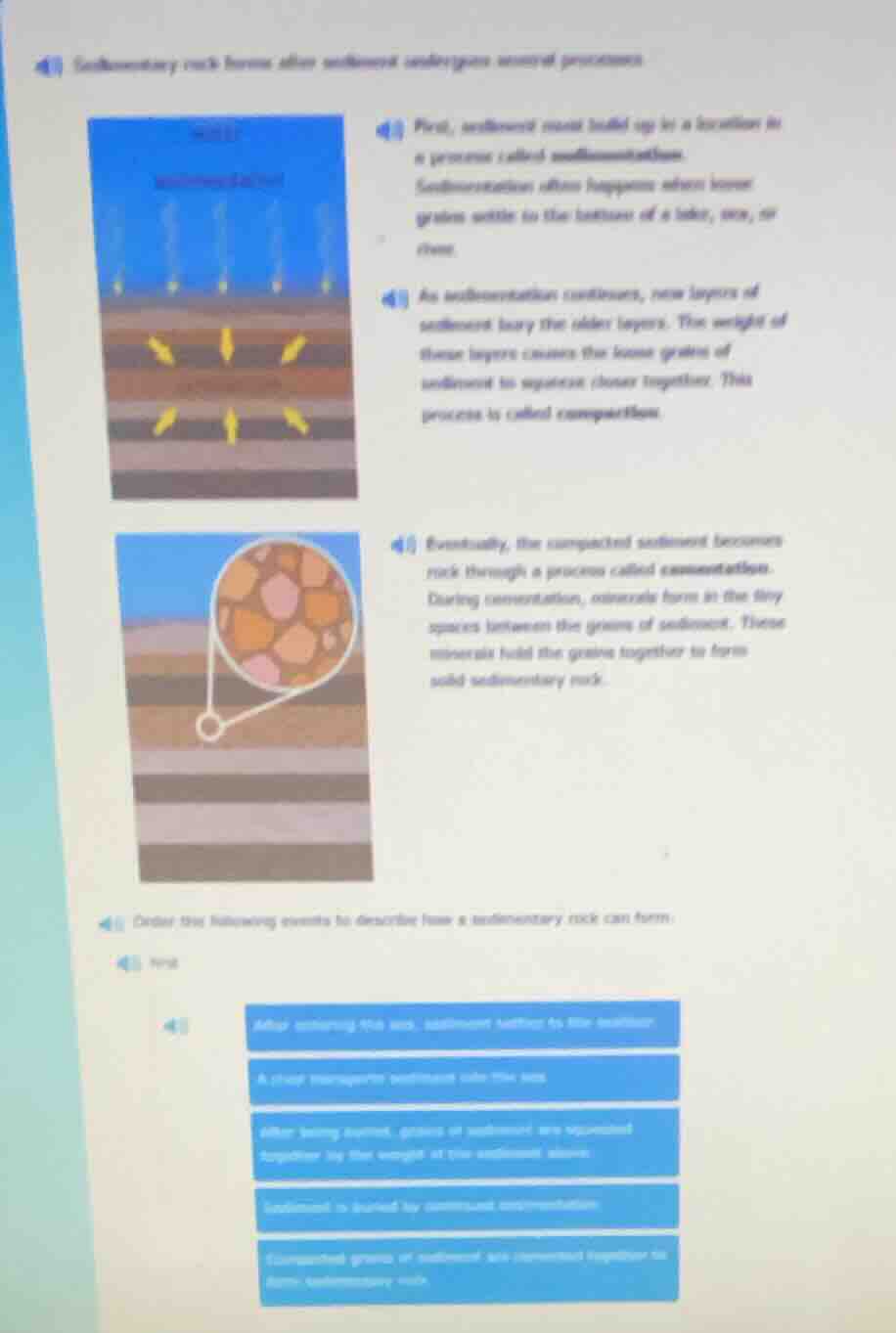
first, sediment is first laid up in a location in a process called sedimentation. sedimentation often happens when loose grains settle to the bottom of a lake, sea, or river.
as sedimentation continues, new layers of sediment bury the older layers. the weight of these layers causes the loose grains of sediment to squeeze closer together. this process is called compaction.
eventually, the compacted sediment becomes rock through a process called cementation. during cementation, minerals form in the tiny spaces between the grains of sediment. these minerals hold the grains together to form solid sedimentary rock.
order the following events to describe how a sedimentary rock can form:
1.
after entering the sea, sediment settles to the bottom
a river transports sediment into the sea
after being buried, grains of sediment are squeezed together by the weight of the sediment above
sediment is buried by continued sedimentation
compacted grains of sediment are cemented together to form sedimentary rock
To solve the problem of ordering the events in sedimentary rock formation, we analyze the process described:
Step 1: Identify the First Event
Rocks are weathered and eroded, and agents like water transport the sediment. So the first event is: A river transports sediment into the sea
Step 2: Second Event
After sediment is transported to a body of water (like the sea), it settles. So the next event is: After entering the sea, sediment settles to the bottom
Step 3: Third Event
As more sediment accumulates, the weight of the top layers compacts the lower layers. So: After being deposited, grains of sediment are squeezed together by the weight of the sediment above
Step 4: Fourth Event
Compaction is followed by cementation, where minerals bind the sediment grains. So: Sediment is buried by cemented sedimentation (Note: This likely refers to the cementation process binding the compacted sediment.)
Step 5: Final Event
The cemented and compacted sediment becomes rock. So: Compressed grains of sediment are cemented together to form sedimentary rock
Ordered Sequence:
- A river transports sediment into the sea
- After entering the sea, sediment settles to the bottom
- After being deposited, grains of sediment are squeezed together by the weight of the sediment above
- Sediment is buried by cemented sedimentation
- Compressed grains of sediment are cemented together to form sedimentary rock
(Note: The phrase “Sediment is buried by cemented sedimentation” may have a typo, but it logically fits as the cementation step after compaction.)

Snap & solve any problem in the app
Get step-by-step solutions on Sovi AI
Photo-based solutions with guided steps
Explore more problems and detailed explanations
To solve the problem of ordering the events in sedimentary rock formation, we analyze the process described:
Step 1: Identify the First Event
Rocks are weathered and eroded, and agents like water transport the sediment. So the first event is: A river transports sediment into the sea
Step 2: Second Event
After sediment is transported to a body of water (like the sea), it settles. So the next event is: After entering the sea, sediment settles to the bottom
Step 3: Third Event
As more sediment accumulates, the weight of the top layers compacts the lower layers. So: After being deposited, grains of sediment are squeezed together by the weight of the sediment above
Step 4: Fourth Event
Compaction is followed by cementation, where minerals bind the sediment grains. So: Sediment is buried by cemented sedimentation (Note: This likely refers to the cementation process binding the compacted sediment.)
Step 5: Final Event
The cemented and compacted sediment becomes rock. So: Compressed grains of sediment are cemented together to form sedimentary rock
Ordered Sequence:
- A river transports sediment into the sea
- After entering the sea, sediment settles to the bottom
- After being deposited, grains of sediment are squeezed together by the weight of the sediment above
- Sediment is buried by cemented sedimentation
- Compressed grains of sediment are cemented together to form sedimentary rock
(Note: The phrase “Sediment is buried by cemented sedimentation” may have a typo, but it logically fits as the cementation step after compaction.)