QUESTION IMAGE
Question
select the correct answer from each drop-down menu.
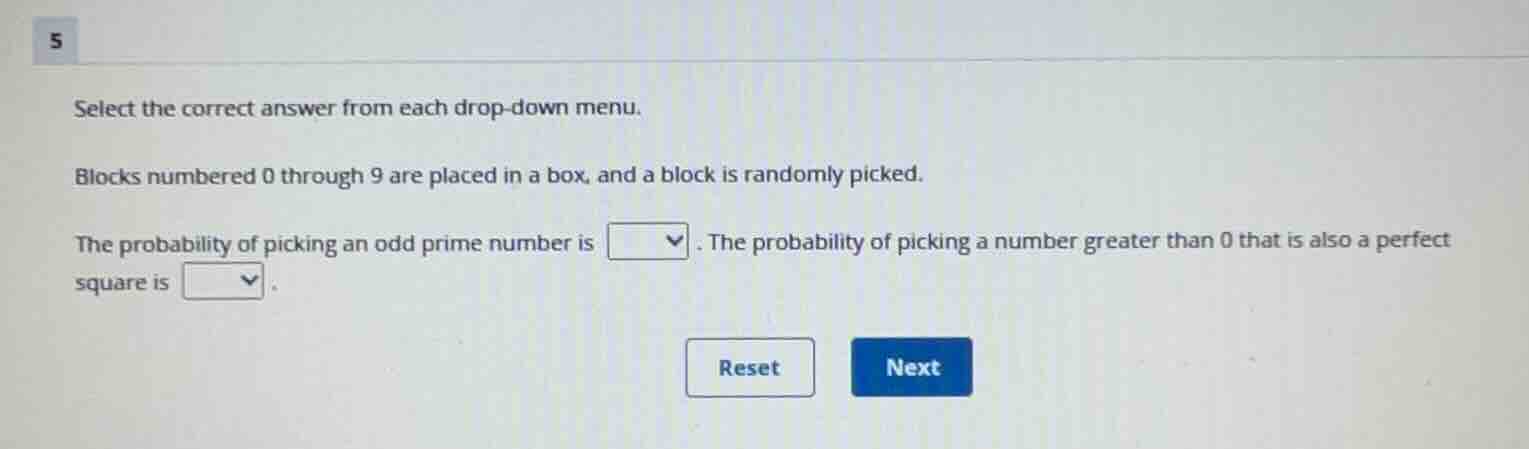
blocks numbered 0 through 9 are placed in a box, and a block is randomly picked.
the probability of picking an odd prime number is. the probability of picking a number greater than 0 that is also a perfect square is.
Step1: Find total number of blocks
There are blocks numbered 0 - 9, so total number of blocks \( n = 10 \).
Step2: Find odd prime numbers between 0 - 9
Prime numbers are numbers greater than 1 that have no divisors other than 1 and themselves. Odd prime numbers between 0 - 9 are 3, 5, 7. So number of odd prime numbers \( m_1 = 3 \).
Probability of picking an odd prime number \( P_1=\frac{m_1}{n}=\frac{3}{10} \).
Step3: Find numbers greater than 0 and perfect squares between 0 - 9
Perfect squares greater than 0 between 0 - 9 are \( 1 = 1^2 \), \( 4 = 2^2 \), \( 9 = 3^2 \). So number of such numbers \( m_2 = 3 \).
Probability of picking such a number \( P_2=\frac{m_2}{n}=\frac{3}{10} \)? Wait, no: wait, 1, 4, 9: that's 3 numbers? Wait, 1 is \( 1^2 \), 4 is \( 2^2 \), 9 is \( 3^2 \). So yes, 3 numbers. Wait, but let's check again. Numbers greater than 0: so from 1 - 9. Perfect squares: 1, 4, 9. So three numbers. So probability \( P_2=\frac{3}{10} \)? Wait, no, wait: 1, 4, 9: that's 3 numbers. Wait, but let's confirm:
Wait, first part: odd primes between 0 - 9: primes are 2, 3, 5, 7. But odd primes: exclude 2 (since 2 is even). So 3,5,7: three numbers. So probability \( \frac{3}{10} \).
Second part: numbers greater than 0 and perfect squares: 1 (1²), 4 (2²), 9 (3²). So three numbers. So probability \( \frac{3}{10} \)? Wait, but wait, 1 is a perfect square, 4 is 2², 9 is 3². So yes, three numbers. So both probabilities are \( \frac{3}{10} \)? Wait, no, wait:
Wait, first part: odd primes. Primes between 0 - 9: 2,3,5,7. Odd primes: 3,5,7 (since 2 is even). So 3 numbers. So probability \( \frac{3}{10} \).
Second part: numbers greater than 0 and perfect squares. Perfect squares in 1 - 9: 1 (1²), 4 (2²), 9 (3²). So 3 numbers. So probability \( \frac{3}{10} \). Wait, but let's check again.
Wait, first probability: odd primes (0 - 9):
Primes: 2,3,5,7. Odd primes: 3,5,7 (because 2 is even). So 3 numbers. So probability \( \frac{3}{10} \).
Second probability: numbers >0 and perfect squares:
Perfect squares: 0 (0²), 1 (1²), 4 (2²), 9 (3²). But numbers greater than 0: so 1,4,9. So 3 numbers. So probability \( \frac{3}{10} \).
Wait, but maybe I made a mistake. Let's re-express:
First probability:
Total outcomes: 10 (0-9).
Favorable for odd prime: odd primes are 3,5,7 (since 2 is even prime, so odd primes are 3,5,7). So 3 outcomes. So probability \( \frac{3}{10} \).
Second probability:
Numbers greater than 0: 1-9 (9 numbers? No, 0-9 is 10 numbers, numbers greater than 0 are 1-9: 9 numbers? Wait, no: the blocks are numbered 0 - 9, so when we pick a block, the number can be 0-9. So numbers greater than 0: 1,2,3,4,5,6,7,8,9: 9 numbers? Wait, no! Wait, the total number of blocks is 10 (0-9). So when we pick a block, the possible numbers are 0,1,2,3,4,5,6,7,8,9. So numbers greater than 0: 1,2,3,4,5,6,7,8,9: 9 numbers? Wait, no, 0-9 is 10 numbers (0,1,2,3,4,5,6,7,8,9). So numbers greater than 0: 1-9: 9 numbers? Wait, no, 0 is included, so total 10. So numbers greater than 0: 9 numbers? Wait, no: 0 is one number, so 10 -1 =9 numbers greater than 0. Wait, but in the second part, the event is "picking a number greater than 0 that is also a perfect square". So the sample space for the second event is numbers greater than 0 (i.e., 1-9), but the total number of possible outcomes is still 10 (since we are picking from 0-9). Wait, no: probability is (number of favorable outcomes) / (total number of possible outcomes). So total possible outcomes are 10 (0-9). Favorable outcomes for second event: numbers greater than 0 and perfect square. Per…

Snap & solve any problem in the app
Get step-by-step solutions on Sovi AI
Photo-based solutions with guided steps
Explore more problems and detailed explanations
The probability of picking an odd prime number is \(\frac{3}{10}\). The probability of picking a number greater than 0 that is also a perfect square is \(\frac{3}{10}\).