QUESTION IMAGE
Question
select the correct answer.
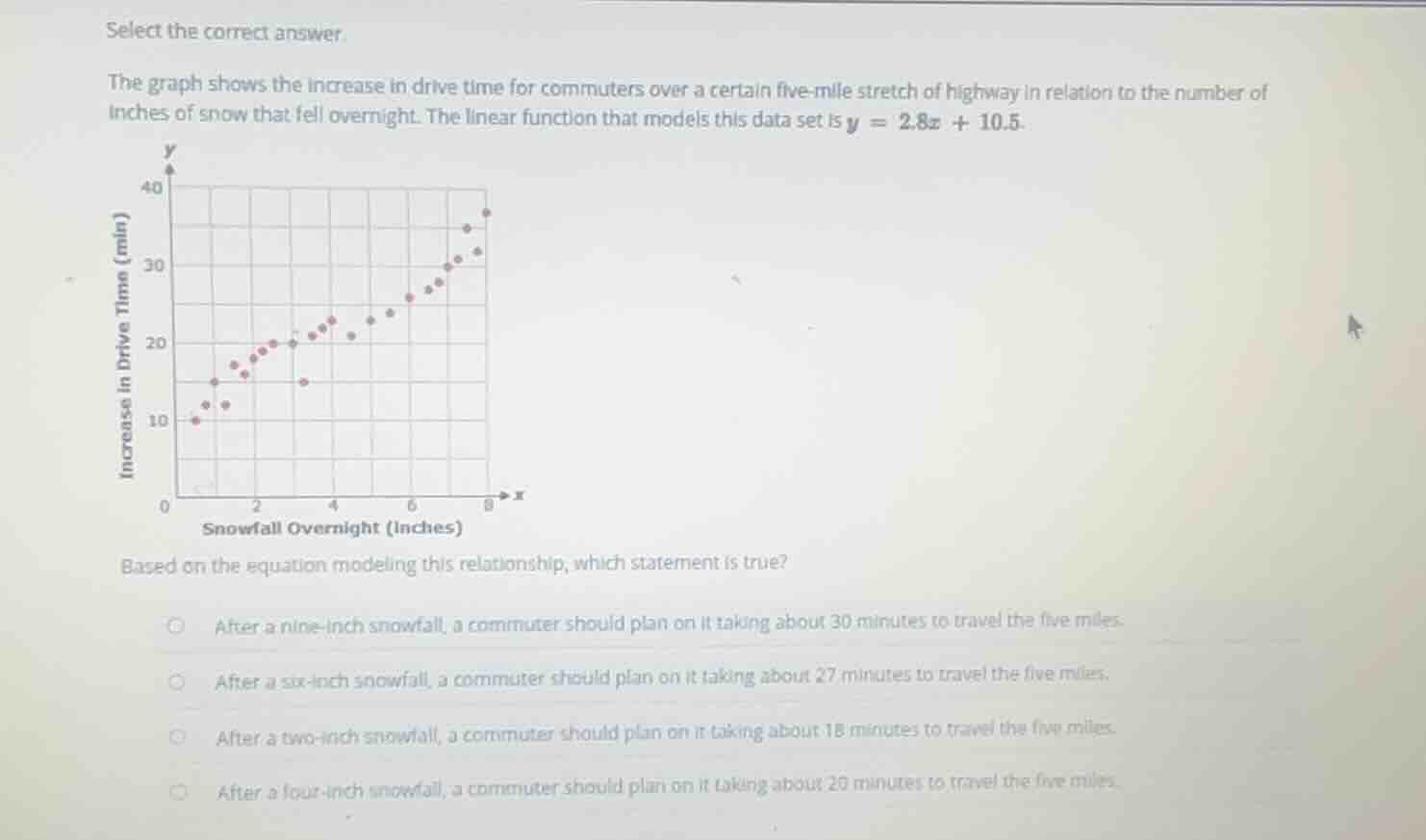
the graph shows the increase in drive time for commuters over a certain five-mile stretch of highway in relation to the number of inches of snow that fell overnight. the linear function that models this data set is $y = 2.8x + 10.5$.
based on the equation modeling this relationship, which statement is true?
after a nine-inch snowfall, a commuter should plan on it taking about 30 minutes to travel the five miles.
after a six-inch snowfall, a commuter should plan on it taking about 27 minutes to travel the five miles.
after a two-inch snowfall, a commuter should plan on it taking about 18 minutes to travel the five miles.
after a four-inch snowfall, a commuter should plan on it taking about 20 minutes to travel the five miles.
Step1: Define variables
In the linear function $y = 2.8x + 10.5$, $x$ = snowfall (inches), $y$ = increase in drive time (min). Total travel time is not given, but we calculate $y$ for each option to verify.
Step2: Test 9-inch snowfall
Substitute $x=9$:
$y = 2.8(9) + 10.5 = 25.2 + 10.5 = 35.7$
This does not match "30 minutes".
Step3: Test 6-inch snowfall
Substitute $x=6$:
$y = 2.8(6) + 10.5 = 16.8 + 10.5 = 27.3$
This is approximately 27 minutes.
Step4: Test 2-inch snowfall
Substitute $x=2$:
$y = 2.8(2) + 10.5 = 5.6 + 10.5 = 16.1$
This does not match "18 minutes".
Step5: Test 4-inch snowfall
Substitute $x=4$:
$y = 2.8(4) + 10.5 = 11.2 + 10.5 = 21.7$
This does not match "20 minutes".

Snap & solve any problem in the app
Get step-by-step solutions on Sovi AI
Photo-based solutions with guided steps
Explore more problems and detailed explanations
After a six-inch snowfall, a commuter should plan on it taking about 27 minutes to travel the five miles.