QUESTION IMAGE
Question
select the correct answer.
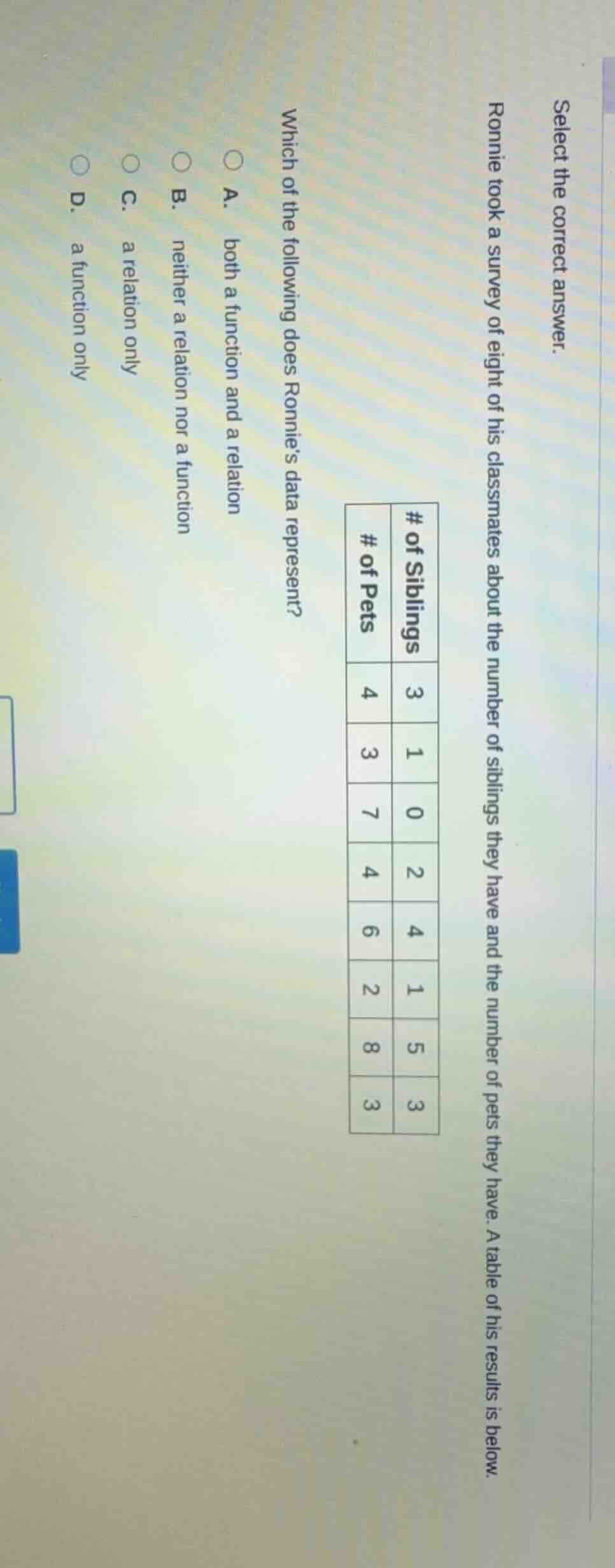
ronnie took a survey of eight of his classmates about the number of siblings they have and the number of pets they have. a table of his results is below.
| # of siblings | # of pets |
|---|---|
| 1 | 3 |
| 0 | 7 |
| 2 | 4 |
| 4 | 6 |
| 1 | 2 |
| 5 | 8 |
| 3 | 3 |
which of the following does ronnie’s data represent?
a. both a function and a relation
b. neither a relation nor a function
c. a relation only
d. a function only
Step1: Recall definitions of relation and function
A relation is a set of ordered pairs \((x,y)\) where \(x\) and \(y\) are from two sets. A function is a special type of relation where each input \(x\) has exactly one output \(y\) (i.e., no two ordered pairs have the same \(x\)-value with different \(y\)-values).
Step2: Analyze the data as ordered pairs
The data can be represented as ordered pairs \((\text{\# of Siblings}, \text{\# of Pets})\): \((3,4)\), \((1,3)\), \((0,7)\), \((2,4)\), \((4,6)\), \((1,2)\), \((5,8)\), \((3,3)\).
Step3: Check if it's a relation
Since it's a set of ordered pairs, it is a relation.
Step4: Check if it's a function
Look at the \(x\)-values (number of siblings): \(x = 3\) appears with \(y = 4\) and \(y = 3\); \(x = 1\) appears with \(y = 3\) and \(y = 2\). So, there are \(x\)-values with multiple \(y\)-values, so it is not a function. Wait, no—wait, maybe I mixed up the input and output. Wait, actually, the problem: is the data a relation (which it is, as any set of ordered pairs is a relation) and is it a function? Wait, no—wait, let's re-express. Wait, maybe the input is the number of siblings, output is number of pets. But since for \(x = 3\) (siblings), we have two different \(y\)-values (4 and 3), and for \(x = 1\) (siblings), two different \(y\)-values (3 and 2), so it's a relation (because it's a set of ordered pairs) but not a function? Wait, no—wait, the options: A. both a function and a relation; B. neither; C. a relation only; D. a function only.
Wait, wait, maybe I made a mistake. Wait, a relation is any set of ordered pairs. So the data is a relation. Now, is it a function? A function requires that each input (let's say the number of siblings is the input \(x\)) has exactly one output (number of pets \(y\)). But in the data, when \(x = 3\), \(y = 4\) and \(y = 3\); when \(x = 1\), \(y = 3\) and \(y = 2\). So it's not a function. Wait, but that would mean it's a relation only (option C). Wait, but let's check again. Wait, maybe the input is the number of pets? No, the table is \(\text{\# of Siblings}\) and \(\text{\# of Pets}\). So the ordered pairs are (siblings, pets). So as a relation, yes. As a function: no, because same siblings (x) have different pets (y). So it's a relation only. Wait, but wait, maybe I messed up. Wait, the definition: a relation is any set of ordered pairs. A function is a relation where each x has unique y. So since there are repeated x's with different y's, it's a relation but not a function. So the answer is C: a relation only? Wait, no—wait, the options: A. both; B. neither; C. relation only; D. function only. Wait, but let's re-express the ordered pairs. Wait, maybe the input is the number of pets? No, the table is siblings (first column) and pets (second). So the domain is siblings, codomain is pets. So since domain elements (siblings) map to multiple codomain elements (pets), it's a relation (because it's a set of ordered pairs) but not a function. So the data is a relation only. Wait, but wait, maybe I made a mistake. Wait, let's list all ordered pairs:
(3,4), (1,3), (0,7), (2,4), (4,6), (1,2), (5,8), (3,3).
So for \(x = 3\): two outputs (4 and 3). For \(x = 1\): two outputs (3 and 2). So it's a relation (since it's a set of ordered pairs) but not a function. Therefore, it's a relation only. Wait, but the options: C is "a relation only". So that's the answer.

Snap & solve any problem in the app
Get step-by-step solutions on Sovi AI
Photo-based solutions with guided steps
Explore more problems and detailed explanations
C. a relation only