QUESTION IMAGE
Question
selections 1 and 2
selection 1: the architect of possibility
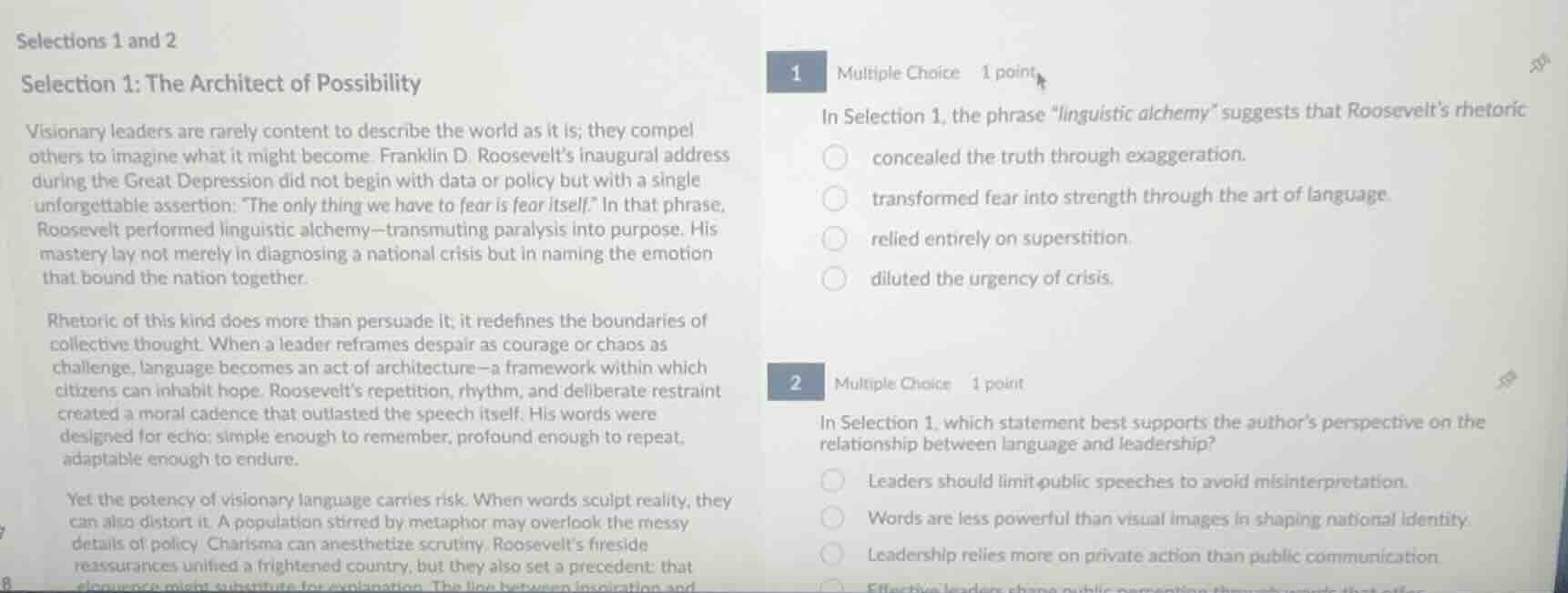
visionary leaders are rarely content to describe the world as it is; they compel others to imagine what it might become. franklin d. roosevelt’s inaugural address during the great depression did not begin with data or policy but with a single unforgettable assertion: “the only thing we have to fear is fear itself.” in that phrase, roosevelt performed linguistic alchemy—transmuting paralysis into purpose. his mastery lay not merely in diagnosing a national crisis but in naming the emotion that bound the nation together.
rhetoric of this kind does more than persuade it; it redefines the boundaries of collective thought. when a leader reframes despair as courage or chaos as challenge, language becomes an act of architecture—a framework within which citizens can inhabit hope. roosevelt’s repetition, rhythm, and deliberate restraint created a moral cadence that outlasted the speech itself. his words were designed for echo: simple enough to remember, profound enough to repeat, adaptable enough to endure.
yet the potency of visionary language carries risk. when words sculpt reality, they can also distort it. a population stirred by metaphor may overlook the messy details of policy. charisma can anesthetize scrutiny. roosevelt’s fireside reassurances united a frightened country, but they also set a precedent: that
1 multiple choice 1 point
in selection 1, the phrase “linguistic alchemy” suggests that roosevelt’s rhetoric
○ concealed the truth through exaggeration.
○ transformed fear into strength through the art of language
○ relied entirely on superstition.
○ diluted the urgency of crisis.
2 multiple choice 1 point
in selection 1, which statement best supports the author’s perspective on the relationship between language and leadership?
○ leaders should limit public speeches to avoid misinterpretation.
○ words are less powerful than visual images in shaping national identity.
○ leadership relies more on private action than public communication.
Question 1
To solve this, we analyze the phrase "linguistic alchemy" in the context. The text says Roosevelt "transmuting paralysis into purpose" with his rhetoric. "Alchemy" implies transformation, and the options are evaluated:
- Option 1: The text doesn't suggest exaggeration to conceal truth.
- Option 2: "Transformed fear into strength through the art of language" matches "transmuting paralysis (fear - induced) into purpose (strength)" via rhetoric.
- Option 3: No mention of superstition.
- Option 4: The text shows urgency was addressed, not diluted.

Snap & solve any problem in the app
Get step-by-step solutions on Sovi AI
Photo-based solutions with guided steps
Explore more problems and detailed explanations
B. transformed fear into strength through the art of language
Question 2
(Note: The last option in question 2 is cut off, but we analyze the visible options and the author's perspective on language and leadership from the text. The author says visionary language redefines collective thought, leaders use language to frame hope, etc. Among the visible wrong options:
- Option 1: The text says language is powerful, not to limit speeches.
- Option 2: The text emphasizes language's power, not visual images.
- Option 3: The text focuses on public communication (rhetoric, fireside chats), not private action.
Assuming the cut - off option is about effective leaders shaping perception through words (consistent with the author's view), but with the given visible options, the wrong ones are eliminated. However, since the last option is incomplete, if we assume the intended correct option is the one about effective leaders shaping public perception through words (as per the author's argument that language redefines collective thought, leaders use language to create hope, etc.), but with the current info, we can only analyze the visible ones and note the correct approach. But since the problem is presented with a cut - off, we can infer based on the author's perspective that the correct option (the cut - off one) should be the one aligning with "effective leaders shape public perception through words that offer..." (consistent with the text's view on language and leadership).)
For the purpose of answering with the given (incomplete) options, we can only state that the correct option (when the last option is fully visible) will be the one that aligns with the author's view that language is a powerful tool for leaders to shape public thought and perception, as seen in the text where Roosevelt's language redefined the nation's mindset, created hope, etc. If we had to choose from the visible (wrong) options, none are correct, so the correct one is the cut - off one. But with the current data, we can't provide the full answer for question 2 as the last option is incomplete.