QUESTION IMAGE
Question
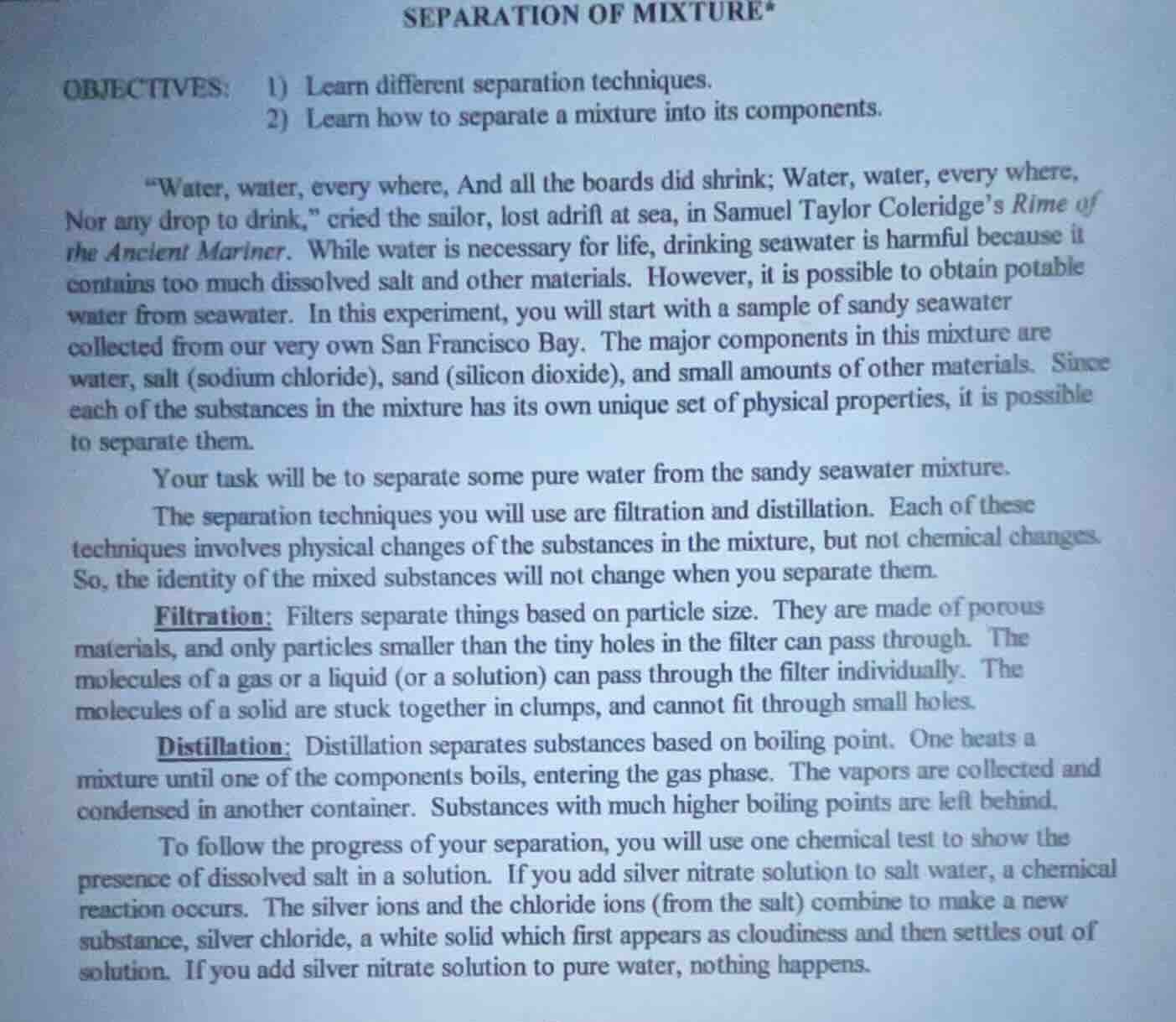
separation of mixture* objectives: 1) learn different separation techniques. 2) learn how to separate a mixture into its components. \water, water, every where, and all the boards did shrink; water, water, every where, nor any drop to drink,\ cried the sailor, lost adrift at sea, in samuel taylor coleridge’s rime of the ancient mariner. while water is necessary for life, drinking seawater is harmful because it contains too much dissolved salt and other materials. however, it is possible to obtain potable water from seawater. in this experiment, you will start with a sample of sandy seawater collected from our very own san francisco bay. the major components in this mixture are water, salt (sodium chloride), sand (silicon dioxide), and small amounts of other materials. since each of the substances in the mixture has its own unique set of physical properties, it is possible to separate them. your task will be to separate some pure water from the sandy seawater mixture. the separation techniques you will use are filtration and distillation. each of these techniques involves physical changes of the substances in the mixture, but not chemical changes. so, the identity of the mixed substances will not change when you separate them. filtration: filters separate things based on particle size. they are made of porous materials, and only particles smaller than the tiny holes in the filter can pass through. the molecules of a gas or a liquid (or a solution) can pass through the filter individually. the molecules of a solid are stuck together in clumps, and cannot fit through small holes. distillation: distillation separates substances based on boiling point. one heats a mixture until one of the components boils, entering the gas phase. the vapors are collected and condensed in another container. substances with much higher boiling points are left behind. to follow the progress of your separation, you will use one chemical test to show the presence of dissolved salt in a solution. if you add silver nitrate solution to salt water, a chemical reaction occurs. the silver ions and the chloride ions (from the salt) combine to make a new substance, silver chloride, a white solid which first appears as cloudiness and then settles out of solution. if you add silver nitrate solution to pure water, nothing happens.
Since no specific question is provided, it's hard to give a targeted answer. If you want to know about the separation techniques (like how filtration or distillation works in this experiment), or about the chemical test for salt, or something else related to this mixture separation experiment, please clarify your question. For example, if you ask "What is the purpose of using filtration in the sandy seawater mixture separation?", here is the answer:
Filtration is used to separate sand from the liquid part (water and dissolved salt) of the sandy seawater mixture. Filters separate based on particle size; sand particles (solid clumps) are too big to pass through the filter's holes, while water and dissolved salt (smaller particles/molecules) can pass through.

Snap & solve any problem in the app
Get step-by-step solutions on Sovi AI
Photo-based solutions with guided steps
Explore more problems and detailed explanations
The purpose of filtration is to separate sand (solid clumps with larger particle size) from the liquid portion (water and dissolved salt, with smaller particle size/molecules) of the sandy seawater mixture, as sand particles cannot pass through the filter's small holes while water and salt molecules can.