QUESTION IMAGE
Question
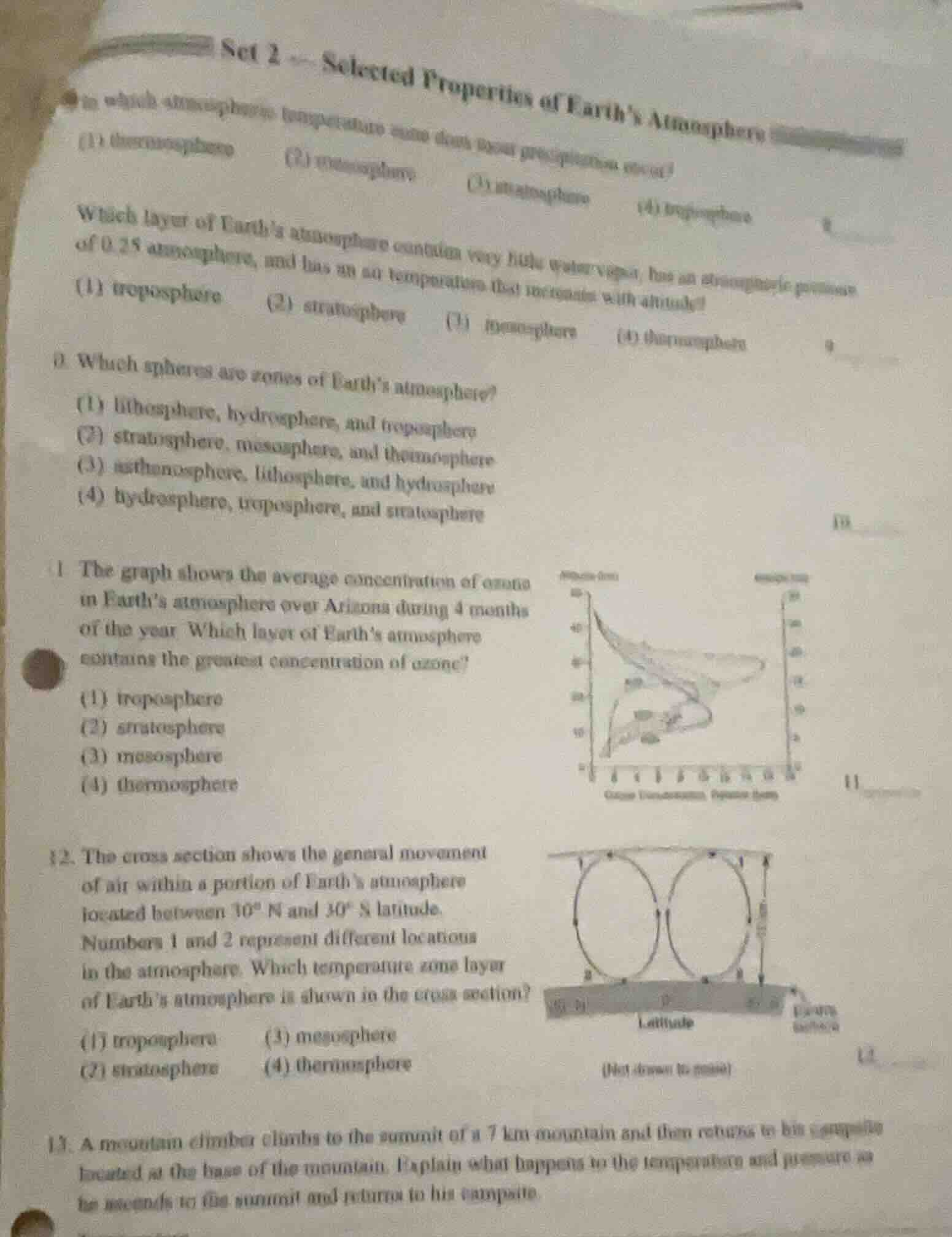
set 2 - selected properties of earths atmosphere10. in which atmospheric temperature zone does most precipitation occur?(1) thermosphere (2) mesosphere (3) stratosphere (4) troposphere11. which layer of earths atmosphere contains very little water vapor, has an atmospheric pressure of 0.25 atmosphere, and has an air temperature that increases with altitude?(1) troposphere (2) stratosphere (3) mesosphere (4) thermosphere12. which spheres are zones of earths atmosphere?(1) lithosphere, hydrosphere, and troposphere(2) stratosphere, mesosphere, and thermosphere(3) asthenosphere, lithosphere, and hydrosphere(4) hydrosphere, troposphere, and stratosphere13. the graph shows the average concentration of ozone in earths atmosphere over arizona during 4 months of the year. which layer of earths atmosphere contains the greatest concentration of ozone?(1) troposphere(2) stratosphere(3) mesosphere(4) thermosphere14. the cross section shows the general movement of air within a portion of earths atmosphere located between 30° n and 30° s latitude.numbers 1 and 2 represent different locations in the atmosphere. which temperature zone layer of earths atmosphere is shown in the cross section?(1) troposphere (3) mesosphere(2) stratosphere (4) thermosphere(not drawn to scale)15. a mountain climber climbs to the summit of a 7 km mountain and then returns to his campsite located at the base of the mountain. explain what happens to the temperature and pressure as he ascends to the summit and returns to his campsite.
Question 8 (partial, first visible question):
This question asks which atmospheric layer has most precipitation. Precipitation forms in the lowest layer where most water vapor is found.
Question 9:
This layer has low water vapor, ~0.25 atm pressure, and temperature increases with altitude. This matches the stratosphere's traits (ozone layer causes temperature rise, low moisture, lower pressure than surface).
Question 10:
Earth's atmospheric zones are the troposphere, stratosphere, mesosphere, thermosphere, and exosphere. Lithosphere (crust/mantle) and hydrosphere (water) are not atmospheric layers.
Question 11:
The ozone layer, with the highest ozone concentration, is located in the stratosphere, which protects Earth from UV radiation.
Question 12:
Air circulation between 30°N and 30°S (Hadley cells) occurs in the troposphere, the lowest layer where all weather and large-scale air movement takes place.
Question 13:
Atmospheric pressure and temperature follow tropospheric trends: pressure decreases with altitude due to fewer air molecules above, and temperature decreases with altitude in the troposphere (environmental lapse rate). The reverse happens when descending.

Snap & solve any problem in the app
Get step-by-step solutions on Sovi AI
Photo-based solutions with guided steps
Explore more problems and detailed explanations
- (4) troposphere
- (2) stratosphere
- (2) stratosphere, mesosphere, and thermosphere
- (2) stratosphere
- (1) troposphere
- As the climber ascends to the summit: Atmospheric pressure decreases because there are fewer air molecules pressing down from above. Air temperature decreases (at an average rate of ~6.5°C per km) because the troposphere gets cooler with increasing altitude.
As the climber descends back to the campsite: Atmospheric pressure increases as more air molecules are above the climber, and air temperature increases as they move back to lower, warmer altitudes in the troposphere.