QUESTION IMAGE
Question
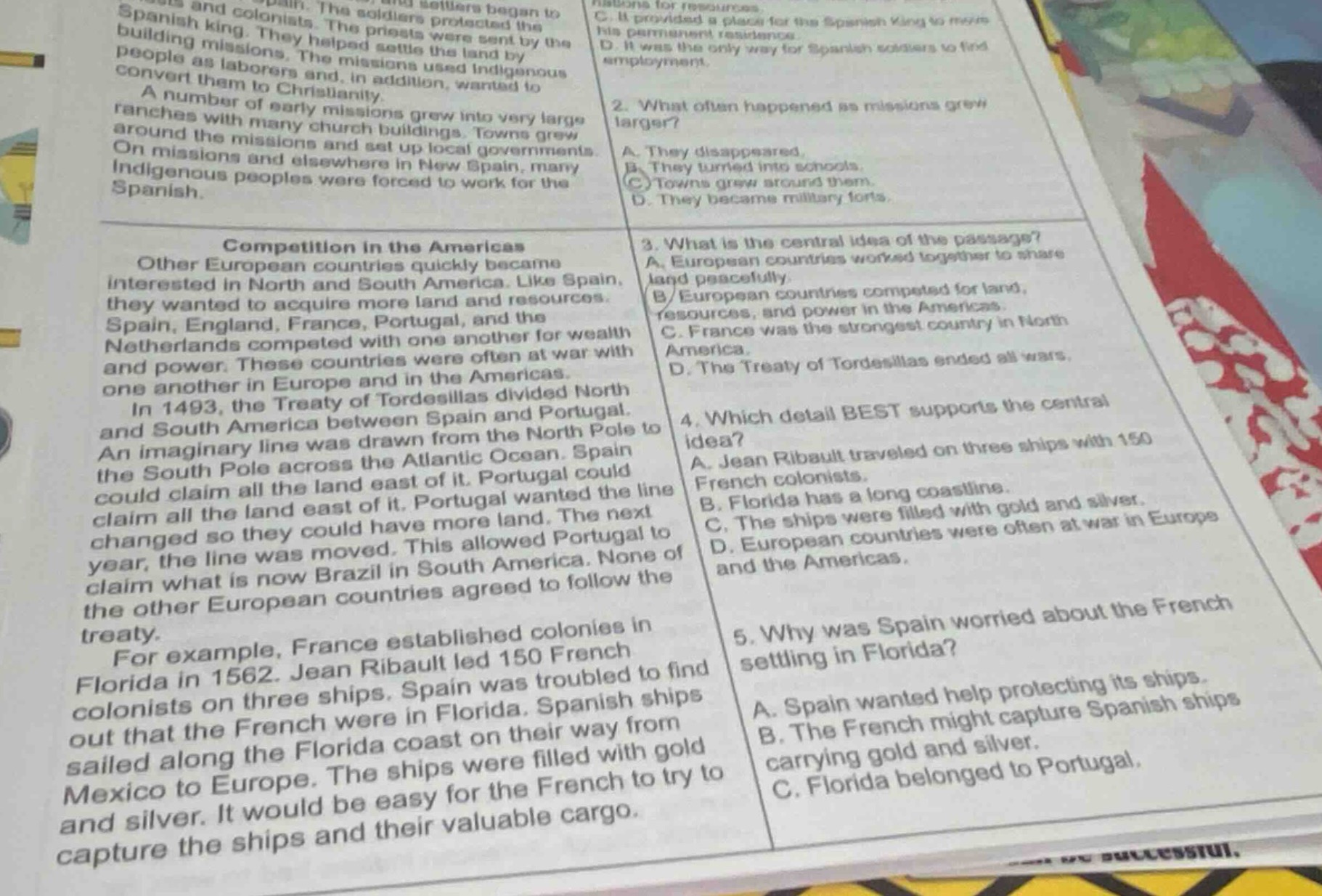
settlers began to and colonists. the soldiers protected the spanish king. they helped settle the land by building missions. the missions used indigenous people as laborers and, in addition, wanted to convert them to christianity.
a number of early missions grew into very large ranches with many church buildings. towns grew around the missions and set up local governments. on missions and elsewhere in new spain, many indigenous peoples were forced to work for the spanish.
competition in the americas
other european countries quickly became interested in north and south america. like spain, they wanted to acquire more land and resources. spain, england, france, portugal, and the netherlands competed with one another for wealth and power. these countries were often at war with one another in europe and in the americas.
in 1493, the treaty of tordesillas divided north and south america between spain and portugal. an imaginary line was drawn from the north pole to the south pole across the atlantic ocean. spain could claim all the land east of it. portugal could claim all the land east of it, portugal wanted the line changed so they could have more land. the next year, the line was moved. this allowed portugal to claim what is now brazil in south america. none of the other european countries agreed to follow the treaty.
for example, france established colonies in florida in 1562. jean ribault led 150 french colonists on three ships. spain was troubled to find out that the french were in florida. spanish ships sailed along the florida coast on their way from mexico to europe. the ships were filled with gold and silver. it would be easy for the french to try to capture the ships and their valuable cargo.
c. it provided a place for the spanish king to move his permanent residence.
d. it was the only way for spanish settlers to find employment.
- what often happened as missions grew larger?
a. they disappeared.
b. they turned into schools.
c. towns grew around them.
d. they became military forts.
- what is the central idea of the passage?
a. european countries worked together to share land peacefully.
b. european countries competed for land, resources, and power in the americas.
c. france was the strongest country in north america.
d. the treaty of tordesillas ended all wars.
- which detail best supports the central idea?
a. jean ribault traveled on three ships with 150 french colonists.
b. florida has a long coastline.
c. the ships were filled with gold and silver.
d. european countries were often at war in europe and the americas.
- why was spain worried about the french settling in florida?
a. spain wanted help protecting its ships.
b. the french might capture spanish ships carrying gold and silver.
c. florida belonged to portugal.
Question 2
The passage states "A number of early missions grew into very large ranches with many church buildings. Towns grew around the missions and set up local governments." So when missions grew larger, towns grew around them. Option A is wrong as they didn't disappear. Option B is wrong as they didn't turn into schools. Option D is wrong as they didn't become military forts.
The passage's "Competition in the Americas" section talks about European countries (Spain, England, France, etc.) competing for land, resources, and power in the Americas. Option A is wrong as they competed, not worked together. Option C is wrong as there's no info France was strongest. Option D is wrong as the treaty didn't end all wars and other countries didn't follow it.
The central idea is European countries competing. Option D says "European countries were often at war in Europe and the Americas", which supports competition. Option A is just about a French expedition. Option B is about Florida's coastline. Option C is about ships' cargo, not competition.

Snap & solve any problem in the app
Get step-by-step solutions on Sovi AI
Photo-based solutions with guided steps
Explore more problems and detailed explanations
C. Towns grew around them.