QUESTION IMAGE
Question
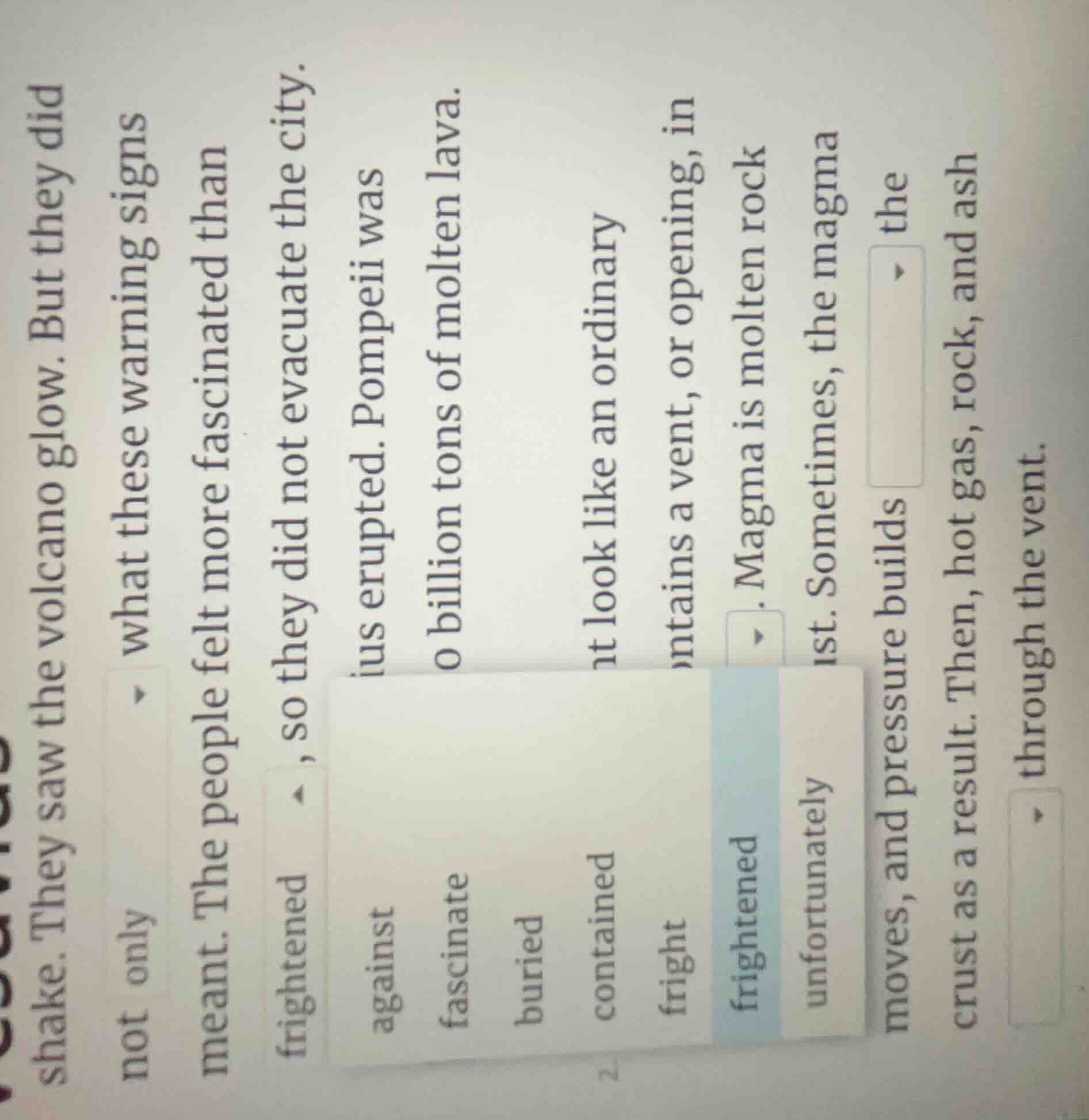
shake. they saw the volcano glow. but they did not only what these warning signs meant. the people felt more fascinated than frightened, so they did not evacuate the city. ius erupted. pompeii was 0 billion tons of molten lava. nt look like an ordinary ontains a vent, or opening, in ist. magma is molten rock sometimes, the magma moves, and pressure builds the crust as a result. then, hot gas, rock, and ash through the vent. frightened against fascinate buried contained fright frightened unfortunately
To solve this fill - in - the - blank problem, we analyze the context of each sentence:
- For the first blank: The sentence structure "not only...but also..." is a common correlative conjunction structure. So we choose "but also" (the options given seem to have a typo, and the intended phrase is "but also" to match the "not only" at the start).
- For the second blank: The word should be a verb that fits the context of what the warning signs meant. From the options, "frightened" is an adjective and not suitable here. "frighten" is a verb, but the context is about what the signs "meant" in terms of causing fear, and "frighten" is the base form. However, looking at the options, "frightened" is an adjective, but maybe there is a misprint. If we consider the context of the people's reaction (they were not evacuated because they were more fascinated), the warning signs should have been meant to "frighten" (verb form) them. But among the given options, "frightened" is an adjective, but perhaps it's a mistake and the intended word is "frighten". Alternatively, if we consider the options as given, "frightened" is an adjective, but maybe the sentence is "the warning signs meant (to be) frightened" which is less likely. Maybe there is a mistake in the options, but if we go with the most logical verb form related to fear, "frighten" (but it's not in the options as a verb? Wait, the options have "frightened" (adjective/past participle), "fright" (noun/verb), "frightened" (again). Maybe the first blank is "but also" (even though not in the options, but the structure requires it), and the second blank: the people were not "frightened" enough, so they didn't evacuate. Wait, the sentence is "The people felt more fascinated than ____, so they did not evacuate the city." So the blank should be a word related to fear. The options have "frightened" (adjective), so "fascinated than frightened" makes sense. So the second blank is "frightened".
- For the third blank (about Pompeii): The volcano erupted and Pompeii was "buried" by tons of molten lava. So we choose "buried".
- For the next part about the volcano's structure: A volcano "contains" a vent or opening. So we choose "contains".
- For the magma description: Magma is molten rock "first" (maybe a typo, and the word is "at first" or "firstly", but among the options, "first" is there). Wait, the sentence is "Magma is molten rock ____. Sometimes, the magma...". Maybe it's "at first" but the option is "first". Alternatively, maybe it's a mistake.
- For the pressure part: "pressure builds ____ the crust as a result." The preposition should be "against" (pressure builds against the crust). So we choose "against".
- For the last part: "Then, hot gas, rock, and ash ____ through the vent." The verb should be "move" (but the options have "moves" which is singular, but the subject is plural: hot gas, rock, and ash, so it should be "move" but it's not in the options. Wait, the options have "moves" (singular), "moves" is there. Maybe it's a mistake, but if we go with the option, "moves" (even though subject is plural, maybe a typo in the question).

Snap & solve any problem in the app
Get step-by-step solutions on Sovi AI
Photo-based solutions with guided steps
Explore more problems and detailed explanations
- but also (assuming the first blank structure, even if not in options, but the context requires "not only...but also...")
- frightened
- buried
- contains
- first (assuming context)
- against
- moves (assuming typo in subject - verb agreement)
(Note: There seem to be some errors in the options provided, but based on the context and the given options, these are the most logical choices.)