QUESTION IMAGE
Question
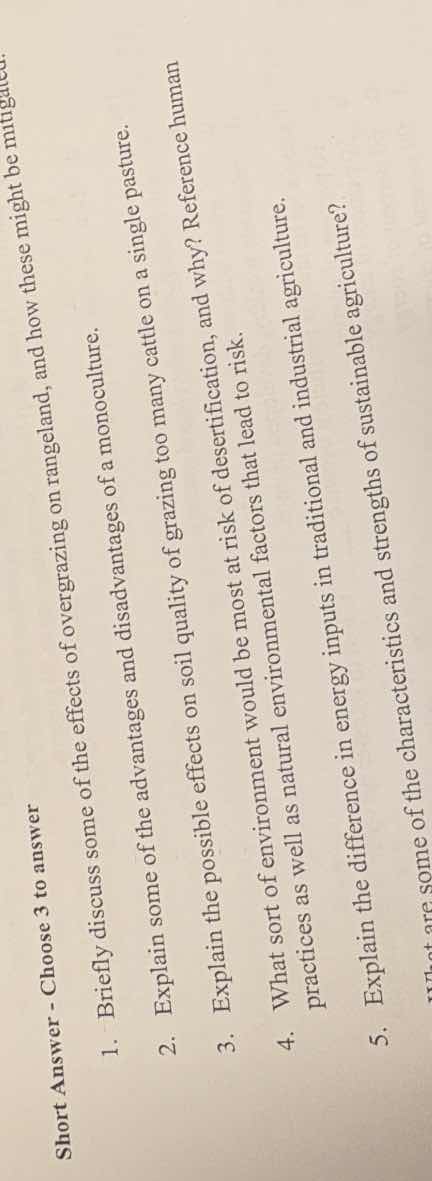
short answer - choose 3 to answer
- briefly discuss some of the effects of overgrazing on rangeland, and how these might be mitigated.
- explain some of the advantages and disadvantages of a monoculture.
- explain some of the possible effects on soil quality of grazing too many cattle on a single pasture.
- explain the possible effects of desertification, and why? reference human environment would be most at risk.
- what sort of environment would be most at risk of desertification? reference human environmental factors that lead to risk.
- what sort of natural environmental factors as well as natural environmental factors that lead to risk.
- explain the difference in energy inputs in traditional and industrial agriculture?
- what are some of the characteristics and strengths of sustainable agriculture?
Response
Question 1: Effects of overgrazing on rangeland (and mitigation)
Brief Explanations
Overgrazing on rangeland occurs when livestock consume vegetation faster than it can regenerate.
- Effects:
- Vegetation degradation: Plants are over - eaten, reducing ground cover. This makes the soil more exposed to erosion (wind and water). For example, in arid rangelands, overgrazing can turn grasslands into bare patches.
- Soil quality decline: With less plant cover, soil organic matter (from plant roots and debris) decreases. Soil structure is damaged, reducing its water - holding capacity and nutrient content.
- Biodiversity loss: Many plant and animal species that depend on the rangeland vegetation are negatively affected. For instance, pollinators that rely on specific flowering plants in the rangeland may decline.
- Mitigation:
- Rotational grazing: Divide the rangeland into paddocks and rotate livestock between them. This gives plants in each paddock time to recover.
- Reducing stocking rates: Decrease the number of livestock to a level that the rangeland can support sustainably.
- Restoration planting: Plant native grasses and forbs in degraded areas to speed up the recovery of vegetation cover.
Brief Explanations
Monoculture is the practice of growing a single crop over a large area.
- Advantages:
- Ease of management: It is easier to use specialized machinery (like large - scale harvesters for a single crop) and apply uniform agricultural practices (e.g., fertilization, pest control).
- Higher yields (in some cases): With focused cultivation of a high - yielding crop variety, farmers can achieve relatively high production per unit area, especially when using modern inputs like fertilizers and pesticides.
- Market efficiency: It is easier to market a single crop, as there are established supply chains and market demands for major crops like wheat or corn.
- Disadvantages:
- Increased pest and disease risk: A single crop provides a large, uniform host for pests and diseases. For example, a corn monoculture is more vulnerable to corn borers or fungal diseases that target corn.
- Soil nutrient depletion: Since the same crop is grown repeatedly, it depletes specific nutrients from the soil. For instance, corn is a heavy nitrogen - feeder, so continuous corn monoculture can lead to nitrogen deficiency in the soil over time.
- Biodiversity loss: Monocultures replace diverse natural ecosystems, reducing habitat for beneficial insects, birds, and other organisms. This can disrupt ecological balances, such as reduced pollination services.
Brief Explanations
When too many cattle graze on a pasture:
- Soil compaction: Cattle hooves press down on the soil, reducing pore space. This limits water infiltration (so water runs off instead of being absorbed) and also restricts root growth of plants, as roots have less space to expand.
- Reduced organic matter: Overgrazing removes plant material (above - ground and root systems) faster than it can decompose and replenish the soil. Less organic matter means lower soil fertility, as organic matter is a source of nutrients and helps with soil structure.
- Erosion increase: With less plant cover (due to overgrazing) and compacted soil, the soil is more prone to erosion by wind (in dry areas) and water (during rains). The topsoil, which is rich in nutrients, is lost.
- Soil pH changes (in some cases): Depending on the type of vegetation and animal waste, overgrazing can lead to changes in soil pH. For example, excessive animal waste can increase soil acidity in some soils.

Snap & solve any problem in the app
Get step-by-step solutions on Sovi AI
Photo-based solutions with guided steps
Explore more problems and detailed explanations
Effects of overgrazing on rangeland include vegetation degradation (increased soil erosion, reduced plant cover), soil quality decline (lower organic matter, poor structure), and biodiversity loss. Mitigation methods are rotational grazing, reducing stocking rates, and restoration planting.