QUESTION IMAGE
Question
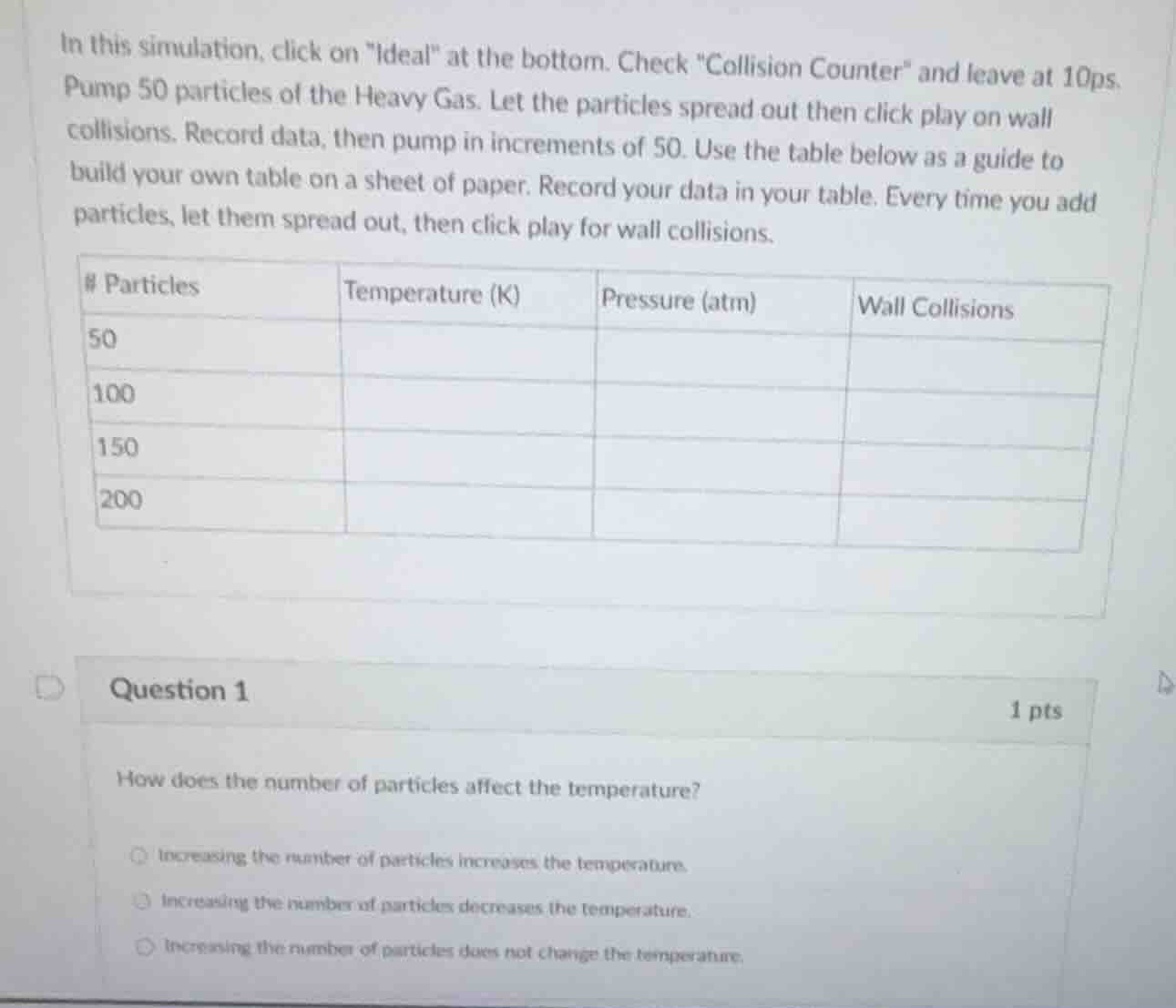
in this simulation, click on \ideal\ at the bottom. check \collision counter\ and leave at 10ps. pump 50 particles of the heavy gas. let the particles spread out then click play on wall collisions. record data, then pump in increments of 50. use the table below as a guide to build your own table on a sheet of paper. record your data in your table. every time you add particles, let them spread out, then click play for wall collisions.
particles temperature (k) pressure (atm) wall collisions
50
100
150
200
question 1
1 pts
how does the number of particles affect the temperature?
increasing the number of particles increases the temperature.
increasing the number of particles decreases the temperature.
increasing the number of particles does not change the temperature.
In an ideal gas simulation (as specified by clicking "Ideal"), the temperature of an ideal gas is related to the average kinetic energy of its particles. Adding more particles (while keeping other factors like volume and time for spreading out consistent, as per the simulation steps) does not change the average kinetic energy per particle, so the temperature remains unchanged.

Snap & solve any problem in the app
Get step-by-step solutions on Sovi AI
Photo-based solutions with guided steps
Explore more problems and detailed explanations
C. Increasing the number of particles does not change the temperature.