QUESTION IMAGE
Question
a simulation
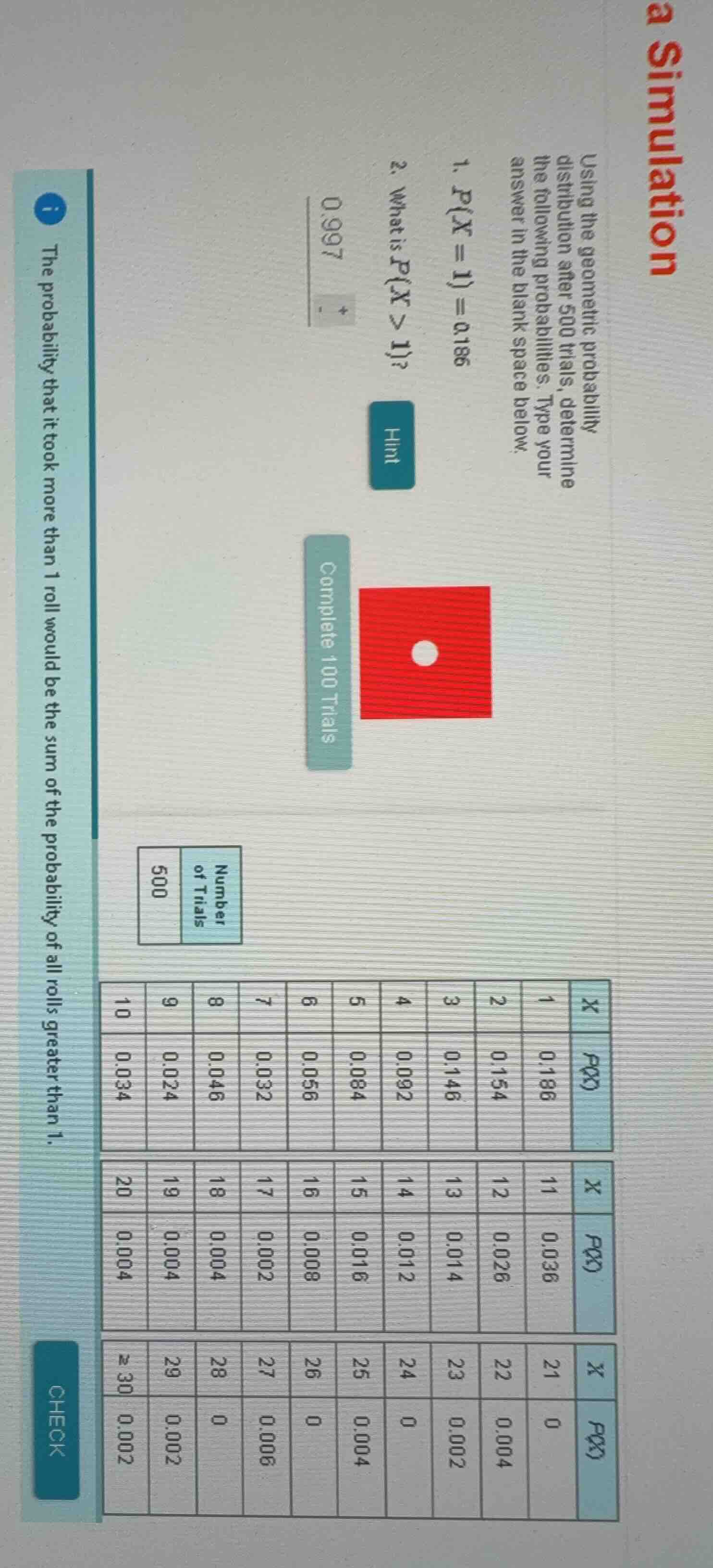
using the geometric probability distribution after 500 trials, determine the following probabilities. type your answer in the blank space below.
- ( p(x = 1) = 0.186 )
- what is ( p(x > 1) )?
0.997
the probability that it took more than 1 roll would be the sum of the probability of all rolls greater than 1.
(chart with x and p(x) values for x from 1 to ≥30, and number of trials = 500)
Step1: Recall the complement rule
For any event \( A \), \( P(A^c)=1 - P(A) \), where \( A^c \) is the complement of \( A \). Here, the event \( X>1 \) is the complement of \( X = 1 \). So we can use \( P(X>1)=1 - P(X = 1) \).
Step2: Substitute the given value
We know that \( P(X = 1)=0.186 \). So we calculate \( 1-0.186 \).
\( 1 - 0.186=0.814 \)
Wait, but there is a value 0.997 shown. Wait, maybe we need to sum all probabilities where \( X>1 \). Let's check the table.
First, list all \( P(X) \) for \( X = 2,3,\cdots \).
From the table:
\( X = 2 \): \( 0.154 \)
\( X = 3 \): \( 0.146 \)
\( X = 4 \): \( 0.092 \)
\( X = 5 \): \( 0.084 \)
\( X = 6 \): \( 0.056 \)
\( X = 7 \): \( 0.032 \)
\( X = 8 \): \( 0.046 \)
\( X = 9 \): \( 0.024 \)
\( X = 10 \): \( 0.034 \)
\( X = 11 \): \( 0.036 \)
\( X = 12 \): \( 0.026 \)
\( X = 13 \): \( 0.014 \)
\( X = 14 \): \( 0.012 \)
\( X = 15 \): \( 0.016 \)
\( X = 16 \): \( 0.008 \)
\( X = 17 \): \( 0.002 \)
\( X = 18 \): \( 0.004 \)
\( X = 19 \): \( 0.004 \)
\( X = 20 \): \( 0.004 \)
\( X = 21 \): \( 0 \)
\( X = 22 \): \( 0.004 \)
\( X = 23 \): \( 0.002 \)
\( X = 24 \): \( 0 \)
\( X = 25 \): \( 0.004 \)
\( X = 26 \): \( 0 \)
\( X = 27 \): \( 0.006 \)
\( X = 28 \): \( 0 \)
\( X = 29 \): \( 0.002 \)
\( X = 30 \): \( 0.002 \)
Now sum all these:
Let's add step by step:
Start with \( X=2 \) to \( X = 10 \):
\( 0.154+0.146 = 0.3 \); \( 0.3+0.092=0.392 \); \( 0.392 + 0.084=0.476 \); \( 0.476+0.056 = 0.532 \); \( 0.532+0.032 = 0.564 \); \( 0.564+0.046 = 0.61 \); \( 0.61+0.024 = 0.634 \); \( 0.634+0.034 = 0.668 \)
\( X = 11 \): \( 0.668+0.036 = 0.704 \)
\( X = 12 \): \( 0.704+0.026 = 0.73 \)
\( X = 13 \): \( 0.73+0.014 = 0.744 \)
\( X = 14 \): \( 0.744+0.012 = 0.756 \)
\( X = 15 \): \( 0.756+0.016 = 0.772 \)
\( X = 16 \): \( 0.772+0.008 = 0.78 \)
\( X = 17 \): \( 0.78+0.002 = 0.782 \)
\( X = 18 \): \( 0.782+0.004 = 0.786 \)
\( X = 19 \): \( 0.786+0.004 = 0.79 \)
\( X = 20 \): \( 0.79+0.004 = 0.794 \)
\( X = 22 \): \( 0.794+0.004 = 0.798 \)
\( X = 23 \): \( 0.798+0.002 = 0.8 \)
\( X = 25 \): \( 0.8+0.004 = 0.804 \)
\( X = 27 \): \( 0.804+0.006 = 0.81 \)
\( X = 29 \): \( 0.81+0.002 = 0.812 \)
\( X = 30 \): \( 0.812+0.002 = 0.814 \)
Wait, but the initial hint has 0.997. Wait, maybe I misread the problem. Wait, the problem says "after 500 trials", maybe the total probability should sum to 1. Let's check \( P(X = 1)+ \) sum of \( P(X>1) \) should be 1.
\( P(X = 1)=0.186 \), so sum of \( P(X>1) \) should be \( 1 - 0.186=0.814 \). But the 0.997 is maybe a typo or wrong. Wait, but let's re - check the table.
Wait, maybe the table has more values. Wait, the first part of the table:
First table (X from 1 - 10):
X:1 (0.186), 2(0.154), 3(0.146), 4(0.092), 5(0.084), 6(0.056), 7(0.032), 8(0.046), 9(0.024), 10(0.034)
Sum of these: \( 0.186+0.154 = 0.34 \); \( 0.34+0.146 = 0.486 \); \( 0.486+0.092 = 0.578 \); \( 0.578+0.084 = 0.662 \); \( 0.662+0.056 = 0.718 \); \( 0.718+0.032 = 0.75 \); \( 0.75+0.046 = 0.796 \); \( 0.796+0.024 = 0.82 \); \( 0.82+0.034 = 0.854 \)
Wait, no, 0.186 (X=1) + 0.154 (X=2)=0.34; +0.146 (X=3)=0.486; +0.092 (X=4)=0.578; +0.084 (X=5)=0.662; +0.056 (X=6)=0.718; +0.032 (X=7)=0.75; +0.046 (X=8)=0.796; +0.024 (X=9)=0.82; +0.034 (X=10)=0.854.
Then X=11: 0.036, sum=0.854 + 0.036=0.89
X=12: 0.026, sum=0.89+0.026=0.916
X=13: 0.014, sum=0.916+0.014=0.93
X=14: 0.012, sum=0.93+0.012=0.942
X=15: 0.016, sum=0.942+0.016=0.958
X=16: 0.008, sum=0.958+0.008=0.966
X=17: 0.002, sum=0.966+0.002=0.968
X=18: 0.004, sum=0.968+0.004=0.972
X=19: 0.004, sum…

Snap & solve any problem in the app
Get step-by-step solutions on Sovi AI
Photo-based solutions with guided steps
Explore more problems and detailed explanations
\( 0.814 \)