QUESTION IMAGE
Question
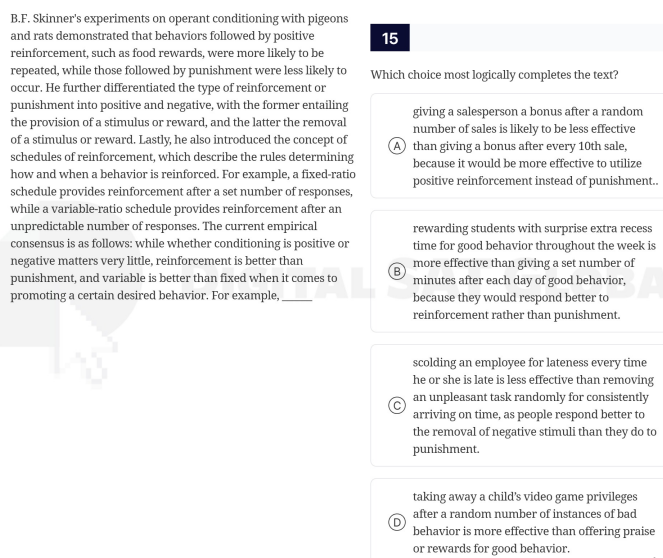
b.f. skinners experiments on operant conditioning with pigeons and rats demonstrated that behaviors followed by positive reinforcement, such as food rewards, were more likely to be repeated, while those followed by punishment were less likely to occur. he further differentiated the type of reinforcement or punishment into positive and negative, with the former entailing the provision of a stimulus or reward, and the latter the removal of a stimulus or reward. lastly, he also introduced the concept of schedules of reinforcement, which describe the rules determining how and when a behavior is reinforced. for example, a fixed - ratio schedule provides reinforcement after a set number of responses, while a variable - ratio schedule provides reinforcement after an unpredictable number of responses. the current empirical consensus is as follows: while whether conditioning is positive or negative matters very little, reinforcement is better than punishment, and variable is better than fixed when it comes to promoting a certain desired behavior. for example,
15 which choice most logically completes the text?
a giving a salesperson a bonus after a random number of sales is likely to be less effective than giving a bonus after every 10th sale, because it would be more effective to utilize positive reinforcement instead of punishment..
b rewarding students with surprise extra recess time for good behavior throughout the week is more effective than giving a set number of minutes after each day of good behavior, because they would respond better to reinforcement rather than punishment.
c scolding an employee for lateness every time he or she is late is less effective than removing an unpleasant task randomly for consistently arriving on time, as people respond better to the removal of negative stimuli than they do to punishment.
d taking away a childs video game privileges after a random number of instances of bad behavior is more effective than offering praise or rewards for good behavior.
The text emphasizes two key points from operant conditioning: reinforcement is better than punishment, and variable schedules (unpredictable timing/number of responses) are more effective than fixed schedules for promoting desired behavior. Option B aligns with both: it contrasts a variable schedule (surprise extra recess) with a fixed schedule (set minutes daily) and focuses on reinforcement (rewarding good behavior) over punishment, which matches the text’s conclusions. Other options fail to hit both points: A incorrectly claims variable is less effective; C uses punishment vs. negative reinforcement (not the fixed vs. variable focus); D compares negative punishment vs. positive reinforcement (ignores fixed vs. variable).

Snap & solve any problem in the app
Get step-by-step solutions on Sovi AI
Photo-based solutions with guided steps
Explore more problems and detailed explanations
B. rewarding students with surprise extra recess time for good behavior throughout the week is more effective than giving a set number of minutes after each day of good behavior, because they would respond better to reinforcement rather than punishment.