QUESTION IMAGE
Question
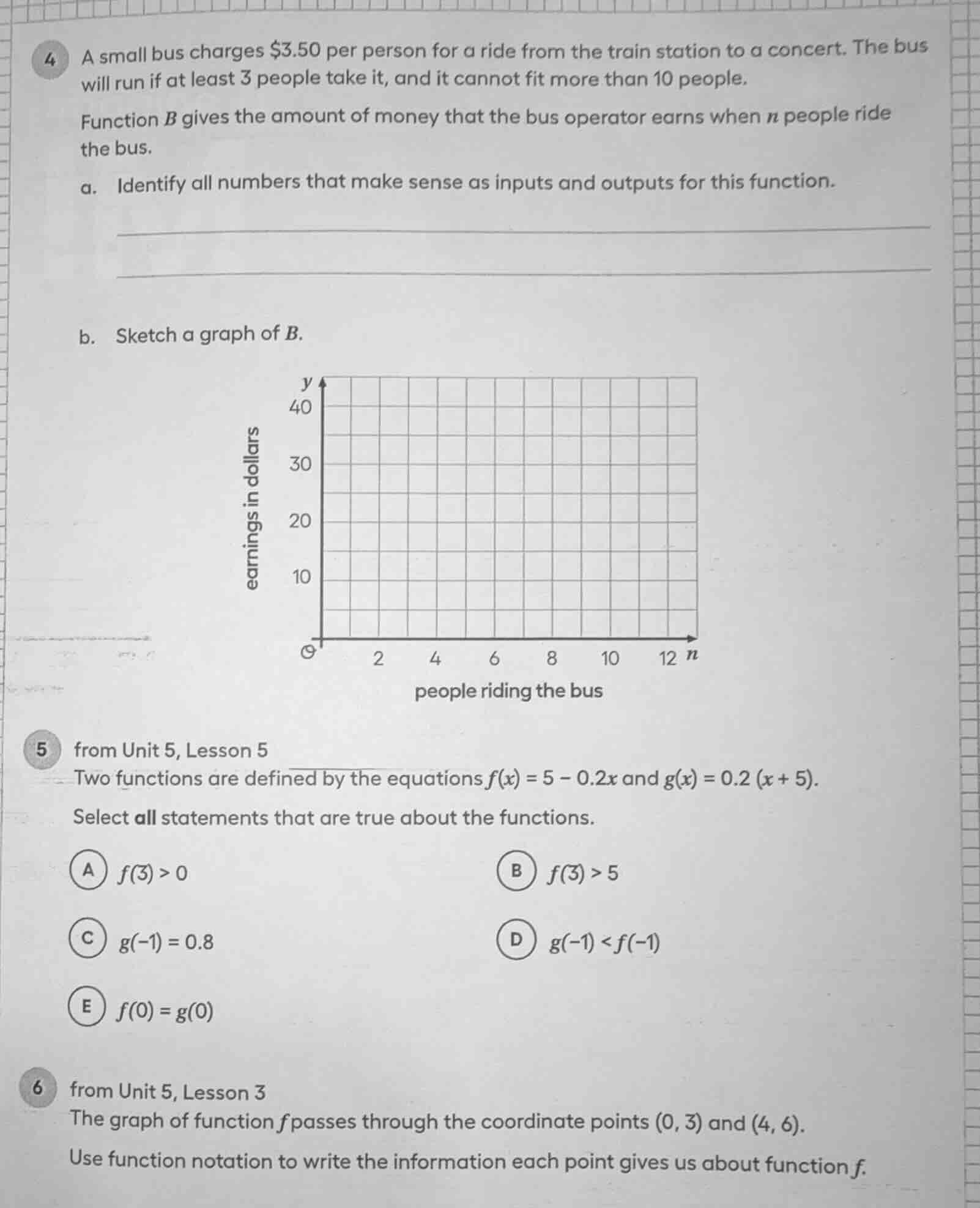
4 a small bus charges $3.50 per person for a ride from the train station to a concert. the bus will run if at least 3 people take it, and it cannot fit more than 10 people. function b gives the amount of money that the bus operator earns when n people ride the bus. a. identify all numbers that make sense as inputs and outputs for this function. b. sketch a graph of b. (graph with y-axis earnings in dollars, x-axis people riding the bus) 5 from unit 5, lesson 5 two functions are defined by the equations f(x) = 5 - 0.2x and g(x) = 0.2 (x + 5). select all statements that are true about the functions. a f(3) > 0 b f(3) > 5 c g(-1) = 0.8 d g(-1) < f(-1) e f(0) = g(0) 6 from unit 5, lesson 3 the graph of function f passes through the coordinate points (0, 3) and (4, 6). use function notation to write the information each point gives us about function f.
Problem 4a
Step1: Determine input range
The bus runs with at least 3 and at most 10 people. So input \( n \) is integers from 3 to 10, i.e., \( n \in \{3, 4, 5, 6, 7, 8, 9, 10\} \).
Step2: Determine output range
Earnings \( B(n) = 3.50n \). For \( n = 3 \), \( B(3)=3.50\times3 = 10.50 \); for \( n = 10 \), \( B(10)=3.50\times10 = 35.00 \). Outputs are \( 3.50n \) where \( n \) is 3 - 10, so outputs are \( 10.50, 14.00, 17.50, 21.00, 24.50, 28.00, 31.50, 35.00 \).
Step1: Identify points
For \( n = 3 \), \( B(3)=10.50 \); \( n = 4 \), \( B(4)=14.00 \); \( n = 5 \), \( B(5)=17.50 \); \( n = 6 \), \( B(6)=21.00 \); \( n = 7 \), \( B(7)=24.50 \); \( n = 8 \), \( B(8)=28.00 \); \( n = 9 \), \( B(9)=31.50 \); \( n = 10 \), \( B(10)=35.00 \).
Step2: Plot points
On the graph, plot the points \((3, 10.50)\), \((4, 14.00)\), \((5, 17.50)\), \((6, 21.00)\), \((7, 24.50)\), \((8, 28.00)\), \((9, 31.50)\), \((10, 35.00)\) and connect them (since \( n \) is discrete, it can also be plotted as individual points).
Step1: Evaluate \( f(3) \)
\( f(x)=5 - 0.2x \), so \( f(3)=5-0.2\times3 = 5 - 0.6 = 4.4 \). Check statements:
- A: \( 4.4>0 \), true.
- B: \( 4.4>5 \), false.
Step2: Evaluate \( g(-1) \)
\( g(x)=0.2(x + 5) \), so \( g(-1)=0.2(-1 + 5)=0.2\times4 = 0.8 \). Check statements:
- C: \( g(-1)=0.8 \), true.
Step3: Evaluate \( f(-1) \)
\( f(-1)=5-0.2\times(-1)=5 + 0.2 = 5.2 \). Check D: \( 0.8<5.2 \), true.
Step4: Evaluate \( f(0) \) and \( g(0) \)
\( f(0)=5-0.2\times0 = 5 \); \( g(0)=0.2(0 + 5)=1 \). Check E: \( 5 = 1 \), false.

Snap & solve any problem in the app
Get step-by-step solutions on Sovi AI
Photo-based solutions with guided steps
Explore more problems and detailed explanations
Inputs: Integers from 3 to 10 (3, 4, 5, 6, 7, 8, 9, 10).
Outputs: \( 3.50\times3 = 10.50 \), \( 3.50\times4 = 14.00 \), \( 3.50\times5 = 17.50 \), \( 3.50\times6 = 21.00 \), \( 3.50\times7 = 24.50 \), \( 3.50\times8 = 28.00 \), \( 3.50\times9 = 31.50 \), \( 3.50\times10 = 35.00 \) (i.e., \( 10.50, 14.00, 17.50, 21.00, 24.50, 28.00, 31.50, 35.00 \)).