QUESTION IMAGE
Question
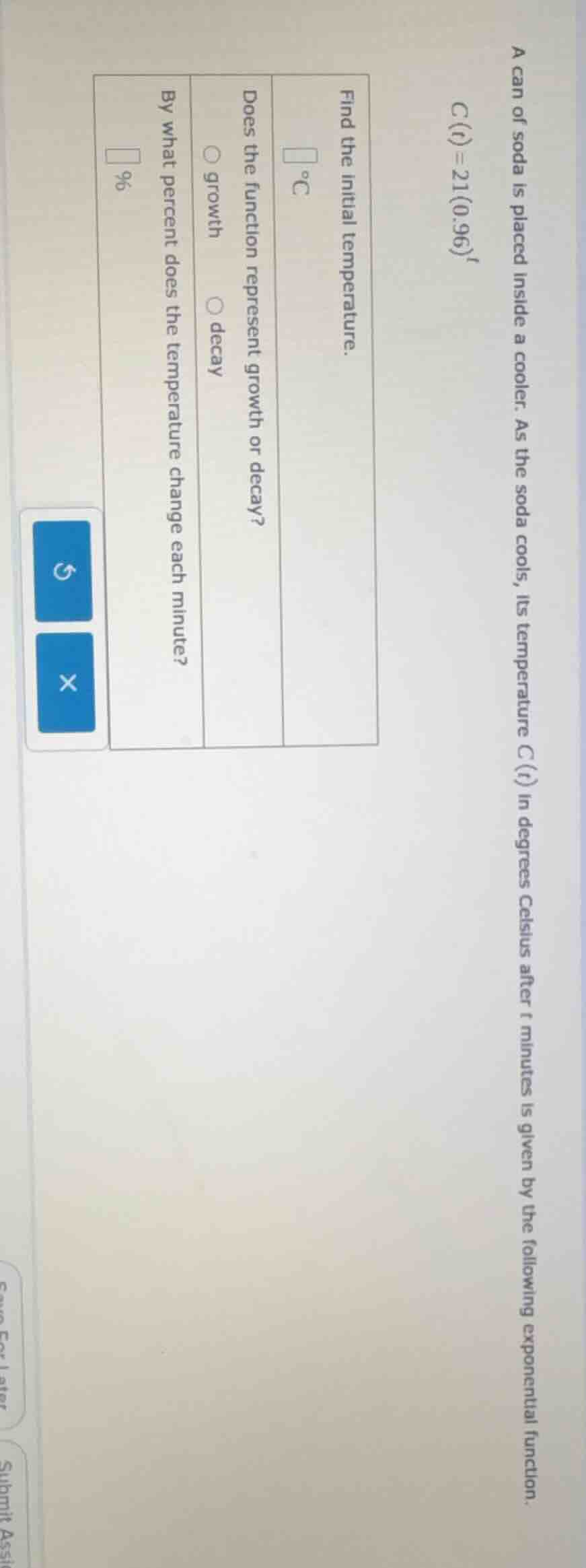
a can of soda is placed inside a cooler. as the soda cools, its temperature ( c(t) ) in degrees celsius after ( t ) minutes is given by the following exponential function. ( c(t) = 21(0.96)^t )
find the initial temperature. ( square^circ \text{c}
does the function represent growth or decay? ( \bigcirc ) growth ( \bigcirc ) decay
by what percent does the temperature change each minute? ( square% )
First Sub - Question: Find the initial temperature
Step1: Recall the exponential function form
The general form of an exponential function is $y = a(b)^t$, where $a$ is the initial value (when $t = 0$).
Step2: Substitute $t = 0$ into the function $C(t)=21(0.96)^{t}$
When $t = 0$, any non - zero number to the power of $0$ is $1$. So $C(0)=21\times(0.96)^{0}=21\times1 = 21$.
In the exponential function $y=a(b)^t$, if $0 < b<1$, the function represents decay; if $b > 1$, the function represents growth. Here, the base of the exponential function $C(t)=21(0.96)^{t}$ is $b = 0.96$, and $0<0.96 < 1$.
Step1: Recall the formula for percent change in exponential decay
For an exponential function $y=a(1 - r)^t$, where $r$ is the rate of decay (expressed as a decimal), and the percent change is $r\times100\%$. Our function is $C(t)=21(0.96)^{t}$, which can be written as $C(t)=21(1 - 0.04)^{t}$.
Step2: Calculate the percent change
Since $1-r = 0.96$, then $r=1 - 0.96=0.04$. To find the percent change, we multiply $r$ by $100\%$, so $0.04\times100\% = 4\%$. The negative sign (implied by decay) means the temperature is decreasing by $4\%$ each minute.

Snap & solve any problem in the app
Get step-by-step solutions on Sovi AI
Photo-based solutions with guided steps
Explore more problems and detailed explanations
$21$