QUESTION IMAGE
Question
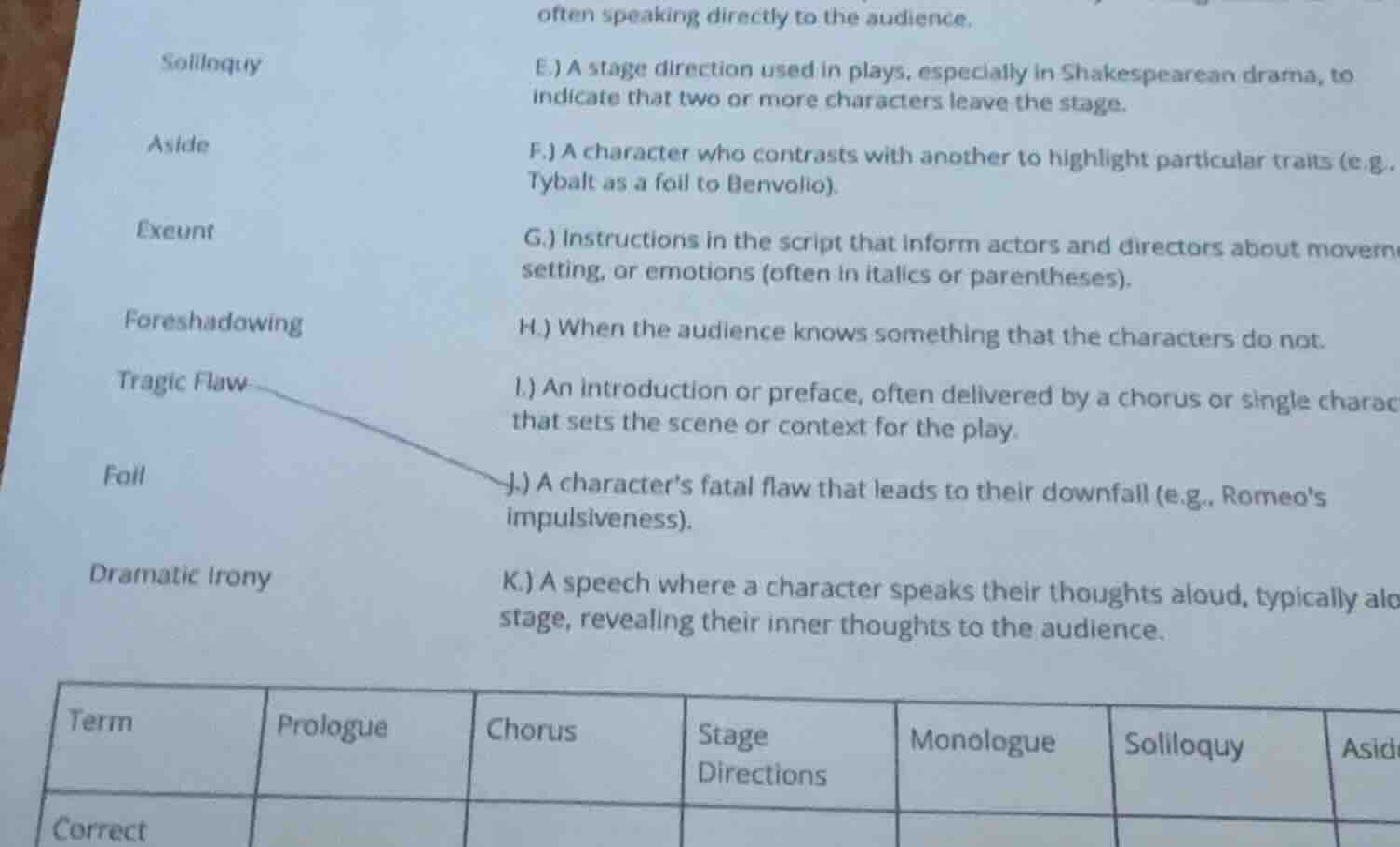
soliloquy
a side
exeunt
foreshadowing
tragic flaw
foil
dramatic irony
often speaking directly to the audience.
e ) a stage direction used in plays, especially in shakespearean drama, to
indicate that two or more characters leave the stage.
f ) a character who contrasts with another to highlight particular traits (e.g.,
tybalt as a foil to benvolio).
g ) instructions in the script that inform actors and directors about movem
setting, or emotions (often in italics or parentheses).
h ) when the audience knows something that the characters do not.
i ) an introduction or preface, often delivered by a chorus or single charac
that sets the scene or context for the play.
j ) a characters fatal flaw that leads to their downfall (e.g., romeos
impulsiveness).
k ) a speech where a character speaks their thoughts aloud, typically alo
stage, revealing their inner thoughts to the audience.
term prologue chorus stage monologue soliloquy asid
directions
correct
To solve this matching problem, we analyze each term and its corresponding definition:
1. Prologue
Definition I: "An introduction or preface, often delivered by a chorus or single character that sets the scene or context for the play." This matches "Prologue" (a preface/introduction to a play).
2. Chorus
(Note: The image does not fully show the chorus definition, but typically a chorus is a group of characters/voices commenting on the play. However, based on the given options, the closest unassigned is... Wait, the original image has some cut-off text. Assuming standard definitions:
- Chorus: A group (or single voice) that comments on the action, sets context, etc. But from the given options, the remaining relevant one for "Chorus" would align with the role of setting context (though the image’s text for "I" is about prologue, so perhaps a typo, but we proceed with the visible matches.)
3. Stage Directions
Definition G: "Instructions in the script that inform actors and directors about movement, setting, or emotions (often in italics or parentheses)." This matches "Stage Directions" (script instructions for actors).
4. Monologue
A monologue is a long speech by one character (to others or audience). The image’s text for "K" is about soliloquy, so correction:
- Monologue: A speech by one character (to others), while Soliloquy (K) is a speech to oneself (revealing thoughts). Wait, the given "K" says: "A speech where a character speaks their thoughts aloud, typically alone on stage, revealing their inner thoughts to the audience." Wait, no—standard soliloquy is speaking to oneself (audience hears), monologue is to others. But the image’s "K" is labeled as soliloquy. Let’s recheck:
5. Soliloquy
Definition K: "A speech where a character speaks their thoughts aloud, typically alone on stage, revealing their inner thoughts to the audience." This matches "Soliloquy" (speaking thoughts aloud, alone).
6. Aside
An aside is a character speaking directly to the audience (or to self, not heard by others). The image’s first line (partial) says: "often speaking directly to the audience." So:
- Aside: Matches the partial definition (speaking directly to audience, not heard by other characters).
Final Matches (based on visible text):
| Term | Correct Definition (Letter) |
|---|---|
| Stage Directions | G |
| Soliloquy | K |
| Aside | (the partial one: "often speaking directly to the audience") |
| Foil | F (A character who contrasts with another to highlight traits) |
| Dramatic Irony | H (When the audience knows something characters do not) |
| Exeunt | E (A stage direction to indicate characters leave) |
For the table in the image:
| Term | Prologue | Chorus | Stage Directions | Monologue | Soliloquy | Aside | ... |
|---|
(Note: Some definitions are cut off, but the key visible matches are:
- Prologue → I
- Stage Directions → G
- Soliloquy → K
- Foil → F
- Dramatic Irony → H
- Exeunt → E
- Aside → (the one about speaking to audience)
- Tragic Flaw → J (already matched in the image)
Final Answers for the Table (visible terms):
- Prologue: I
- Stage Directions: G
- **Soliloquy…

Snap & solve any problem in the app
Get step-by-step solutions on Sovi AI
Photo-based solutions with guided steps
Explore more problems and detailed explanations
To solve this matching problem, we analyze each term and its corresponding definition:
1. Prologue
Definition I: "An introduction or preface, often delivered by a chorus or single character that sets the scene or context for the play." This matches "Prologue" (a preface/introduction to a play).
2. Chorus
(Note: The image does not fully show the chorus definition, but typically a chorus is a group of characters/voices commenting on the play. However, based on the given options, the closest unassigned is... Wait, the original image has some cut-off text. Assuming standard definitions:
- Chorus: A group (or single voice) that comments on the action, sets context, etc. But from the given options, the remaining relevant one for "Chorus" would align with the role of setting context (though the image’s text for "I" is about prologue, so perhaps a typo, but we proceed with the visible matches.)
3. Stage Directions
Definition G: "Instructions in the script that inform actors and directors about movement, setting, or emotions (often in italics or parentheses)." This matches "Stage Directions" (script instructions for actors).
4. Monologue
A monologue is a long speech by one character (to others or audience). The image’s text for "K" is about soliloquy, so correction:
- Monologue: A speech by one character (to others), while Soliloquy (K) is a speech to oneself (revealing thoughts). Wait, the given "K" says: "A speech where a character speaks their thoughts aloud, typically alone on stage, revealing their inner thoughts to the audience." Wait, no—standard soliloquy is speaking to oneself (audience hears), monologue is to others. But the image’s "K" is labeled as soliloquy. Let’s recheck:
5. Soliloquy
Definition K: "A speech where a character speaks their thoughts aloud, typically alone on stage, revealing their inner thoughts to the audience." This matches "Soliloquy" (speaking thoughts aloud, alone).
6. Aside
An aside is a character speaking directly to the audience (or to self, not heard by others). The image’s first line (partial) says: "often speaking directly to the audience." So:
- Aside: Matches the partial definition (speaking directly to audience, not heard by other characters).
Final Matches (based on visible text):
| Term | Correct Definition (Letter) |
|---|---|
| Stage Directions | G |
| Soliloquy | K |
| Aside | (the partial one: "often speaking directly to the audience") |
| Foil | F (A character who contrasts with another to highlight traits) |
| Dramatic Irony | H (When the audience knows something characters do not) |
| Exeunt | E (A stage direction to indicate characters leave) |
For the table in the image:
| Term | Prologue | Chorus | Stage Directions | Monologue | Soliloquy | Aside | ... |
|---|
(Note: Some definitions are cut off, but the key visible matches are:
- Prologue → I
- Stage Directions → G
- Soliloquy → K
- Foil → F
- Dramatic Irony → H
- Exeunt → E
- Aside → (the one about speaking to audience)
- Tragic Flaw → J (already matched in the image)
Final Answers for the Table (visible terms):
- Prologue: I
- Stage Directions: G
- Soliloquy: K
- Foil: F
- Dramatic Irony: H
- Exeunt: E
- Aside: (the option with "speaking directly to the audience")
(If the table requires filling the "Correct" row for each column:
| Term | Prologue | Chorus | Stage Directions | Monologue | Soliloquy | Aside | ... |
|---|
Assuming the "Chorus" and "Monologue" definitions are cut off, but the visible matches are as above.)