QUESTION IMAGE
Question
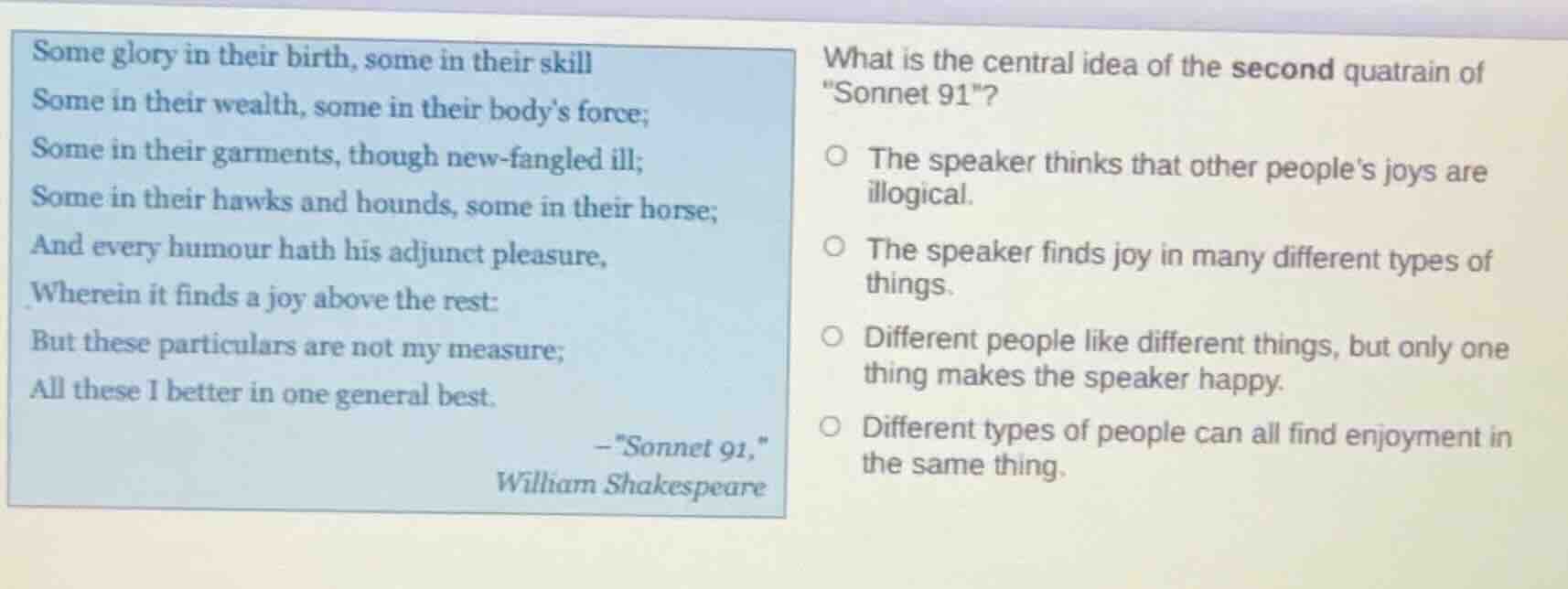
some glory in their birth, some in their skill
some in their wealth, some in their bodys force;
some in their garments, though new - fangled ill;
some in their hawks and hounds, some in their horse;
and every humour hath his adjunct pleasure,
wherein it finds a joy above the rest:
but these particulars are not my measure;
all these i better in one general best.
--\sonnet 91,\
william shakespeare
what is the central idea of the second quatrain of \sonnet 91\?
the speaker thinks that other peoples joys are illogical.
the speaker finds joy in many different types of things.
different people like different things, but only one thing makes the speaker happy.
different types of people can all find enjoyment in the same thing.
First, analyze the second quatrain (lines 5 - 8): "And every humour hath his adjunct pleasure, / Wherein it finds a joy above the rest: / But these particulars are not my measure; / All these I better in one general best." The first two lines say each person has their own pleasure, the last two say those particulars (different joys of others) aren't the speaker's measure, and the speaker has one general best. Now check options:
- Option 1: The quatrain doesn't focus on illogical joys, eliminate.
- Option 2: The speaker says these aren't his measure, so he doesn't find joy in many things, eliminate.
- Option 3: Different people (humour) like different things (adjunct pleasure), but the speaker's measure is one general best (only one thing makes him happy), matches.
- Option 4: The quatrain shows different people like different things, not same thing, eliminate.

Snap & solve any problem in the app
Get step-by-step solutions on Sovi AI
Photo-based solutions with guided steps
Explore more problems and detailed explanations
C. Different people like different things, but only one thing makes the speaker happy.