QUESTION IMAGE
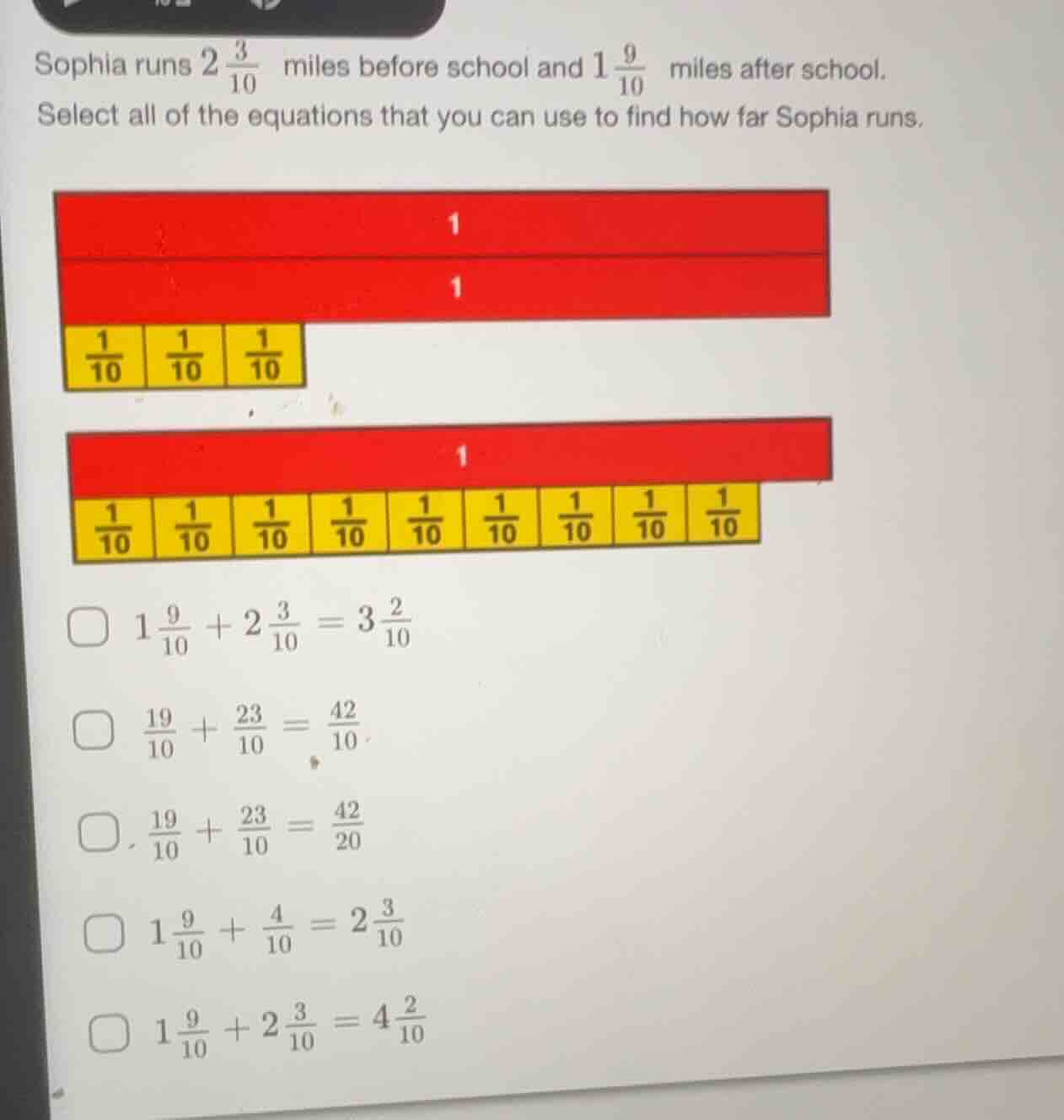
Question
sophia runs $2\frac{3}{10}$ miles before school and $1\frac{9}{10}$ miles after school. select all of the equations that you can use to find how far sophia runs. $\square\\ 1\frac{9}{10}+2\frac{3}{10}=3\frac{2}{10}$ $\square\\ \frac{19}{10}+\frac{23}{10}=\frac{42}{10}$ $\square\\ \frac{19}{10}+\frac{23}{10}=\frac{42}{20}$ $\square\\ 1\frac{9}{10}+\frac{4}{10}=2\frac{3}{10}$ $\square\\ 1\frac{9}{10}+2\frac{3}{10}=4\frac{2}{10}$
To find the total distance Sophia runs, we need to add the distance she runs before school (\(2\frac{3}{10}\) miles) and after school (\(1\frac{9}{10}\) miles).
- First, convert the mixed numbers to improper fractions:
- \(2\frac{3}{10}=\frac{2\times10 + 3}{10}=\frac{23}{10}\)
- \(1\frac{9}{10}=\frac{1\times10+9}{10}=\frac{19}{10}\)
- Now, add the improper fractions: \(\frac{19}{10}+\frac{23}{10}=\frac{19 + 23}{10}=\frac{42}{10}\)
- We can also add the mixed numbers directly:
- Add the whole numbers: \(2 + 1 = 3\)
- Add the fractions: \(\frac{3}{10}+\frac{9}{10}=\frac{12}{10}=1\frac{2}{10}\)
- Combine the whole numbers and fractions: \(3+1\frac{2}{10}=4\frac{2}{10}\)? Wait, no, wait. Wait, \(2\frac{3}{10}+1\frac{9}{10}\):
- Whole numbers: \(2 + 1 = 3\)
- Fractions: \(\frac{3}{10}+\frac{9}{10}=\frac{12}{10}=1\frac{2}{10}\)
- Then total is \(3 + 1\frac{2}{10}=4\frac{2}{10}\). Wait, but let's check the improper fractions:
- \(2\frac{3}{10}=\frac{23}{10}\), \(1\frac{9}{10}=\frac{19}{10}\)
- \(\frac{23}{10}+\frac{19}{10}=\frac{42}{10}=4\frac{2}{10}\) (since \(42\div10 = 4\) with remainder \(2\)).
- Wait, earlier when I added the mixed numbers, I made a mistake. Let's correct that:
- \(2\frac{3}{10}+1\frac{9}{10}=(2 + 1)+(\frac{3}{10}+\frac{9}{10})=3+\frac{12}{10}=3 + 1\frac{2}{10}=4\frac{2}{10}\). Yes, that's correct.
- And \(\frac{19}{10}+\frac{23}{10}=\frac{42}{10}\), which simplifies to \(4\frac{2}{10}\).
- Now let's check each option:
- Option 1: \(1\frac{9}{10}+2\frac{3}{10}=3\frac{2}{10}\) → Incorrect, because we saw it's \(4\frac{2}{10}\).
- Option 2: \(\frac{19}{10}+\frac{23}{10}=\frac{42}{10}\) → Correct, because \(\frac{19 + 23}{10}=\frac{42}{10}\).
- Option 3: \(\frac{19}{10}+\frac{23}{10}=\frac{42}{20}\) → Incorrect, because when adding fractions with the same denominator, we add the numerators, not the denominators. So denominator remains 10, not 20.
- Option 4: \(1\frac{9}{10}+\frac{4}{10}=2\frac{3}{10}\) → Let's check: \(1\frac{9}{10}+\frac{4}{10}=1+\frac{9}{10}+\frac{4}{10}=1+\frac{13}{10}=1 + 1\frac{3}{10}=2\frac{3}{10}\). Wait, but this is not related to finding the total distance Sophia runs (which is before + after), but this equation is correct in itself (since \(1\frac{9}{10}+\frac{4}{10}=2\frac{3}{10}\)), but is it an equation to find how far she runs? No, because she runs \(2\frac{3}{10}\) before and \(1\frac{9}{10}\) after, so total is before + after, not after + some fraction = before. So this equation is mathematically correct but not for finding the total distance. But the question is "Select all of the equations that you can use to find how far Sophia runs." So we need equations that represent total distance = before + after.
- Option 5: \(1\frac{9}{10}+2\frac{3}{10}=4\frac{2}{10}\) → Correct, because that's the sum of the two distances.
- Wait, let's re - evaluate:
- The total distance is \(2\frac{3}{10}+1\frac{9}{10}\) (or \(1\frac{9}{10}+2\frac{3}{10}\)).
- Converting to improper fractions: \(\frac{23}{10}+\frac{19}{10}=\frac{42}{10}\) (Option 2 is correct).
- And \(1\frac{9}{10}+2\frac{3}{10}=4\frac{2}{10}\) (Option 5 is correct), because \(\frac{19}{10}+\frac{23}{10}=\frac{42}{10}=4\frac{2}{10}\).
- Wait, and what about Option 4: \(1\frac{9}{10}+\frac{4}{10}=2\frac{3}{10}\). Let's check: \(1\frac{9}{10}+\frac{4}{10}=1+\frac{9 + 4}{10}=1+\frac{13}{10}=2\frac{3}{10}\). This is a correct equation, but is it used to find the total dista…

Snap & solve any problem in the app
Get step-by-step solutions on Sovi AI
Photo-based solutions with guided steps
Explore more problems and detailed explanations
The correct options are:
- \(\boldsymbol{\frac{19}{10}+\frac{23}{10}=\frac{42}{10}}\) (second option)
- \(\boldsymbol{1\frac{9}{10}+2\frac{3}{10}=4\frac{2}{10}}\) (fifth option)
Wait, but when I first calculated, I thought Option 5 was correct, and Option 2 is also correct. Let's verify with the diagram:
- The first diagram represents \(2\frac{3}{10}\) (2 whole units + 3 tenths)
- The second diagram represents \(1\frac{9}{10}\) (1 whole unit + 9 tenths)
- To find the total, we add them: \(2\frac{3}{10}+1\frac{9}{10}\)
Converting to improper fractions: \(2\frac{3}{10}=\frac{23}{10}\), \(1\frac{9}{10}=\frac{19}{10}\), so \(\frac{23}{10}+\frac{19}{10}=\frac{42}{10}\) (Option 2 is \(\frac{19}{10}+\frac{23}{10}=\frac{42}{10}\), which is the same due to commutativity of addition).
As mixed numbers: \(2\frac{3}{10}+1\frac{9}{10}=(2 + 1)+(\frac{3}{10}+\frac{9}{10})=3+\frac{12}{10}=3 + 1\frac{2}{10}=4\frac{2}{10}\), so \(1\frac{9}{10}+2\frac{3}{10}=4\frac{2}{10}\) (Option 5) is correct.
Option 4: \(1\frac{9}{10}+\frac{4}{10}=2\frac{3}{10}\) is a correct equation, but it's not used to find the total distance (it's a relation between \(1\frac{9}{10}\), \(\frac{4}{10}\), and \(2\frac{3}{10}\), not the sum of the two distances Sophia runs).
So the correct options are the second one (\(\frac{19}{10}+\frac{23}{10}=\frac{42}{10}\)) and the fifth one (\(1\frac{9}{10}+2\frac{3}{10}=4\frac{2}{10}\)).