QUESTION IMAGE
Question
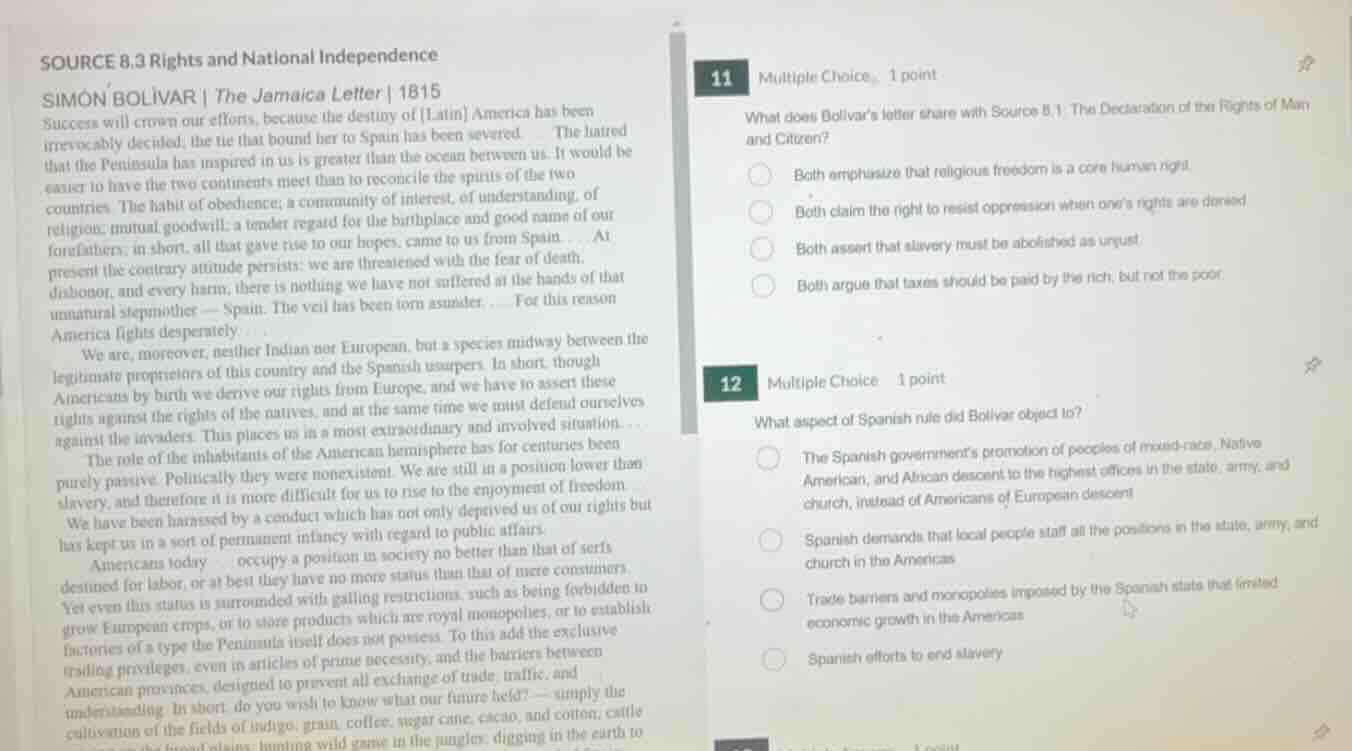
source 8.3 rights and national independence
simón bolivar | the jamaica letter | 1815
success will crown our efforts, because the destiny of latin america has been irrevocably decided: the tie that bound her to spain has been severed. the hatred that the peninsula has inspired in us is greater than the ocean between us: it would be easier to have the two continents meet than to reconcile the spirits of the two countries. the habit of obedience; a community of interest, of understanding, of religious, mutual goodwill; a tender regard for the birthplace of our forefathers, in short, all that gave rise to our hopes, came to us from spain... at present the contrary attitude persists: we are threatened with the fear of death, dishonor, and every harm, there is nothing we have not suffered at the hands of that unnatural stepmother — spain. the veil has been torn asunder... for this reason america fights desperately.
we are, moreover, neither indian nor european, but a species midway between the legitimate proprietors of this country and the spanish usurpers. in short, though americans by birth we derive our rights from europe, and we have to assert these rights against the natives, and at the same time we must defend ourselves against the invaders. this places us in a most extraordinary and involved situation...
the role of the inhabitants of the american hemisphere has for centuries been purely passive. politically they were nonexistent. we are still in a position lower than slavery, and therefore it is more difficult for us to rise to the enjoyment of freedom. we have been harassed by a conduct which has not only deprived us of our rights but has kept us in a sort of permanent infancy with regard to public affairs.
americans today — occupy a position in society no better than that of serfs destined for labor, or at best they have no more status than that of mere consumers. yet even this status is surrounded with galling restrictions, such as being forbidden to grow european crops, or to slave products which are royal monopolies, or to establish factories of a type the peninsula itself does not possess. to this add the exclusive trading privileges, even in articles of prime necessity, and the barriers between american provinces, designed to prevent all exchange of trade, traffic, and understanding. in short, do you wish to know what our future held? — simply the cultivation of the fields of indigo, grain, coffee, sugar cane, cacao, and cotton; cattle
11 multiple choice, 1 point
what does bolívar’s letter share with source 8.1, the declaration of the rights of man and citizen?
○ both emphasize that religious freedom is a core human right.
○ both claim the right to resist oppression when one’s rights are denied.
○ both assert that slavery must be abolished as unjust.
○ both argue that taxes should be paid by the rich, but not the poor.
12 multiple choice 1 point
what aspect of spanish rule did bolívar object to?
○ the spanish government’s promotion of peoples of mixed - race, native american, and african descent to the highest offices in the state, army, and church, instead of americans of european descent
○ spanish demands that local people staff all the positions in the state, army, and church in the americas
○ trade barriers and monopolies imposed by the spanish state that limited economic growth in the americas
○ spanish efforts to end slavery
For question 11: Simón Bolívar's letter frames Spanish rule as oppressive (depriving rights, imposing harm) and justifies resistance, while The Declaration of the Rights of Man and Citizen explicitly states the right to resist oppressive power. The other options are incorrect: religious freedom is not a focus of Bolívar's excerpt, abolition of slavery is not mentioned here, and tax arguments are absent from both texts.
For question 12: Bolívar directly criticizes Spanish restrictions like forbidden crop cultivation, royal product monopolies, exclusive trading privileges, and barriers to inter-American trade that stifle economic activity. The other options are incorrect: he does not object to promotion of mixed-race people, he states locals are barred from positions (not forced to staff them), and he does not oppose ending slavery.

Snap & solve any problem in the app
Get step-by-step solutions on Sovi AI
Photo-based solutions with guided steps
Explore more problems and detailed explanations
- Both claim the right to resist oppression when one's rights are denied
- Trade barriers and monopolies imposed by the Spanish state that limited economic growth in the Americas