QUESTION IMAGE
Question
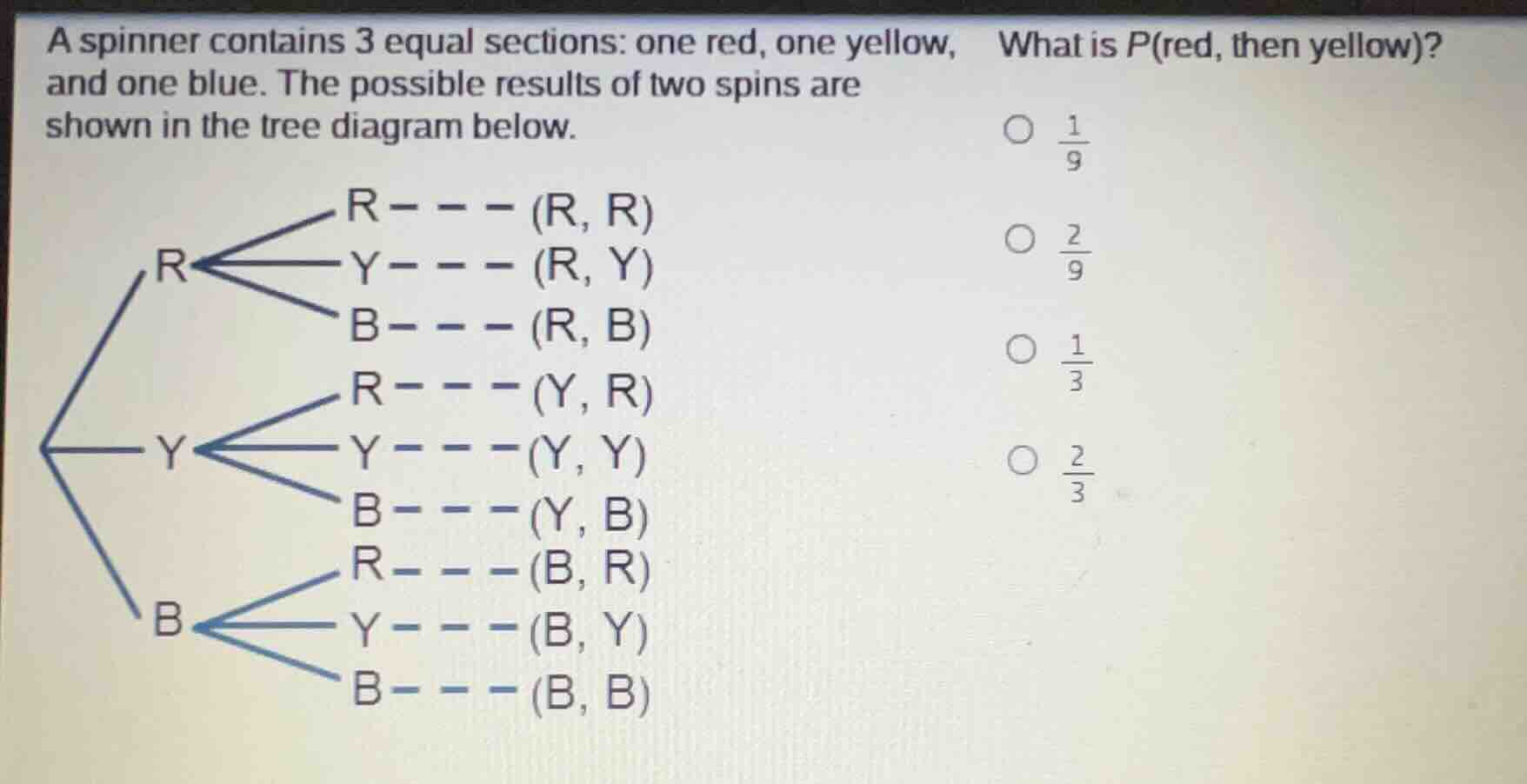
a spinner contains 3 equal sections: one red, one yellow, and one blue. the possible results of two spins are shown in the tree diagram below. what is p(red, then yellow)? \\(\frac{1}{9}\\) \\(\frac{2}{9}\\) \\(\frac{1}{3}\\) \\(\frac{2}{3}\\)
Step1: Find P(red first)
The spinner has 3 equal sections, so the probability of landing on red first is $\frac{1}{3}$.
Step2: Find P(yellow second | red first)
After spinning red first, the spinner is still 3 equal sections, so the probability of landing on yellow next is $\frac{1}{3}$.
Step3: Multiply the probabilities
For independent events (since the spins are independent), $P(\text{red, then yellow}) = P(\text{red}) \times P(\text{yellow} | \text{red}) = \frac{1}{3} \times \frac{1}{3} = \frac{1}{9}$.

Snap & solve any problem in the app
Get step-by-step solutions on Sovi AI
Photo-based solutions with guided steps
Explore more problems and detailed explanations
$\frac{1}{9}$ (corresponding to the first option)