QUESTION IMAGE
Question
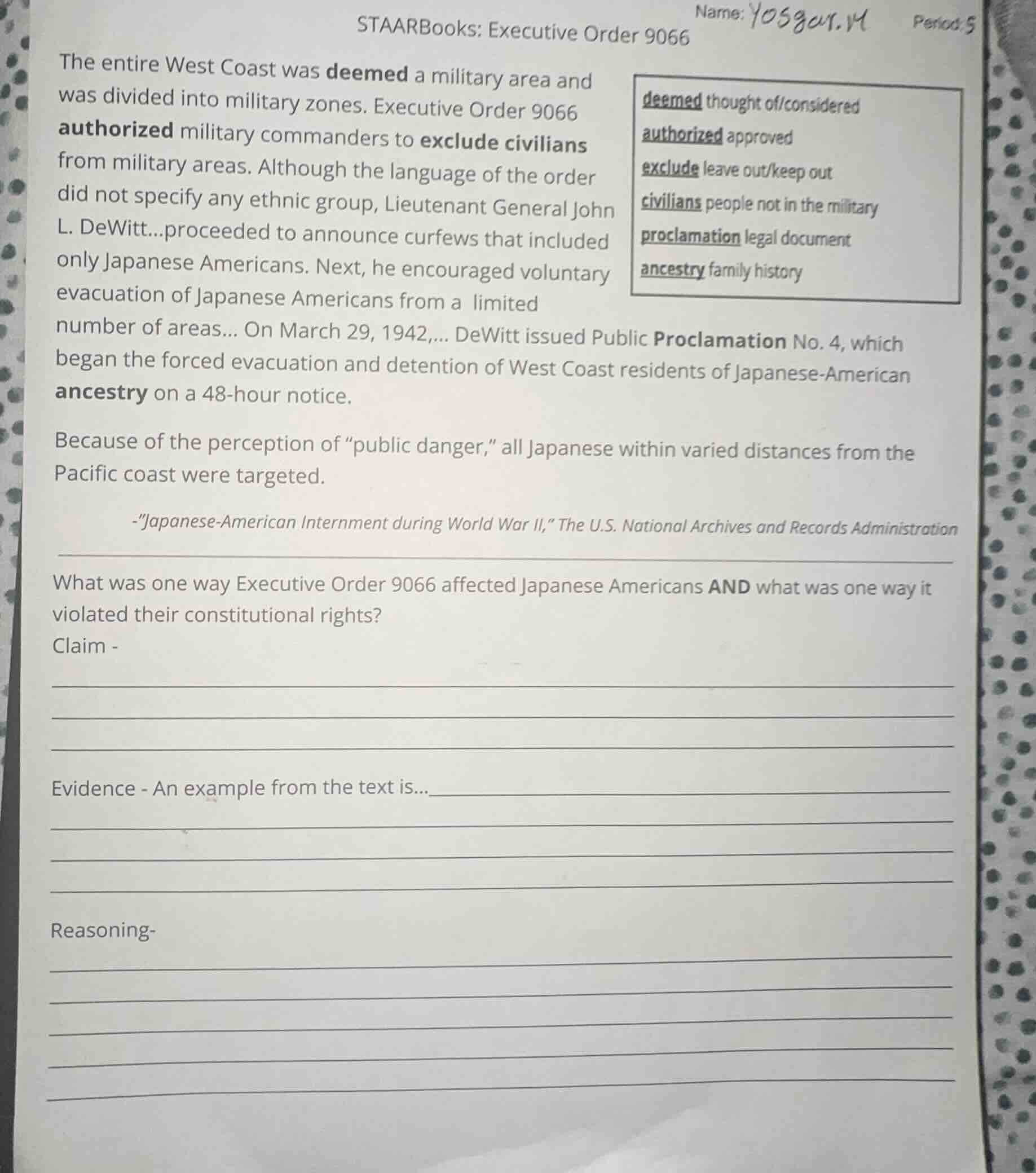
staarbooks: executive order 9066
the entire west coast was deemed a military area and
was divided into military zones. executive order 9066
authorized military commanders to exclude civilians
from military areas. although the language of the order
did not specify any ethnic group, lieutenant general john
l. dewitt...proceeded to announce curfews that included
only japanese americans. next, he encouraged voluntary
evacuation of japanese americans from a limited
number of areas... on march 29, 1942,... dewitt issued public proclamation no. 4, which
began the forced evacuation and detention of west coast residents of japanese-american
ancestry on a 48-hour notice.
because of the perception of \public danger,\ all japanese within varied distances from the
pacific coast were targeted.
-\japanese-american internment during world war ii,\ the u.s. national archives and records administration
what was one way executive order 9066 affected japanese americans and what was one way it
violated their constitutional rights?
claim -
evidence - an example from the text is...
reasoning-
Claim -
Executive Order 9066 affected Japanese Americans by forcing their evacuation and detention, and it violated their constitutional rights by targeting them based on ancestry (racial profiling) and depriving them of due process.
Evidence - An example from the text is...
On March 29, 1942, DeWitt issued Public Proclamation No. 4, which began the forced evacuation and detention of West Coast residents of Japanese - American ancestry on a 48 - hour notice. Also, Lieutenant General John L. DeWitt announced curfews that included only Japanese Americans and encouraged their voluntary evacuation from some areas before the forced evacuation.
Reasoning -
The forced evacuation and detention (as seen in Public Proclamation No. 4) disrupted the lives of Japanese Americans, taking away their homes, businesses, and normal way of life. Constitutionally, the Fifth Amendment guarantees due process, and targeting a group based on their Japanese - American ancestry (without individual suspicion of wrongdoing) violated this right. The curfews and evacuation orders that singled out Japanese Americans based on their race/ancestry also violated the Equal Protection Clause of the Fourteenth Amendment, as they were not treated equally under the law compared to other citizens.

Snap & solve any problem in the app
Get step-by-step solutions on Sovi AI
Photo-based solutions with guided steps
Explore more problems and detailed explanations
Claim -
Executive Order 9066 affected Japanese Americans by forcing their evacuation and detention, and it violated their constitutional rights by targeting them based on ancestry (racial profiling) and depriving them of due process.
Evidence - An example from the text is...
On March 29, 1942, DeWitt issued Public Proclamation No. 4, which began the forced evacuation and detention of West Coast residents of Japanese - American ancestry on a 48 - hour notice. Also, Lieutenant General John L. DeWitt announced curfews that included only Japanese Americans and encouraged their voluntary evacuation from some areas before the forced evacuation.
Reasoning -
The forced evacuation and detention (as seen in Public Proclamation No. 4) disrupted the lives of Japanese Americans, taking away their homes, businesses, and normal way of life. Constitutionally, the Fifth Amendment guarantees due process, and targeting a group based on their Japanese - American ancestry (without individual suspicion of wrongdoing) violated this right. The curfews and evacuation orders that singled out Japanese Americans based on their race/ancestry also violated the Equal Protection Clause of the Fourteenth Amendment, as they were not treated equally under the law compared to other citizens.