QUESTION IMAGE
Question
stalemate
for the first time in a century,
europe was engulfed in a large scale war.
not since the napoleonic wars had so
many european powers been at war with
one another. before the fighting began in
august and september of 1914, many
military experts believed the conflict
would be a short one.
however, when the germans failed
to swiftly defeat the french while the
austrians held off the russians (a strategy
known as the schlieffen plan), the war
soon devolved into a stalemate and both
sides dug themselves into a series of
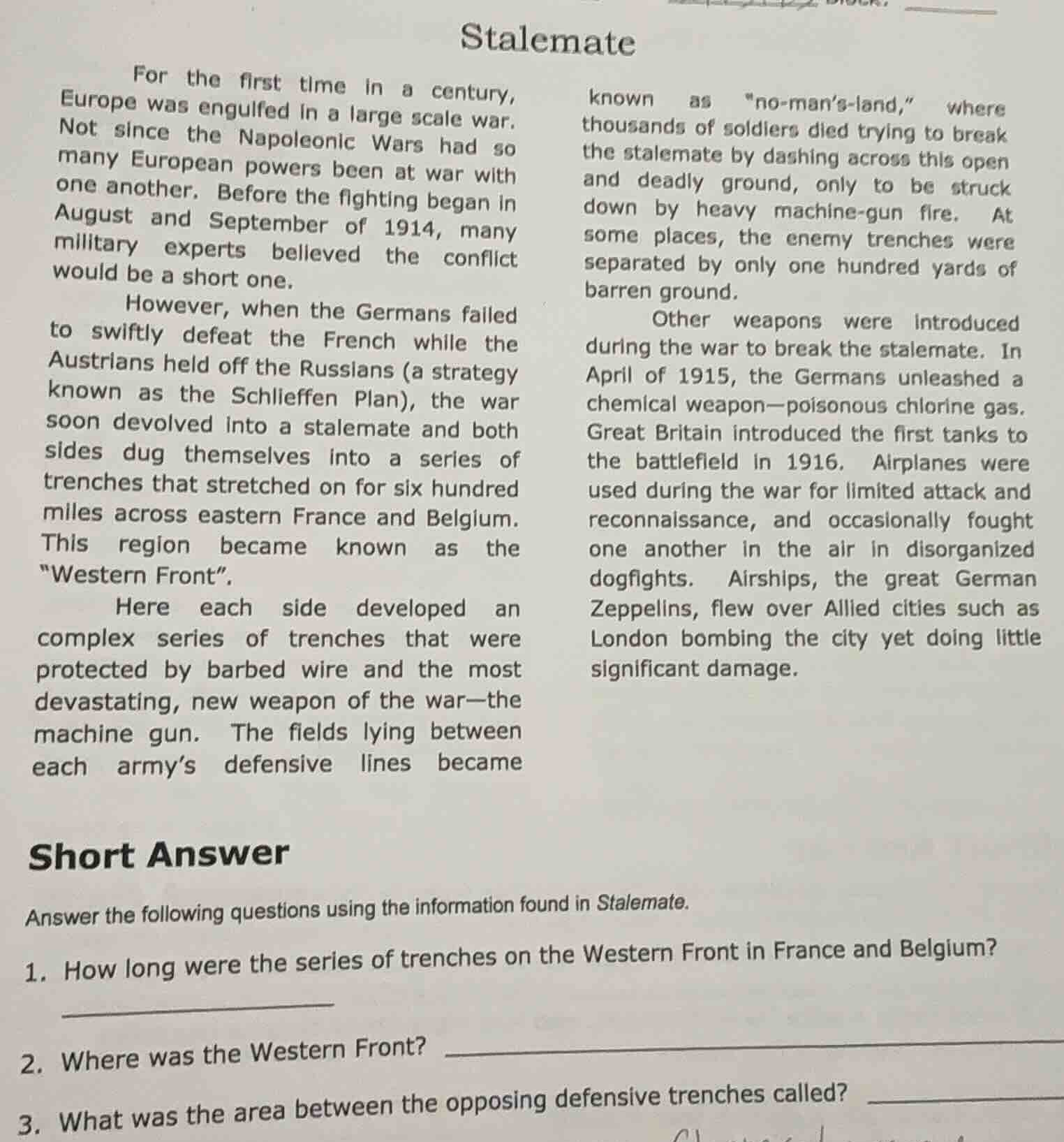
trenches that stretched on for six hundred
miles across eastern france and belgium.
this region became known as the
\western front\.
here each side developed an
complex series of trenches that were
protected by barbed wire and the most
devastating, new weapon of the war—the
machine gun. the fields lying between
each army’s defensive lines became
known as
o - man’s - land,\ where
thousands of soldiers died trying to break
the stalemate by dashing across this open
and deadly ground, only to be struck
down by heavy machine - gun fire. at
some places, the enemy trenches were
separated by only one hundred yards of
barren ground.
other weapons were introduced
during the war to break the stalemate. in
april of 1915, the germans unleashed a
chemical weapon—poisonous chlorine gas.
great britain introduced the first tanks to
the battlefield in 1916. airplanes were
used during the war for limited attack and
reconnaissance, and occasionally fought
one another in the air in disorganized
dogfights. airships, the great german
zeppelins, flew over allied cities such as
london bombing the city yet doing little
significant damage.
short answer
answer the following questions using the information found in stalemate.
- how long were the series of trenches on the western front in france and belgium?
- where was the western front?
- what was the area between the opposing defensive trenches called?
Question 1
To answer this, we look for the relevant sentence in the text: "both sides dug themselves into a series of trenches that stretched on for six hundred miles across eastern France and Belgium".
We find the relevant sentence: "both sides dug themselves into a series of trenches that stretched on for six hundred miles across eastern France and Belgium. This region became known as the 'Western Front'".
From the text: "The fields lying between each army’s defensive lines became known as 'no - man’s - land'".

Snap & solve any problem in the app
Get step-by-step solutions on Sovi AI
Photo-based solutions with guided steps
Explore more problems and detailed explanations
The series of trenches on the Western Front in France and Belgium were six hundred miles long.