QUESTION IMAGE
Question
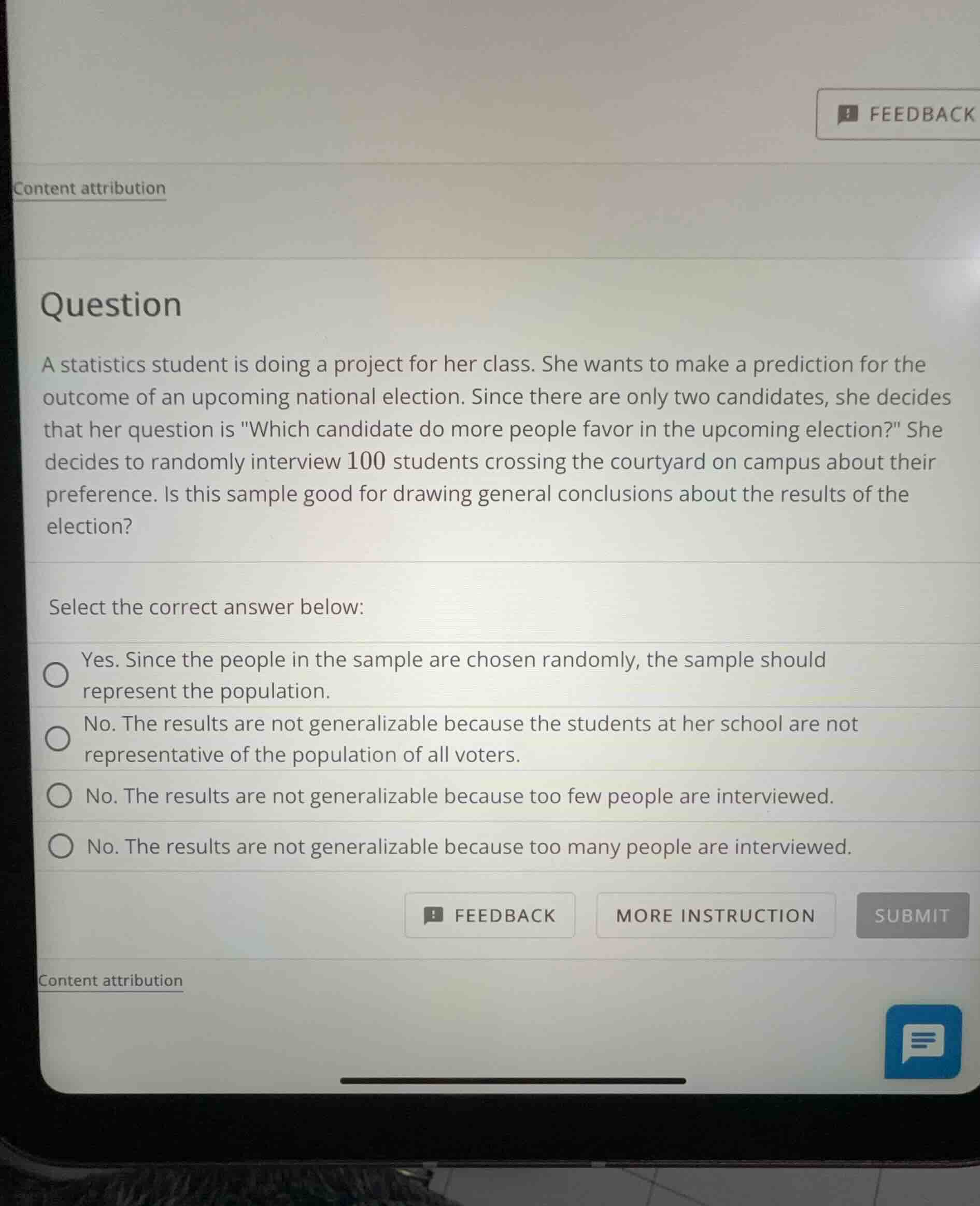
a statistics student is doing a project for her class. she wants to make a prediction for the outcome of an upcoming national election. since there are only two candidates, she decides that her question is \which candidate do more people favor in the upcoming election?\ she decides to randomly interview 100 students crossing the courtyard on campus about their preference. is this sample good for drawing general conclusions about the results of the election?
select the correct answer below:
yes. since the people in the sample are chosen randomly, the sample should represent the population.
no. the results are not generalizable because the students at her school are not representative of the population of all voters.
no. the results are not generalizable because too few people are interviewed.
no. the results are not generalizable because too many people are interviewed.
To determine if the sample is good for generalizing election results, we analyze the sample's representativeness. The student interviews only students at her school. The population for the election is all voters, not just students. Even though the sample is random within the student group, students are not a representative subset of all voters (e.g., they may have different demographics, political views, or voting eligibility compared to the general voting population). Option 1 is wrong because random selection within a non - representative group (students) doesn't make the sample representative of all voters. Option 3 is wrong as 100 can be a sufficient sample size if the sample is representative, but here the issue is representativeness, not sample size. Option 4 is wrong as more people interviewed wouldn't fix the representativeness issue. So the correct answer is the option stating the sample isn't generalizable because school students don't represent all voters.

Snap & solve any problem in the app
Get step-by-step solutions on Sovi AI
Photo-based solutions with guided steps
Explore more problems and detailed explanations
No. The results are not generalizable because the students at her school are not representative of the population of all voters.