QUESTION IMAGE
Question
stoichiometry quiz
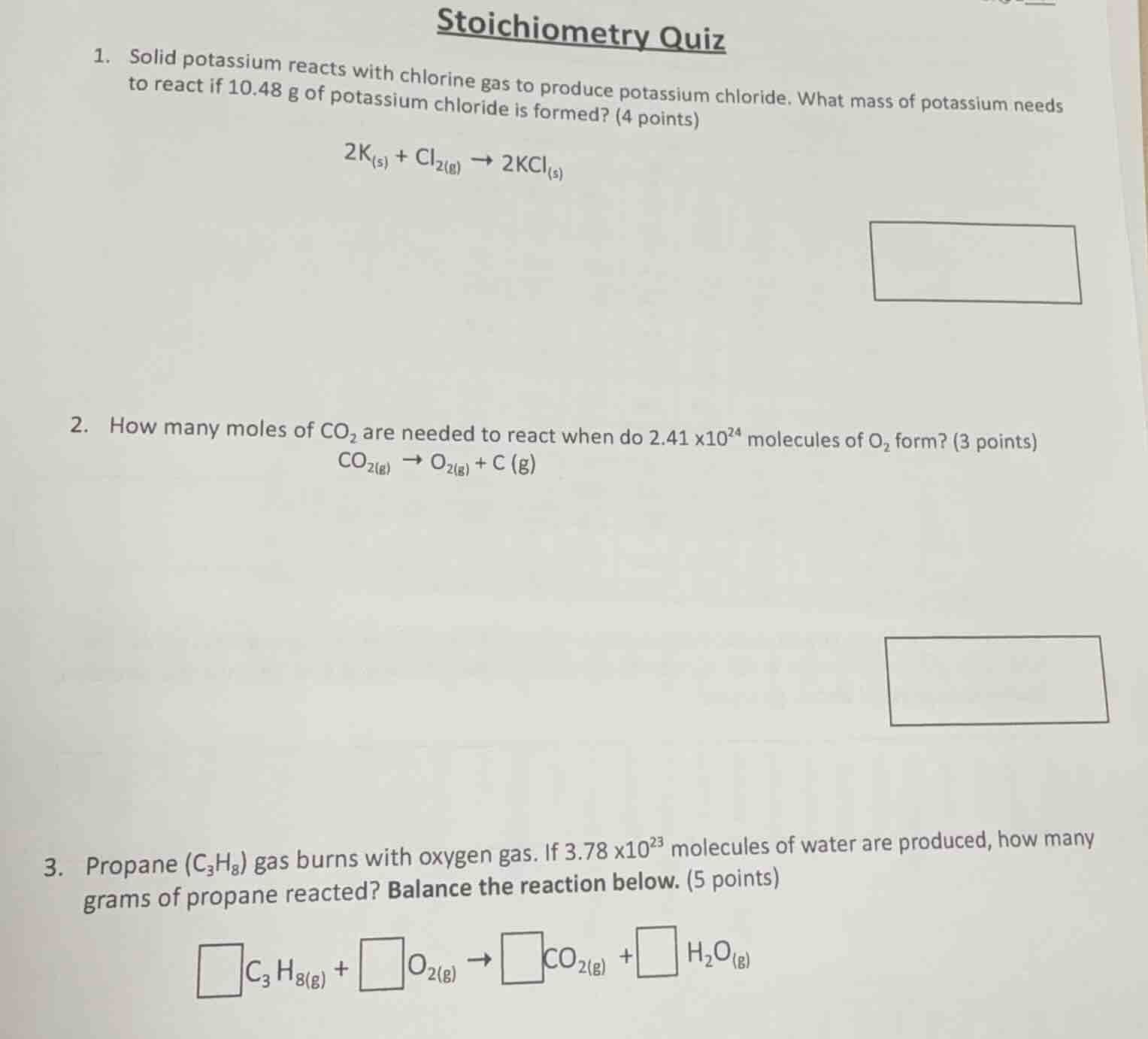
- solid potassium reacts with chlorine gas to produce potassium chloride. what mass of potassium needs to react if 10.48 g of potassium chloride is formed? (4 points)
\\(2k_{(s)} + cl_{2(g)} \
ightarrow 2kcl_{(s)}\\)
- how many moles of \\(co_2\\) are needed to react when do \\(2.41 \times 10^{24}\\) molecules of \\(o_2\\) form? (3 points)
\\(co_{2(g)} \
ightarrow o_{2(g)} + c_{(g)}\\)
- propane (\\(c_3h_8\\)) gas burns with oxygen gas. if \\(3.78 \times 10^{23}\\) molecules of water are produced, how many grams of propane reacted? balance the reaction below. (5 points)
\\(\square c_3 h_{8(g)} + \square o_{2(g)} \
ightarrow \square co_{2(g)} + \square h_2 o_{(g)}\\)
Question 1
Step 1: Calculate moles of KCl
Molar mass of KCl: $M(\text{KCl}) = 39.10 + 35.45 = 74.55\ \text{g/mol}$
Moles of KCl: $n(\text{KCl}) = \frac{m(\text{KCl})}{M(\text{KCl})} = \frac{10.48\ \text{g}}{74.55\ \text{g/mol}} \approx 0.1406\ \text{mol}$
Step 2: Relate moles of K and KCl
From the reaction $2\text{K} + \text{Cl}_2
ightarrow 2\text{KCl}$, the mole ratio of $\text{K}:\text{KCl}$ is $2:2 = 1:1$. So $n(\text{K}) = n(\text{KCl}) = 0.1406\ \text{mol}$
Step 3: Calculate mass of K
Molar mass of K: $M(\text{K}) = 39.10\ \text{g/mol}$
Mass of K: $m(\text{K}) = n(\text{K}) \times M(\text{K}) = 0.1406\ \text{mol} \times 39.10\ \text{g/mol} \approx 5.498\ \text{g}$
Step 1: Find moles of $\text{O}_2$
Using Avogadro’s number ($N_A = 6.022 \times 10^{23}\ \text{molecules/mol}$):
$n(\text{O}_2) = \frac{N(\text{O}_2)}{N_A} = \frac{2.41 \times 10^{24}\ \text{molecules}}{6.022 \times 10^{23}\ \text{molecules/mol}} \approx 4.00\ \text{mol}$
Step 2: Relate moles of $\text{CO}_2$ and $\text{O}_2$
From the reaction $\text{CO}_2
ightarrow \text{O}_2 + \text{C}$, the mole ratio of $\text{CO}_2:\text{O}_2$ is $1:1$. So $n(\text{CO}_2) = n(\text{O}_2) = 4.00\ \text{mol}$
Step 1: Balance the reaction
- Balance C: $1\ \text{C}_3\text{H}_8$ produces $3\ \text{CO}_2$ (so $\text{CO}_2$ coefficient = 3)
- Balance H: $1\ \text{C}_3\text{H}_8$ has 8 H, so $4\ \text{H}_2\text{O}$ (since $4 \times 2 = 8$; $\text{H}_2\text{O}$ coefficient = 4)
- Balance O: Right side has $3 \times 2 + 4 \times 1 = 10$ O, so $\text{O}_2$ coefficient = $5$ (since $5 \times 2 = 10$)
Balanced reaction: $\boldsymbol{1}\text{C}_3\text{H}_{8(\text{g})} + \boldsymbol{5}\text{O}_{2(\text{g})}
ightarrow \boldsymbol{3}\text{CO}_{2(\text{g})} + \boldsymbol{4}\text{H}_2\text{O}_{(\text{g})}$
Step 2: Moles of $\text{H}_2\text{O}$
$n(\text{H}_2\text{O}) = \frac{N(\text{H}_2\text{O})}{N_A} = \frac{3.78 \times 10^{23}\ \text{molecules}}{6.022 \times 10^{23}\ \text{molecules/mol}} \approx 0.628\ \text{mol}$
Step 3: Relate moles of $\text{C}_3\text{H}_8$ and $\text{H}_2\text{O}$
Mole ratio of $\text{C}_3\text{H}_8:\text{H}_2\text{O} = 1:4$, so $n(\text{C}_3\text{H}_8) = \frac{n(\text{H}_2\text{O})}{4} = \frac{0.628\ \text{mol}}{4} \approx 0.157\ \text{mol}$
Step 4: Mass of $\text{C}_3\text{H}_8$
Molar mass of $\text{C}_3\text{H}_8$: $3 \times 12.01 + 8 \times 1.008 = 44.094\ \text{g/mol}$
Mass: $m(\text{C}_3\text{H}_8) = 0.157\ \text{mol} \times 44.094\ \text{g/mol} \approx 6.92\ \text{g}$

Snap & solve any problem in the app
Get step-by-step solutions on Sovi AI
Photo-based solutions with guided steps
Explore more problems and detailed explanations
Approximately $\boldsymbol{5.50\ \text{g}}$ (or $5.498\ \text{g}$)