QUESTION IMAGE
Question
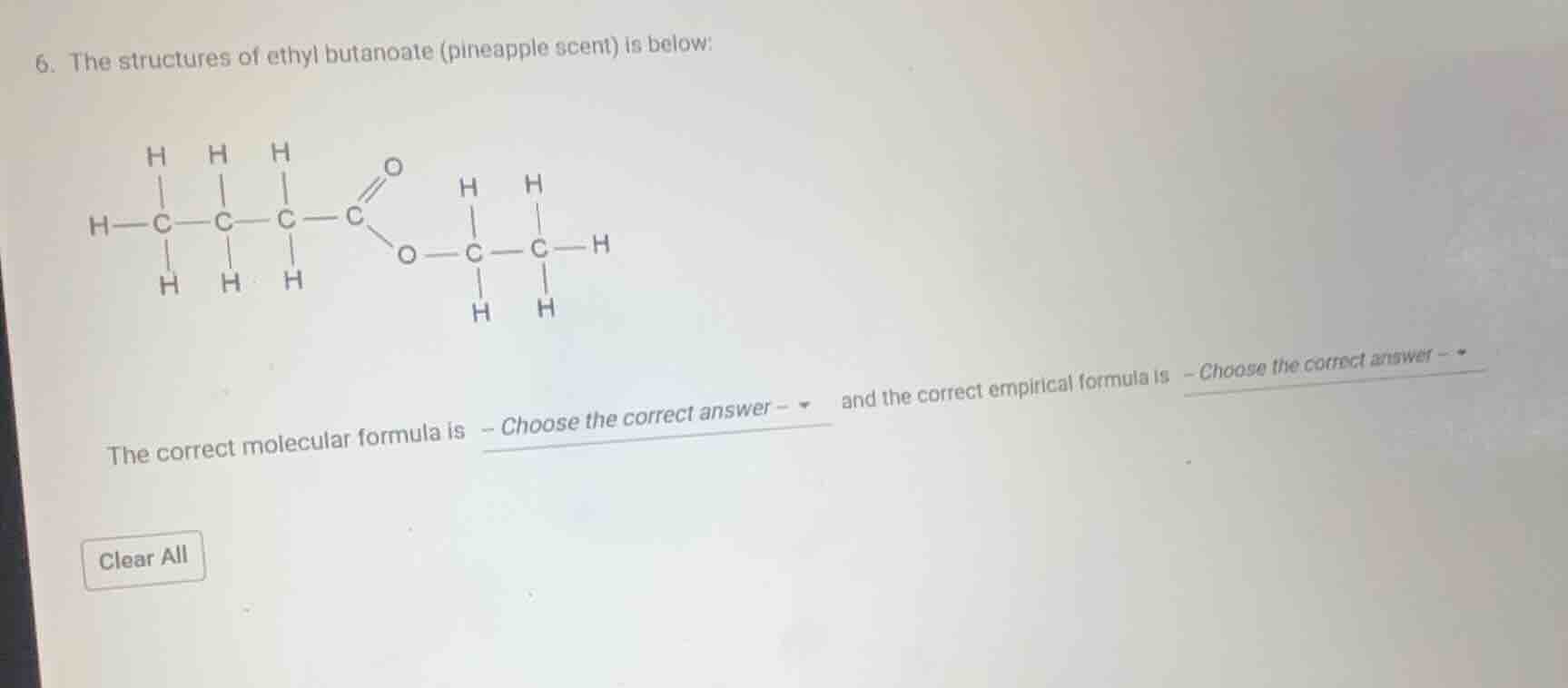
- the structures of ethyl butanoate (pineapple scent) is below:
the correct molecular formula is - choose the correct answer - and the correct empirical formula is - choose the correct answer -
To determine the molecular and empirical formulas of ethyl butanoate, we analyze its structure:
Step 1: Count Atoms for Molecular Formula
From the Lewis structure:
- Carbon (C): Let’s count the C atoms. The left chain has 4 C atoms (from the butanoate part: \( \ce{C-C-C-C} \)), and the ethyl group (\( \ce{-C-C-} \)) adds 2 more. Total \( \boldsymbol{C = 4 + 2 = 6} \).
- Hydrogen (H): Count H atoms. The left chain: each of the first 3 C atoms has 2 H, the 4th C (carbonyl) has 0, and the ethyl group has 5 H? Wait, re-examine:
- Left chain (butanoate): \( \ce{H-C(2H)-C(2H)-C(2H)-C(=O)-} \): that’s \( 3 \times 2 + 1 \times 0 = 6 \) H? Wait, no—let’s list all H:
- First C: \( \ce{H-C(H)(H)-} \): 3 H? Wait, no, the structure shows:
- First C: bonded to H (left), H (top), H (bottom) → 3 H? Wait, no, the structure is:
\( \ce{H - C(H)(H) - C(H)(H) - C(H)(H) - C(=O) - O - C(H)(H) - C(H)(H) - H} \)
Wait, let’s count each C’s H:
- C1 (leftmost): bonded to H (left), H (top), H (bottom) → 3 H? No, wait, the first C is \( \ce{H - C - (H)(H)} \)? Wait, the structure is drawn as:
\( \ce{H - C(H)(H) - C(H)(H) - C(H)(H) - C(=O) - O - C(H)(H) - C(H)(H) - H} \)
Wait, no—let’s count all H:
- Left chain (4 C):
- C1: \( \ce{H - C - (H)(H)} \)? Wait, the first C has bonds: left H, top H, bottom H, and right C → 3 H? No, carbon has 4 bonds. So:
- C1: H (left), C (right), H (top), H (bottom) → 3 H? No, 4 bonds: left H, right C, top H, bottom H → 3 H? No, that’s 4 bonds (H, C, H, H) → 3 H? Wait, no—each C must have 4 bonds. Let’s re-express the structure:
The left part: \( \ce{CH3 - CH2 - CH2 - CO - O - CH2 - CH3} \) (ethyl butanoate, which is \( \ce{CH3CH2CH2COOCH2CH3} \)).
So:
- \( \ce{CH3} \) (C1): 3 H
- \( \ce{CH2} \) (C2): 2 H
- \( \ce{CH2} \) (C3): 2 H
- \( \ce{CO} \) (C4): 0 H (carbonyl)
- \( \ce{O - CH2} \) (C5): 2 H
- \( \ce{CH3} \) (C6): 3 H? Wait, no—ethyl group is \( \ce{-CH2 - CH3} \), so C5: \( \ce{CH2} \) (2 H), C6: \( \ce{CH3} \) (3 H). Wait, no, the structure shows \( \ce{-C - C - H} \) for the ethyl group: the last C (C6) is bonded to H (right), so \( \ce{C(H)(H) - C(H)(H) - H} \)? No, the last C (C6) has bonds: left C, H (right), H (top), H (bottom) → 3 H? Wait, I think I made a mistake. Let’s use the standard formula for ethyl butanoate: \( \ce{CH3CH2CH2COOCH2CH3} \).
Let’s expand \( \ce{CH3CH2CH2COOCH2CH3} \):
- \( \ce{CH3} \): 1 C, 3 H
- \( \ce{CH2} \): 1 C, 2 H
- \( \ce{CH2} \): 1 C, 2 H
- \( \ce{CO} \): 1 C, 0 H (carbonyl)
- \( \ce{O} \): 1 O
- \( \ce{CH2} \): 1 C, 2 H
- \( \ce{CH3} \): 1 C, 3 H? Wait, no—ethyl butanoate is \( \ce{C6H12O2} \). Wait, let’s count:
- C: 4 (butanoate) + 2 (ethyl) = 6
- H: For \( \ce{CH3CH2CH2COOCH2CH3} \):
- \( \ce{CH3} \): 3 H
- \( \ce{CH2} \): 2 H
- \( \ce{CH2} \): 2 H
- \( \ce{CO} \): 0 H
- \( \ce{O} \): 0 H
- \( \ce{CH2} \): 2 H
- \( \ce{CH3} \): 3 H? Wait, no—\( \ce{CH3CH2CH2COOCH2CH3} \) is \( \ce{C6H12O2} \). Let’s verify:
- \( \ce{CH3} \) (1st): 3 H
- \( \ce{CH2} \) (2nd): 2 H
- \( \ce{CH2} \) (3rd): 2 H
- \( \ce{CO} \) (4th C): 0 H
- \( \ce{O} \): 0 H
- \( \ce{CH2} \) (5th C): 2 H…

Snap & solve any problem in the app
Get step-by-step solutions on Sovi AI
Photo-based solutions with guided steps
Explore more problems and detailed explanations
To determine the molecular and empirical formulas of ethyl butanoate, we analyze its structure:
Step 1: Count Atoms for Molecular Formula
From the Lewis structure:
- Carbon (C): Let’s count the C atoms. The left chain has 4 C atoms (from the butanoate part: \( \ce{C-C-C-C} \)), and the ethyl group (\( \ce{-C-C-} \)) adds 2 more. Total \( \boldsymbol{C = 4 + 2 = 6} \).
- Hydrogen (H): Count H atoms. The left chain: each of the first 3 C atoms has 2 H, the 4th C (carbonyl) has 0, and the ethyl group has 5 H? Wait, re-examine:
- Left chain (butanoate): \( \ce{H-C(2H)-C(2H)-C(2H)-C(=O)-} \): that’s \( 3 \times 2 + 1 \times 0 = 6 \) H? Wait, no—let’s list all H:
- First C: \( \ce{H-C(H)(H)-} \): 3 H? Wait, no, the structure shows:
- First C: bonded to H (left), H (top), H (bottom) → 3 H? Wait, no, the structure is:
\( \ce{H - C(H)(H) - C(H)(H) - C(H)(H) - C(=O) - O - C(H)(H) - C(H)(H) - H} \)
Wait, let’s count each C’s H:
- C1 (leftmost): bonded to H (left), H (top), H (bottom) → 3 H? No, wait, the first C is \( \ce{H - C - (H)(H)} \)? Wait, the structure is drawn as:
\( \ce{H - C(H)(H) - C(H)(H) - C(H)(H) - C(=O) - O - C(H)(H) - C(H)(H) - H} \)
Wait, no—let’s count all H:
- Left chain (4 C):
- C1: \( \ce{H - C - (H)(H)} \)? Wait, the first C has bonds: left H, top H, bottom H, and right C → 3 H? No, carbon has 4 bonds. So:
- C1: H (left), C (right), H (top), H (bottom) → 3 H? No, 4 bonds: left H, right C, top H, bottom H → 3 H? No, that’s 4 bonds (H, C, H, H) → 3 H? Wait, no—each C must have 4 bonds. Let’s re-express the structure:
The left part: \( \ce{CH3 - CH2 - CH2 - CO - O - CH2 - CH3} \) (ethyl butanoate, which is \( \ce{CH3CH2CH2COOCH2CH3} \)).
So:
- \( \ce{CH3} \) (C1): 3 H
- \( \ce{CH2} \) (C2): 2 H
- \( \ce{CH2} \) (C3): 2 H
- \( \ce{CO} \) (C4): 0 H (carbonyl)
- \( \ce{O - CH2} \) (C5): 2 H
- \( \ce{CH3} \) (C6): 3 H? Wait, no—ethyl group is \( \ce{-CH2 - CH3} \), so C5: \( \ce{CH2} \) (2 H), C6: \( \ce{CH3} \) (3 H). Wait, no, the structure shows \( \ce{-C - C - H} \) for the ethyl group: the last C (C6) is bonded to H (right), so \( \ce{C(H)(H) - C(H)(H) - H} \)? No, the last C (C6) has bonds: left C, H (right), H (top), H (bottom) → 3 H? Wait, I think I made a mistake. Let’s use the standard formula for ethyl butanoate: \( \ce{CH3CH2CH2COOCH2CH3} \).
Let’s expand \( \ce{CH3CH2CH2COOCH2CH3} \):
- \( \ce{CH3} \): 1 C, 3 H
- \( \ce{CH2} \): 1 C, 2 H
- \( \ce{CH2} \): 1 C, 2 H
- \( \ce{CO} \): 1 C, 0 H (carbonyl)
- \( \ce{O} \): 1 O
- \( \ce{CH2} \): 1 C, 2 H
- \( \ce{CH3} \): 1 C, 3 H? Wait, no—ethyl butanoate is \( \ce{C6H12O2} \). Wait, let’s count:
- C: 4 (butanoate) + 2 (ethyl) = 6
- H: For \( \ce{CH3CH2CH2COOCH2CH3} \):
- \( \ce{CH3} \): 3 H
- \( \ce{CH2} \): 2 H
- \( \ce{CH2} \): 2 H
- \( \ce{CO} \): 0 H
- \( \ce{O} \): 0 H
- \( \ce{CH2} \): 2 H
- \( \ce{CH3} \): 3 H? Wait, no—\( \ce{CH3CH2CH2COOCH2CH3} \) is \( \ce{C6H12O2} \). Let’s verify:
- \( \ce{CH3} \) (1st): 3 H
- \( \ce{CH2} \) (2nd): 2 H
- \( \ce{CH2} \) (3rd): 2 H
- \( \ce{CO} \) (4th C): 0 H
- \( \ce{O} \): 0 H
- \( \ce{CH2} \) (5th C): 2 H
- \( \ce{CH3} \) (6th C): 3 H? Wait, 3 + 2 + 2 + 0 + 0 + 2 + 3 = 12 H. Yes!
- O: 2 (from \( \ce{-COO-} \))
So molecular formula: \( \boldsymbol{C_6H_{12}O_2} \).
Step 2: Determine Empirical Formula
The empirical formula is the simplest whole-number ratio of atoms. For \( \ce{C6H12O2} \), divide all subscripts by their greatest common divisor (GCD). The GCD of 6, 12, and 2 is 2.
- \( \ce{C} \): \( 6 \div 2 = 3 \)
- \( \ce{H} \): \( 12 \div 2 = 6 \)
- \( \ce{O} \): \( 2 \div 2 = 1 \)
Thus, empirical formula: \( \boldsymbol{C_3H_6O} \).
Final Answers
- Molecular Formula: \( \boldsymbol{C_6H_{12}O_2} \)
- Empirical Formula: \( \boldsymbol{C_3H_6O} \)
(Note: If the question provides options, select the one matching \( \ce{C6H12O2} \) for molecular formula and \( \ce{C3H6O} \) for empirical formula.)