QUESTION IMAGE
Question
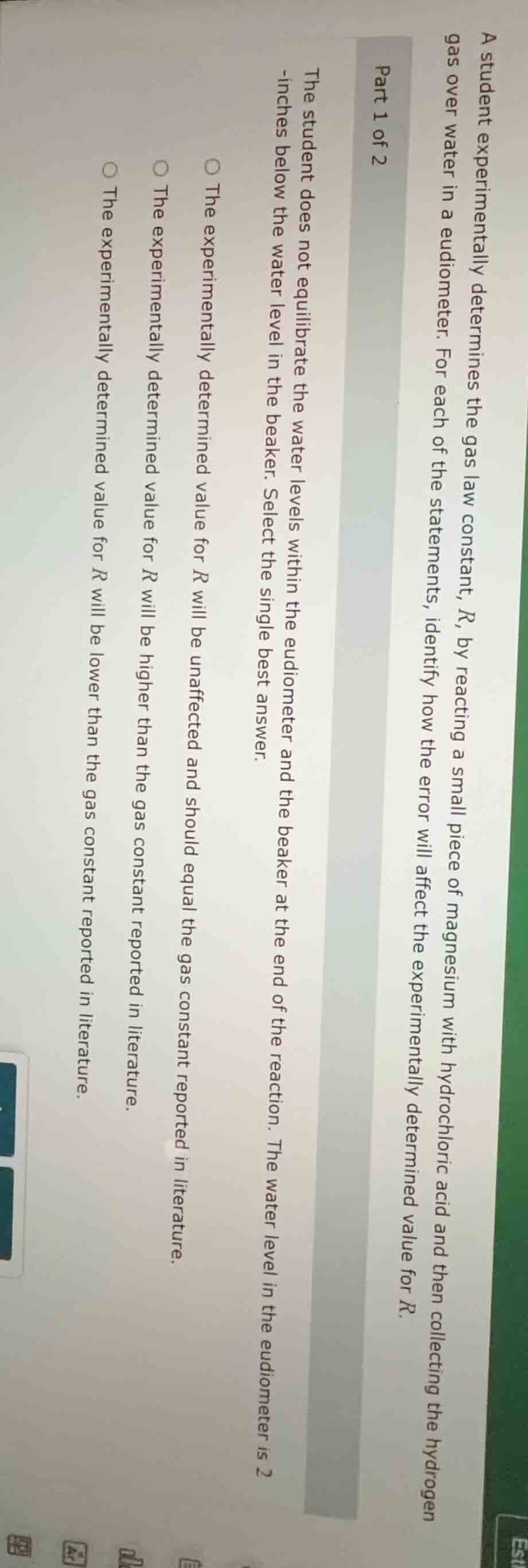
a student experimentally determines the gas law constant, r, by reacting a small piece of magnesium with hydrochloric acid and then collecting the hydrogen gas over water in a eudiometer. for each of the statements, identify how the error will affect the experimentally determined value for r. part 1 of 2 the student does not equilibrate the water levels within the eudiometer and the beaker at the end of the reaction. the water level in the eudiometer is 2 -inches below the water level in the beaker. select the single best answer. the experimentally determined value for r will be unaffected and should equal the gas constant reported in literature. the experimentally determined value for r will be higher than the gas constant reported in literature. the experimentally determined value for r will be lower than the gas constant reported in literature.
When the water level in the eudiometer is 2 inches below the water level in the beaker, the pressure of the hydrogen gas collected is less than the atmospheric pressure (since the pressure inside the eudiometer is equal to the atmospheric pressure minus the pressure due to the water column difference). The ideal gas law is \( PV = nRT \), and \( R=\frac{PV}{nT} \). If we use the atmospheric pressure (which is higher than the actual gas pressure) to calculate \( R \), or if we don't account for the pressure difference, the calculated \( P \) will be higher than the true pressure of the gas. Wait, actually, let's re - think: The pressure of the gas \( P_{gas}=P_{atm}-P_{water\ column} \). If we don't equilibrate the levels, we measure the volume of the gas at a pressure \( P_{gas} \) that is less than \( P_{atm} \). But when we calculate \( R \), we might use \( P_{atm} \) instead of \( P_{gas} \). Let's use the formula for \( R \) from the experiment. The experiment likely uses \( R=\frac{PV}{nT} \). The volume \( V \) is measured, \( n \) is the moles of \( H_2 \), \( T \) is the temperature. If the water level in the eudiometer is below the beaker, the pressure inside the eudiometer (gas pressure) is \( P_{gas}=P_{atm}- \Delta P \) (where \( \Delta P \) is the pressure due to the water column). If we do not equilibrate, we might assume the pressure is \( P_{atm} \), but actually, the true pressure of the gas is lower. Wait, no - when calculating \( R \), we need to use the correct pressure of the gas. If the water level in the eudiometer is 2 inches below the beaker, the gas pressure \( P_{gas}=P_{atm}-P_{water\ column} \). So the actual pressure of the gas is less than \( P_{atm} \). Now, the volume of the gas is measured as \( V \). From \( PV = nRT \), \( R=\frac{PV}{nT} \). If we use \( P = P_{atm} \) (incorrectly, because the true \( P \) is \( P_{atm}- \Delta P \)) when calculating \( R \), or if we use the measured \( V \) which is at \( P = P_{atm}- \Delta P \), but we use \( P = P_{atm} \) in the formula, let's see: Suppose \( P_{true}=P_{atm}-\Delta P \), \( V_{true} \) is the volume at \( P_{true} \). If we don't equilibrate, we measure \( V \) at \( P_{true} \), but when calculating \( R \), we might use \( P = P_{atm} \). So \( R_{calculated}=\frac{P_{atm}\times V}{nT} \), but the true \( R \) is \( \frac{P_{true}\times V}{nT}=\frac{(P_{atm}-\Delta P)\times V}{nT} \). Since \( P_{atm}>P_{true} \), \( R_{calculated}=\frac{P_{atm}V}{nT}>\frac{(P_{atm}-\Delta P)V}{nT}=R_{true} \)? Wait, no, maybe I got the pressure - volume relationship wrong. Let's consider Boyle's law: \( P_1V_1 = P_2V_2 \). If the gas is at \( P_{true} \) and \( V_{measured} \), and we should have \( P_{atm}V_{corrected}=P_{true}V_{measured} \), so \( V_{corrected}=\frac{P_{true}V_{measured}}{P_{atm}} \). If we don't correct for the pressure difference, we use \( V = V_{measured} \) instead of \( V_{corrected} \). So in the formula \( R=\frac{PV}{nT} \), if \( P = P_{atm} \) (correct atmospheric pressure) and \( V = V_{measured} \) (which is larger than \( V_{corrected} \) because \( V_{corrected}=\frac{P_{true}V_{measured}}{P_{atm}} \) and \( P_{true}

Snap & solve any problem in the app
Get step-by-step solutions on Sovi AI
Photo-based solutions with guided steps
Explore more problems and detailed explanations
The experimentally determined value for \( R \) will be higher than the gas constant reported in literature. (The option: "The experimentally determined value for \( R \) will be higher than the gas constant reported in literature.")