QUESTION IMAGE
Question
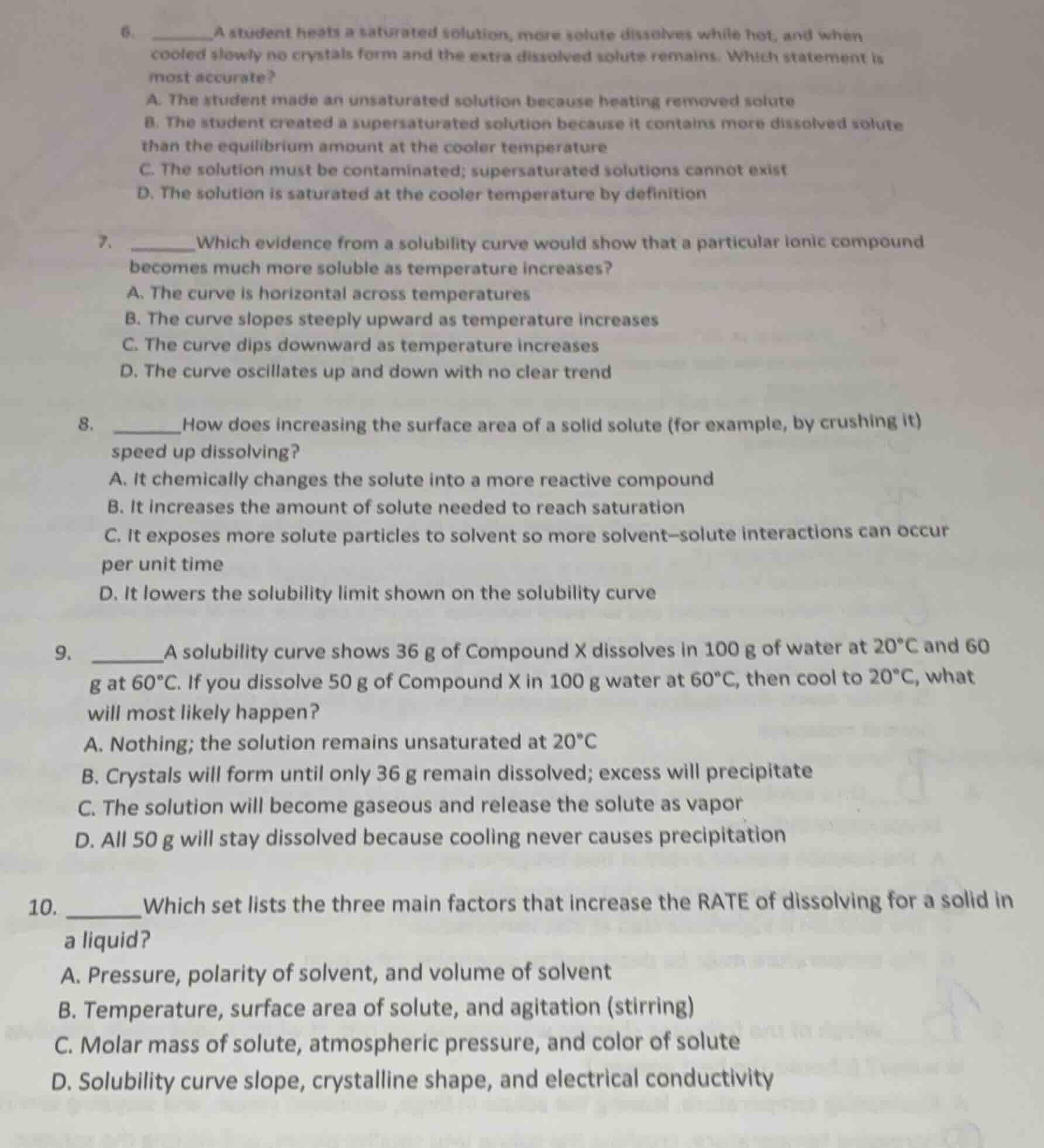
- ____a student heats a saturated solution, more solute dissolves while hot, and when cooled slowly no crystals form and the extra dissolved solute remains. which statement is most accurate?a. the student made an unsaturated solution because heating removed soluteb. the student created a supersaturated solution because it contains more dissolved solute than the equilibrium amount at the cooler temperaturec. the solution must be contaminated; supersaturated solutions cannot existd. the solution is saturated at the cooler temperature by definition7. __which evidence from a solubility curve would show that a particular ionic compound becomes much more soluble as temperature increases?a. the curve is horizontal across temperaturesb. the curve slopes steeply upward as temperature increasesc. the curve dips downward as temperature increasesd. the curve oscillates up and down with no clear trend8. __how does increasing the surface area of a solid solute (for example, by crushing it) speed up dissolving?a. it chemically changes the solute into a more reactive compoundb. it increases the amount of solute needed to reach saturationc. it exposes more solute particles to solvent so more solvent-solute interactions can occur per unit timed. it lowers the solubility limit shown on the solubility curve9. __a solubility curve shows 36 g of compound x dissolves in 100 g of water at 20°c and 60 g at 60°c. if you dissolve 50 g of compound x in 100 g water at 60°c, then cool to 20°c, what will most likely happen?a. nothing; the solution remains unsaturated at 20°cb. crystals will form until only 36 g remain dissolved; excess will precipitatec. the solution will become gaseous and release the solute as vapord. all 50 g will stay dissolved because cooling never causes precipitation10. ____which set lists the three main factors that increase the rate of dissolving for a solid in a liquid?a. pressure, polarity of solvent, and volume of solventb. temperature, surface area of solute, and agitation (stirring)c. molar mass of solute, atmospheric pressure, and color of soluted. solubility curve slope, crystalline shape, and electrical conductivity
Brief Explanations
- A supersaturated solution contains more dissolved solute than the equilibrium (saturated) amount at a given temperature. Heating allows more solute to dissolve, and slow cooling without crystal formation retains this excess solute.
- A solubility curve plots solubility (y-axis) against temperature (x-axis). A steep upward slope means solubility rises sharply with increasing temperature.
- Crushing a solute increases surface area, exposing more solute particles to the solvent, which speeds up solvent-solute interactions and dissolution.
- At 20°C, only 36 g of Compound X can stay dissolved in 100 g water. When cooling a solution with 50 g dissolved, the excess (50 g - 36 g = 14 g) will form crystals and precipitate.
- The three main factors that speed up the rate of dissolving a solid in a liquid are increasing temperature (adds energy for dissolution), increasing solute surface area (more contact with solvent), and agitation (brings fresh solvent to solute).

Snap & solve any problem in the app
Get step-by-step solutions on Sovi AI
Photo-based solutions with guided steps
Explore more problems and detailed explanations
- B. The student created a supersaturated solution because it contains more dissolved solute than the equilibrium amount at the cooler temperature
- B. The curve slopes steeply upward as temperature increases
- C. It exposes more solute particles to solvent so more solvent-solute interactions can occur per unit time
- B. Crystals will form until only 36 g remain dissolved; excess will precipitate
- B. Temperature, surface area of solute, and agitation (stirring)