QUESTION IMAGE
Question
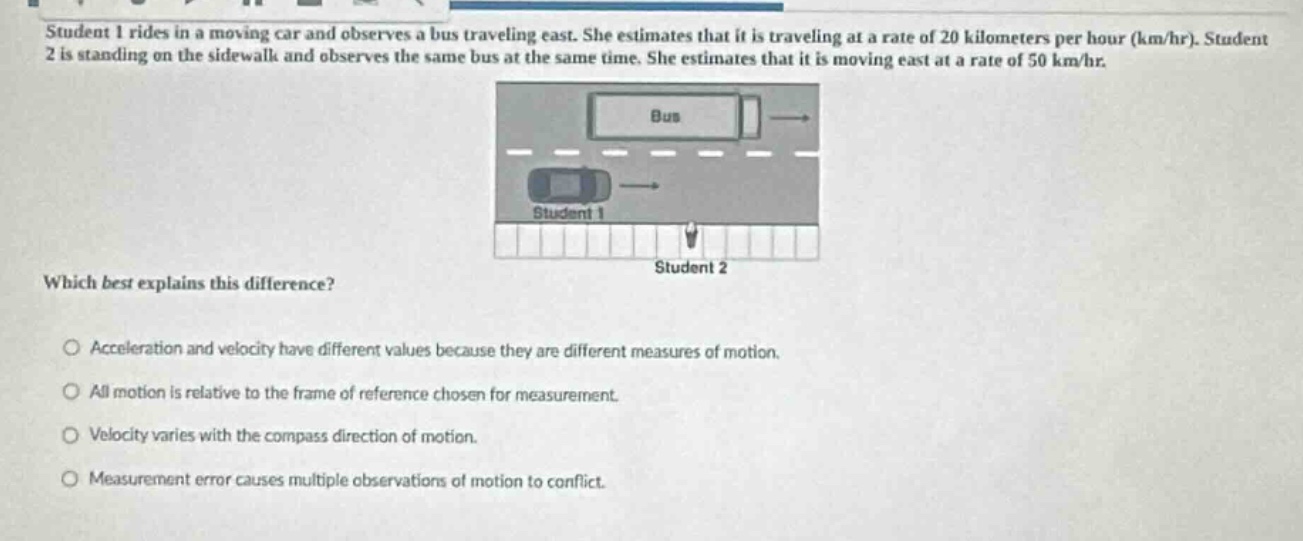
student 1 rides in a moving car and observes a bus traveling east. she estimates that it is traveling at a rate of 20 kilometers per hour (km/hr). student 2 is standing on the sidewalk and observes the same bus at the same time. she estimates that it is moving east at a rate of 50 km/hr.
which best explains this difference?
acceleration and velocity have different values because they are different measures of motion.
all motion is relative to the frame of reference chosen for measurement.
velocity varies with the compass direction of motion.
measurement error causes multiple observations of motion to conflict.
The two students measure different speeds for the same bus because they are in different frames of reference: Student 1 is in a moving car, while Student 2 is stationary on the sidewalk. Motion is always described relative to the observer's chosen frame of reference, which explains the differing measurements. The other options are incorrect: acceleration is not involved here, velocity direction is the same (east) for both, and this is not a measurement error.

Snap & solve any problem in the app
Get step-by-step solutions on Sovi AI
Photo-based solutions with guided steps
Explore more problems and detailed explanations
All motion is relative to the frame of reference chosen for measurement.