QUESTION IMAGE
Question
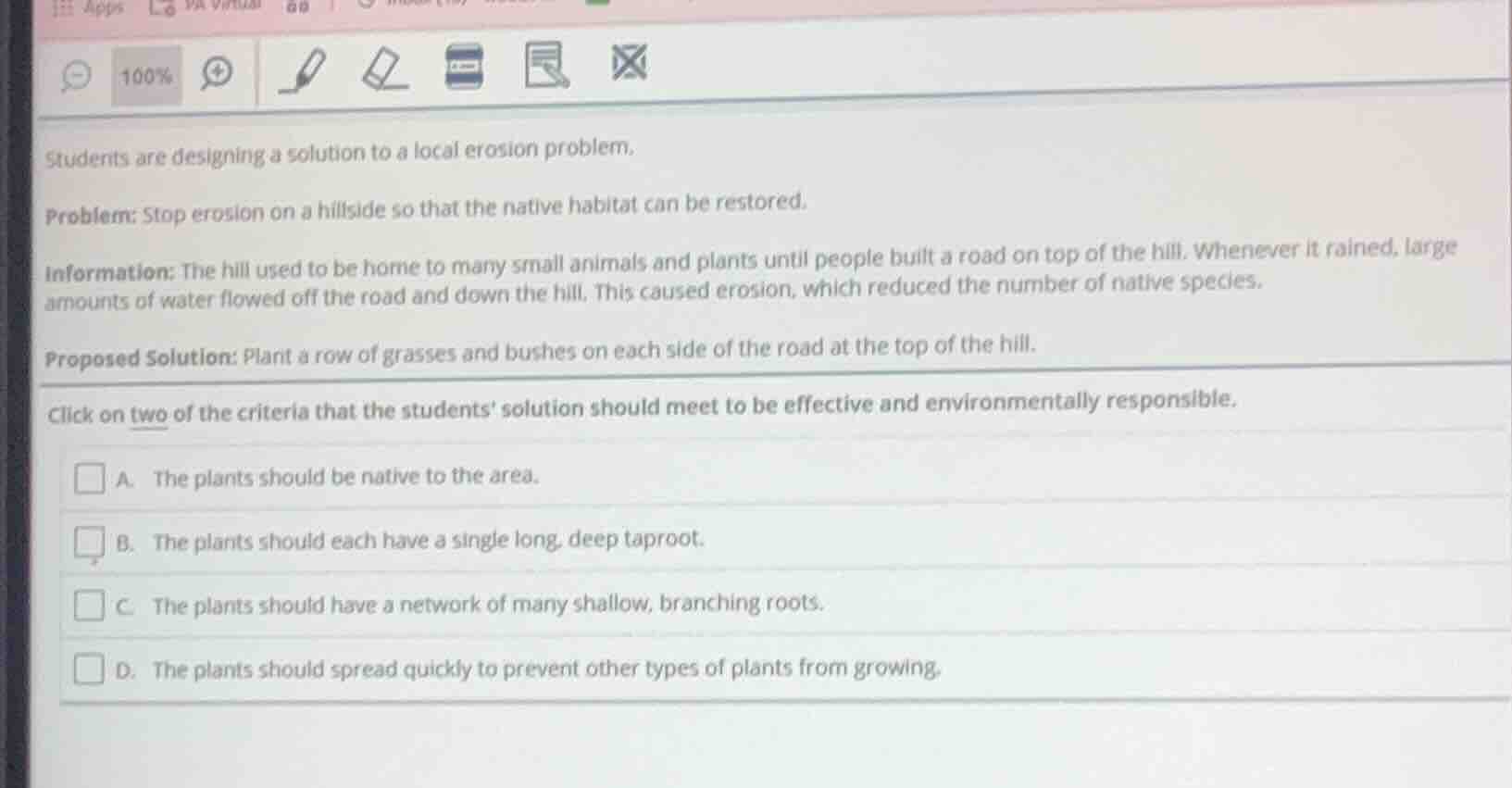
students are designing a solution to a local erosion problem.
problem: stop erosion on a hillside so that the native habitat can be restored.
information: the hill used to be home to many small animals and plants until people built a road on top of the hill. whenever it rained, large amounts of water flowed off the road and down the hill. this caused erosion, which reduced the number of native species.
proposed solution: plant a row of grasses and bushes on each side of the road at the top of the hill.
click on two of the criteria that the students solution should meet to be effective and environmentally responsible.
a. the plants should be native to the area.
b. the plants should each have a single long, deep taproot.
c. the plants should have a network of many shallow, branching roots.
d. the plants should spread quickly to prevent other types of plants from growing.
- Native plants are adapted to the local environment, so they will thrive without disrupting the existing native habitat, making them environmentally responsible.
- A network of shallow, branching roots effectively holds topsoil in place, which directly addresses the erosion problem by slowing and absorbing rainwater runoff.
- Single deep taproots (Option B) are less effective at holding surface soil against erosion, and plants that outcompete others (Option D) would harm the native habitat restoration goal.

Snap & solve any problem in the app
Get step-by-step solutions on Sovi AI
Photo-based solutions with guided steps
Explore more problems and detailed explanations
A. The plants should be native to the area.
C. The plants should have a network of many shallow, branching roots.