QUESTION IMAGE
Question
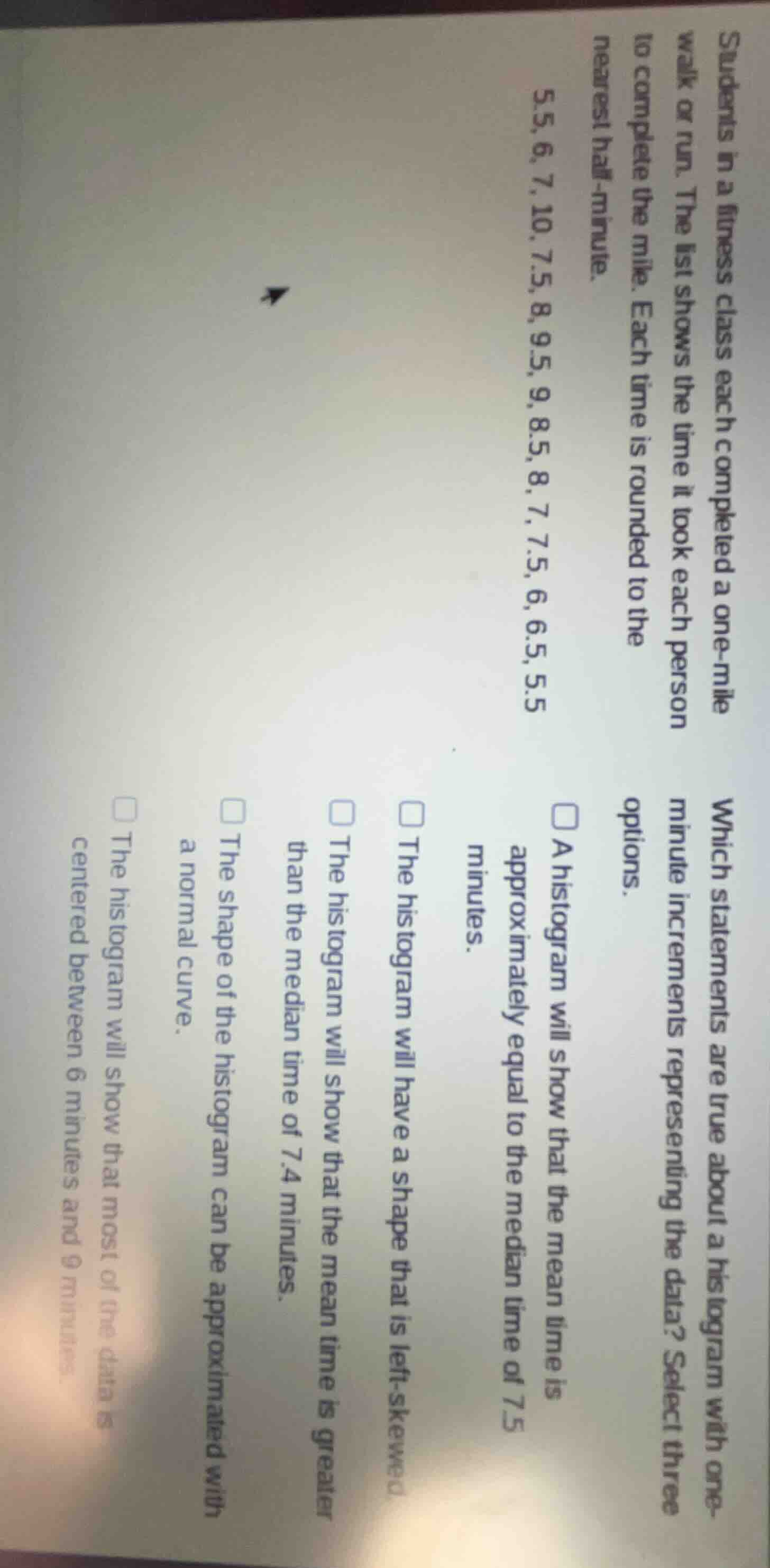
students in a fitness class each completed a one - mile walk or run. the list shows the time it took each person to complete the mile. each time is rounded to the nearest half - minute. 5.5, 6, 7, 10, 7.5, 8, 9.5, 9, 8.5, 8, 7, 7.5, 6, 6.5, 5.5 which statements are true about a histogram with one - minute increments representing the data? select three options. a histogram will show that the mean time is approximately equal to the median time of 7.5 minutes. the histogram will have a shape that is left - skewed. the histogram will show that the mean time is greater than the median time of 7.4 minutes. the shape of the histogram can be approximated with a normal curve. the histogram will show that most of the data is centered between 6 minutes and 9 minutes.
First, let's list out the data points: 5.5, 6, 7, 10, 7.5, 8, 9.5, 9, 8.5, 8, 7, 7.5, 6, 6.5, 5.5. Let's sort them: 5.5, 5.5, 6, 6, 6.5, 7, 7, 7.5, 7.5, 8, 8, 8.5, 9, 9.5, 10.
Step 1: Analyze the mean and median
- Median: There are 15 data points, so the median is the 8th value. The 8th value is 7.5.
- Mean: Let's calculate the sum.
- 5.5 + 5.5 = 11; 6 + 6 = 12; 6.5 = 6.5; 7 + 7 = 14; 7.5 + 7.5 = 15; 8 + 8 = 16; 8.5 = 8.5; 9 = 9; 9.5 = 9.5; 10 = 10.
- Sum = 11 + 12 + 6.5 + 14 + 15 + 16 + 8.5 + 9 + 9.5 + 10 = Let's add step by step: 11+12=23; 23+6.5=29.5; 29.5+14=43.5; 43.5+15=58.5; 58.5+16=74.5; 74.5+8.5=83; 83+9=92; 92+9.5=101.5; 101.5+10=111.5.
- Mean = 111.5 / 15 ≈ 7.43, which is approximately 7.4, close to 7.5. So the mean is approximately equal to the median (7.5) since 7.43 is close to 7.5. So the first statement "A histogram will show that the mean time is approximately equal to the median time of 7.5 minutes" is true.
Step 2: Analyze the shape (skewness)
- The data has a few larger values (9, 9.5, 10) but also smaller values (5.5, 5.5). Wait, when we sorted, the lower end: 5.5,5.5,6,6,6.5 (left side), middle:7,7,7.5,7.5, and right side:8,8,8.5,9,9.5,10. Wait, actually, the right tail has a few larger values (9,9.5,10) but the left tail is shorter? Wait, no. Wait, the number of data points: left of median (7.5): 7 values (5.5,5.5,6,6,6.5,7,7), right of median: 7 values (8,8,8.5,9,9.5,10,7.5? Wait no, sorted list: positions 1 - 15: 1:5.5, 2:5.5, 3:6, 4:6, 5:6.5, 6:7, 7:7, 8:7.5 (median), 9:7.5, 10:8, 11:8, 12:8.5, 13:9, 14:9.5, 15:10. So left of median (positions 1 - 7): 7 values, right of median (positions 9 - 15): 7 values (position 8 is median). Wait, the right side has values 7.5,8,8,8.5,9,9.5,10. The left side has 5.5,5.5,6,6,6.5,7,7. So the right tail is longer (has 10,9.5,9 which are further from the median than the left tail's 5.5,5.5,6). Wait, no, left tail: the smallest values are 5.5 (two times), 6 (two times), 6.5. Right tail: 8.5,9,9.5,10. So the right tail is longer, meaning the distribution is right - skewed? Wait, no, left - skewed is when the left tail is longer. Wait, maybe I made a mistake. Let's recall: left - skewed (negative skew) has a long left tail, right - skewed (positive skew) has a long right tail. In our data, the larger values (10,9.5,9) are further out on the right, so the distribution is right - skewed? Wait, but the option says "left - skewed". Wait, maybe I sorted wrong. Wait the original data: 5.5,6,7,10,7.5,8,9.5,9,8.5,8,7,7.5,6,6.5,5.5. Wait, 10 is an outlier on the right. So the mean is pulled up by 10, 9.5, 9. So mean (≈7.43) is less than median (7.5)? Wait no, 7.43 is less than 7.5? Wait 7.43 < 7.5. Wait, if mean < median, the distribution is left - skewed (because the mean is pulled down by low values, but wait no: left - skewed: mean < median, right - skewed: mean > median. Wait, let's check the formula. In left - skewed, the tail is on the left (low values), so mean is less than median. In right - skewed, tail on the right (high values), mean is greater than median. Wait our mean is ≈7.43, median is 7.5. So mean < median, so the distribution is left - skewed? Wait that contradicts the earlier thought. Wait let's take a simple example: if we have data 1,2,3,4,10. Median is 3, mean is (1+2+3+4+10)/5 = 20/5 = 4. So mean > median, right - skewed (tail on right). If data is 1,5,6,7,8. Median 6, mean (1+5+6+7+8)/5 = 27/5 = 5.4. Mean < median, left - skewed (tail on left). Ah, so in our case, mean (7.43) < median (7.5), so the distribution is left - skewed? Wait but our…

Snap & solve any problem in the app
Get step-by-step solutions on Sovi AI
Photo-based solutions with guided steps
Explore more problems and detailed explanations
- A histogram will show that the mean time is approximately equal to the median time of 7.5 minutes.
- The histogram will have a shape that is left - skewed.
- The histogram will show that most of the data is centered between 6 minutes and 9 minutes.