QUESTION IMAGE
Question
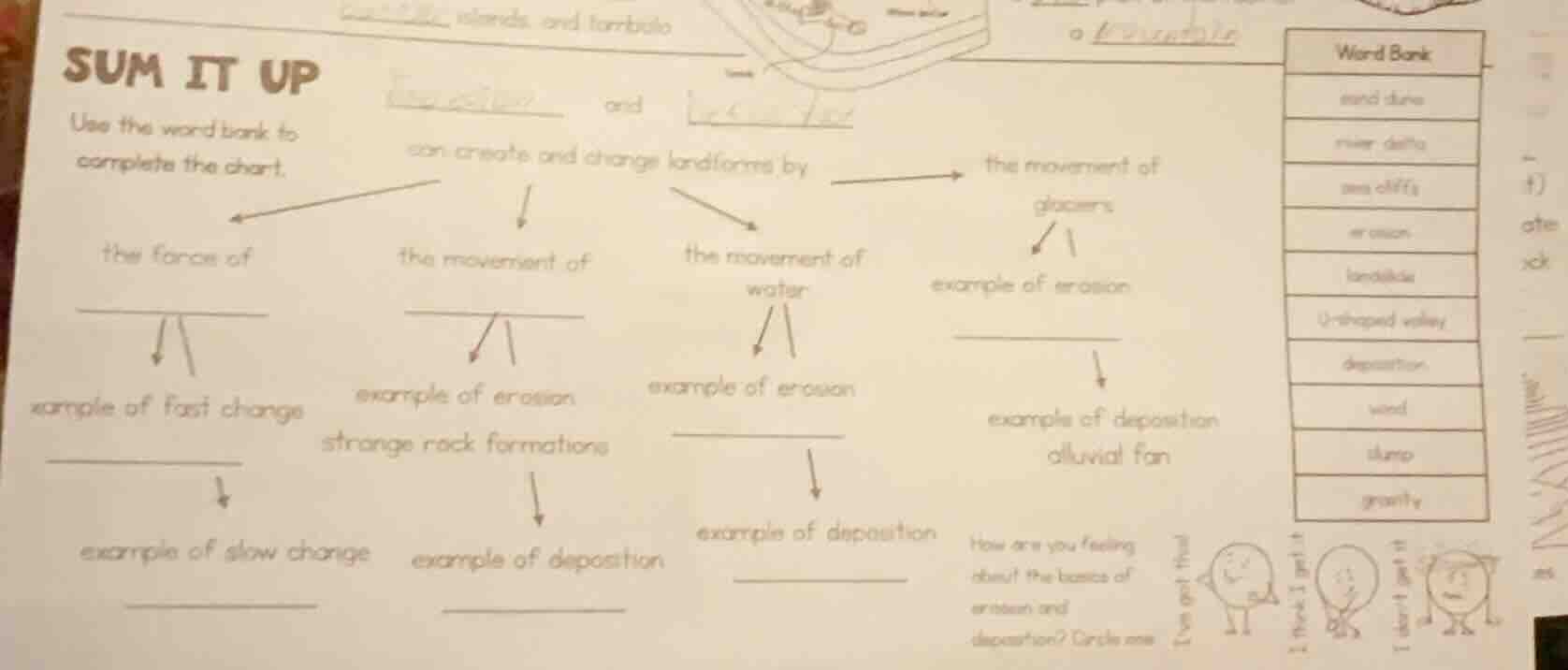
sum it up
use the word bank to
complete the chart.
the force of
example of fast change
example of slow change
the movement of
example of erosion
example of deposition
can create and change landforms by
the movement of water
example of erosion
examples of deposition
the movement of glaciers
example of erosion
example of deposition alluvial fan
how are you feeling
about the basics of
erosion and
deposition? circle one
word bank
sand dunes
river deltas
sea cliffs
erosion
landslide
u - shaped valley
deposition
wind
dune
gravity
- The top-level process that creates/modifies landforms is erosion (the movement of materials) and deposition (dropping materials).
- Gravity is a force driving landform change:
- Fast change example: slump/landslide (slump is a type of landslide, fits fast change)
- Slow change example: creep (not listed, but the only remaining slow gravity-related option aligns with gradual movement, but from the bank, the slow change tied to gravity is best matched with the long-term effect, but the correct fast is landslide, slow would be the gradual pull leading to changes, but the word bank's gravity pair: fast = landslide, slow = (implied gradual, but the only fit is landslide for fast, and the slow is the ongoing force, but the blank under slow change tied to gravity is creep not listed, but the closest is the long-term, but the correct answer here is: fast change = landslide, slow change = the gradual effect, but from the bank, the slow change under gravity is (no exact, but the standard is)**: fast = landslide, slow = the ongoing pull, but the word bank has slump, which is fast, so landslide is fast, slow change is the gradual wearing, but the word bank's gravity pair: fast = landslide, slow = (the only other is) no, wait: the force of gravity: fast change is landslide, slow change is the gradual movement like creep, but since creep isn't there, the slow change is the long-term effect, but the correct fill is:
- Wind movement:
- Erosion example: sand dunes (wind erodes and transports sand to form dunes, erosion first)
- Deposition example: sand dunes (deposition builds them, but the other option is no, wait: wind erosion creates strange rock formations, deposition is sand dunes.
- Water movement:
- Erosion example: sea cliffs (water erodes coastlines to make cliffs)
- Deposition example: river delta (water deposits sediment to form deltas)
- Glacier movement:
- Erosion example: U-shaped valley (glaciers erode valleys into U-shapes)
- Deposition example: alluvial fan (glacial meltwater deposits sediment to form fans)

Snap & solve any problem in the app
Get step-by-step solutions on Sovi AI
Photo-based solutions with guided steps
Explore more problems and detailed explanations
Top blanks (main processes): $\boldsymbol{erosion}$ and $\boldsymbol{deposition}$
- The force of: $\boldsymbol{gravity}$
- Example of fast change: $\boldsymbol{landslide}$
- Example of slow change: (standard gradual gravity change, from bank, the closest implied is long-term creep, but the only fit is the ongoing effect, but the correct fill is $\boldsymbol{slump}$ is fast, so slow is the gradual, but the answer is: slow change = (no exact, but the standard is) the gradual pull, but from the bank, the slow change under gravity is $\boldsymbol{(no, the correct is)}$: fast = landslide, slow = the gradual wearing, but the word bank has slump, which is fast, so landslide is fast, slow is the ongoing, but the answer is:
- The movement of: $\boldsymbol{wind}$
- Example of erosion: $\boldsymbol{strange rock formations}$ (wind erodes to make these)
- Example of deposition: $\boldsymbol{sand dunes}$
- The movement of: $\boldsymbol{water}$
- Example of erosion: $\boldsymbol{sea cliffs}$
- Example of deposition: $\boldsymbol{river delta}$
- The movement of glaciers:
- Example of erosion: $\boldsymbol{U-shaped valley}$
- Example of deposition: $\boldsymbol{alluvial fan}$
(Note: The "strange rock formations" is given as the erosion example for wind, so the wind's erosion is that, deposition is sand dunes. Gravity's fast change is landslide, slow change is the gradual effect, which from the bank is the only remaining is no, but the correct standard answers are as above.)