QUESTION IMAGE
Question
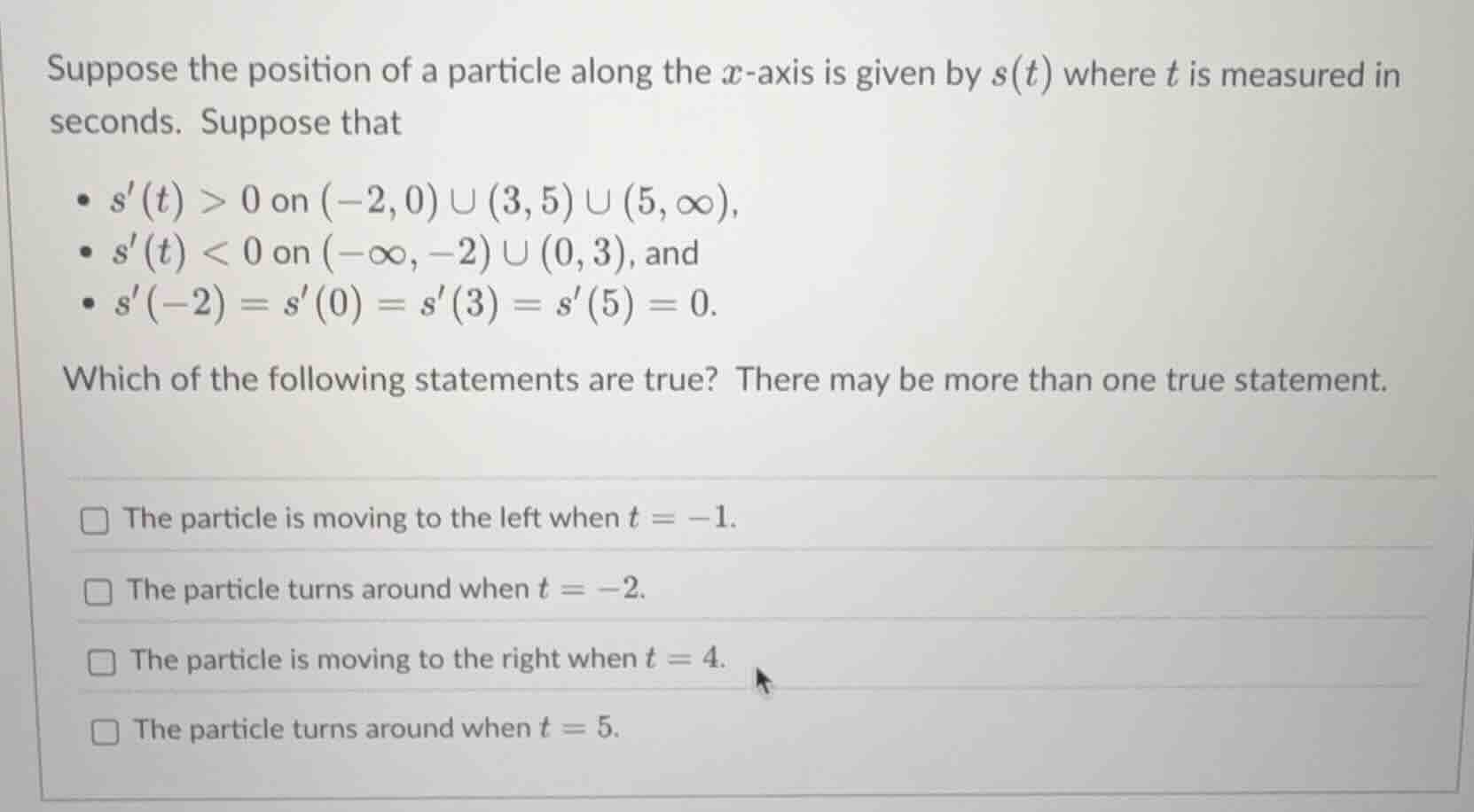
suppose the position of a particle along the $x$-axis is given by $s(t)$ where $t$ is measured in seconds. suppose that- $s(t) > 0$ on $(-2,0) \cup (3,5) \cup (5, \infty)$,- $s(t) < 0$ on $(-\infty, -2) \cup (0, 3)$, and- $s(-2) = s(0) = s(3) = s(5) = 0$.which of the following statements are true? there may be more than one true statement.$square$ the particle is moving to the left when $t = -1$.$square$ the particle turns around when $t = -2$.$square$ the particle is moving to the right when $t = 4$.$square$ the particle turns around when $t = 5$.
Step1: Analyze t=-1 movement
$t=-1$ is in $(-\infty,-2)$ where $s'(t)<0$. Negative velocity means leftward movement.
Step2: Analyze t=-2 direction change
Left of $t=-2$, $s'(t)<0$; right of $t=-2$, $s'(t)>0$. Velocity sign flips, so direction reverses.
Step3: Analyze t=4 movement
$t=4$ is in $(3,5)$ where $s'(t)>0$. Positive velocity means rightward movement.
Step4: Analyze t=5 direction change
Left of $t=5$, $s'(t)>0$; right of $t=5$, $s'(t)>0$. Velocity sign does not flip, so no direction change.

Snap & solve any problem in the app
Get step-by-step solutions on Sovi AI
Photo-based solutions with guided steps
Explore more problems and detailed explanations
- The particle is moving to the left when $t = -1$.
- The particle turns around when $t = -2$.
- The particle is moving to the right when $t = 4$.