QUESTION IMAGE
Question
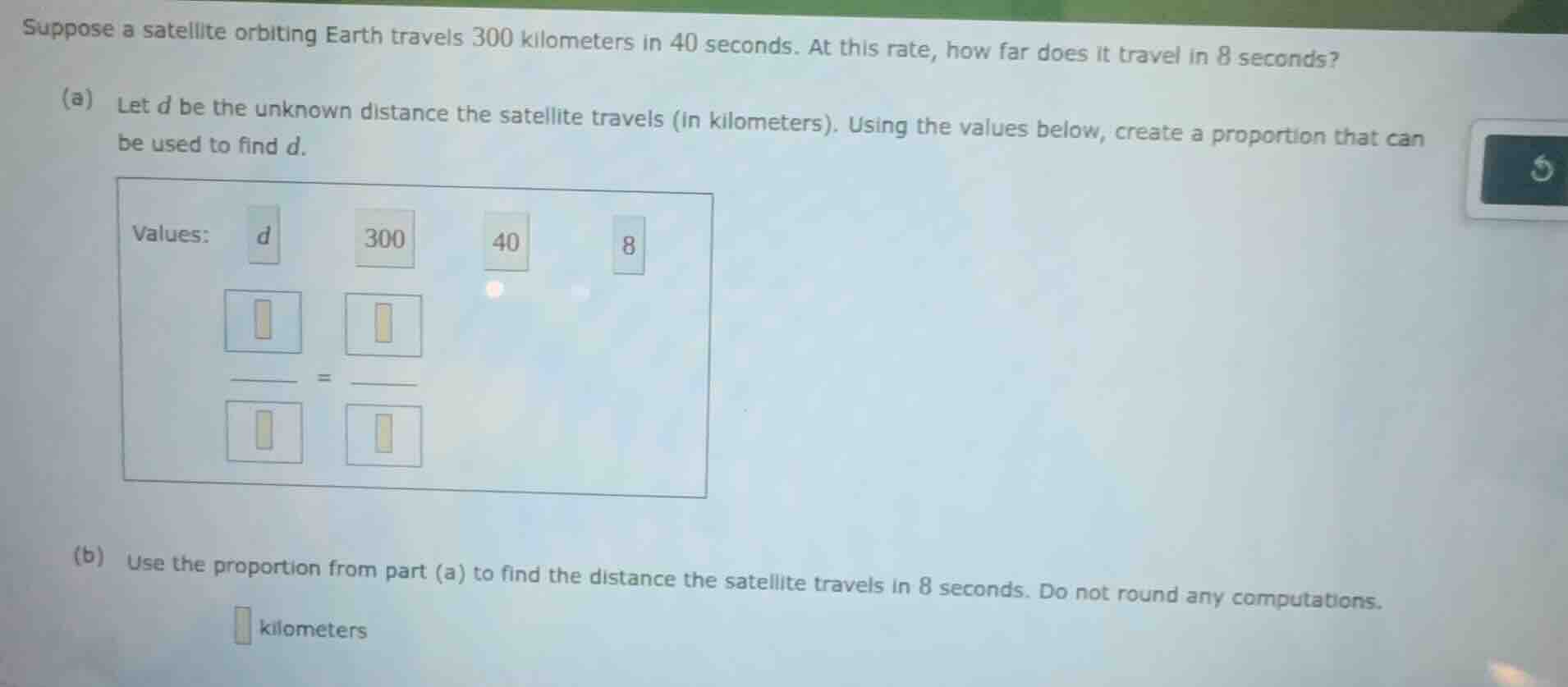
suppose a satellite orbiting earth travels 300 kilometers in 40 seconds. at this rate, how far does it travel in 8 seconds?
(a) let d be the unknown distance the satellite travels (in kilometers). using the values below, create a proportion that can be used to find d.
values: d, 300, 40, 8
(b) use the proportion from part (a) to find the distance the satellite travels in 8 seconds. do not round any computations.
□ kilometers
Part (a)
Step1: Identify the ratio
The satellite's speed is constant, so the ratio of distance to time should be equal. The distance for the first case is 300 km in 40 seconds, and for the second case, it's \( d \) km in 8 seconds.
Step2: Form the proportion
So the proportion is \(\frac{d}{8}=\frac{300}{40}\) (or also \(\frac{300}{40}=\frac{d}{8}\) is correct as well, but we'll use \(\frac{d}{8}=\frac{300}{40}\) for clarity here).
Part (b)
Step1: Cross - multiply the proportion
From \(\frac{d}{8}=\frac{300}{40}\), cross - multiplying gives us \(40\times d=300\times8\).
Step2: Solve for \(d\)
First, calculate \(300\times8 = 2400\). Then, divide both sides of the equation \(40d = 2400\) by 40. So \(d=\frac{2400}{40}\).
Step3: Simplify the division
\(\frac{2400}{40}=60\).
Part (a) Answer:
\(\boldsymbol{\frac{d}{8}=\frac{300}{40}}\) (or \(\boldsymbol{\frac{300}{40}=\frac{d}{8}}\))
Part (b) Answer:
\(\boldsymbol{60}\)

Snap & solve any problem in the app
Get step-by-step solutions on Sovi AI
Photo-based solutions with guided steps
Explore more problems and detailed explanations
Step1: Cross - multiply the proportion
From \(\frac{d}{8}=\frac{300}{40}\), cross - multiplying gives us \(40\times d=300\times8\).
Step2: Solve for \(d\)
First, calculate \(300\times8 = 2400\). Then, divide both sides of the equation \(40d = 2400\) by 40. So \(d=\frac{2400}{40}\).
Step3: Simplify the division
\(\frac{2400}{40}=60\).
Part (a) Answer:
\(\boldsymbol{\frac{d}{8}=\frac{300}{40}}\) (or \(\boldsymbol{\frac{300}{40}=\frac{d}{8}}\))
Part (b) Answer:
\(\boldsymbol{60}\)