QUESTION IMAGE
Question
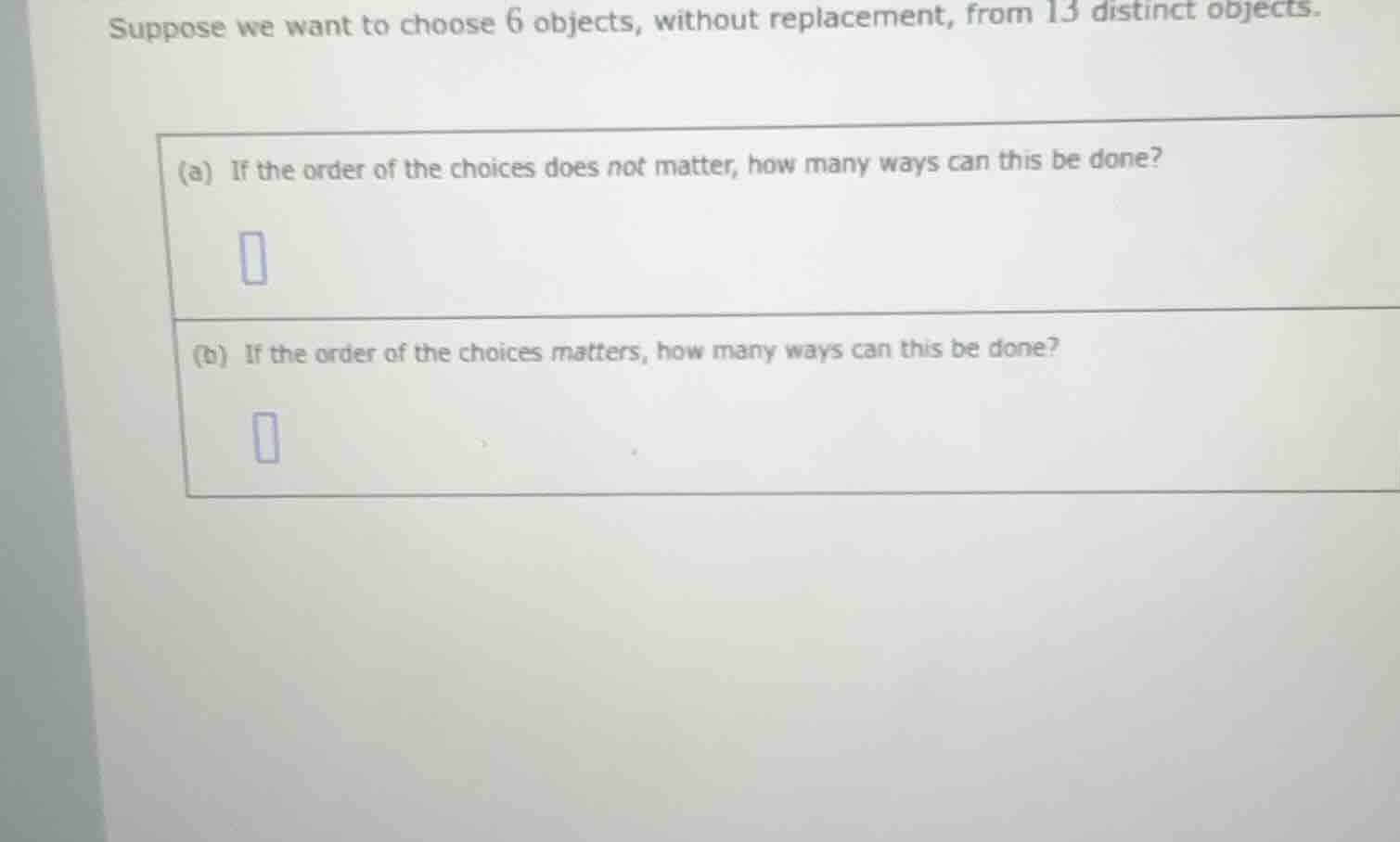
suppose we want to choose 6 objects, without replacement, from 13 distinct objects.
(a) if the order of the choices does not matter, how many ways can this be done?
(b) if the order of the choices matters, how many ways can this be done?
Part (a)
Step1: Identify the formula for combinations
When the order does not matter, we use the combination formula \( C(n, k)=\frac{n!}{k!(n - k)!} \), where \( n = 13 \) (total objects) and \( k=6 \) (objects to choose).
Step2: Substitute values into the formula
Substitute \( n = 13 \) and \( k = 6 \) into the combination formula:
\[
\]
Step1: Identify the formula for permutations
When the order matters, we use the permutation formula \( P(n,k)=\frac{n!}{(n - k)!} \), where \( n = 13 \) and \( k = 6 \).
Step2: Substitute values into the formula
Substitute \( n=13 \) and \( k = 6 \) into the permutation formula:
\[
\]

Snap & solve any problem in the app
Get step-by-step solutions on Sovi AI
Photo-based solutions with guided steps
Explore more problems and detailed explanations
1716