QUESTION IMAGE
Question
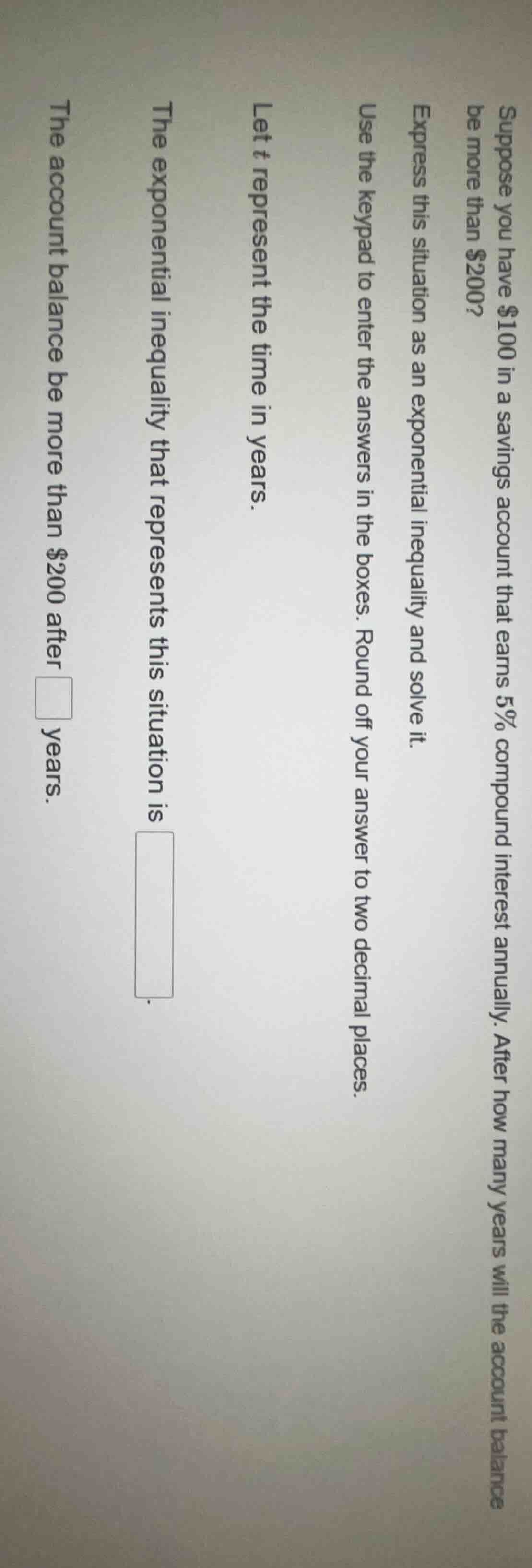
suppose you have $100 in a savings account that earns 5% compound interest annually. after how many years will the account balance be more than $200? express this situation as an exponential inequality and solve it. use the keypad to enter the answers in the boxes. round off your answer to two decimal places. let t represent the time in years. the exponential inequality that represents this situation is. the account balance be more than $200 after years.
Step1: Write compound interest inequality
The formula for annual compound interest is $A = P(1+r)^t$, where $P=100$, $r=0.05$, and $A>200$.
$100(1+0.05)^t > 200$
Step2: Simplify the inequality
Divide both sides by 100.
$(1.05)^t > 2$
Step3: Solve for t using logarithms
Take natural log of both sides, use $\ln(a^b)=b\ln(a)$.
$t > \frac{\ln(2)}{\ln(1.05)}$
Step4: Calculate the value
Compute the logarithmic ratio and round to 2 decimals.
$t > \frac{0.6931}{0.0488} \approx 14.21$

Snap & solve any problem in the app
Get step-by-step solutions on Sovi AI
Photo-based solutions with guided steps
Explore more problems and detailed explanations
The exponential inequality that represents this situation is $100(1.05)^t > 200$.
The account balance be more than $\$200$ after 14.21 years.