QUESTION IMAGE
Question
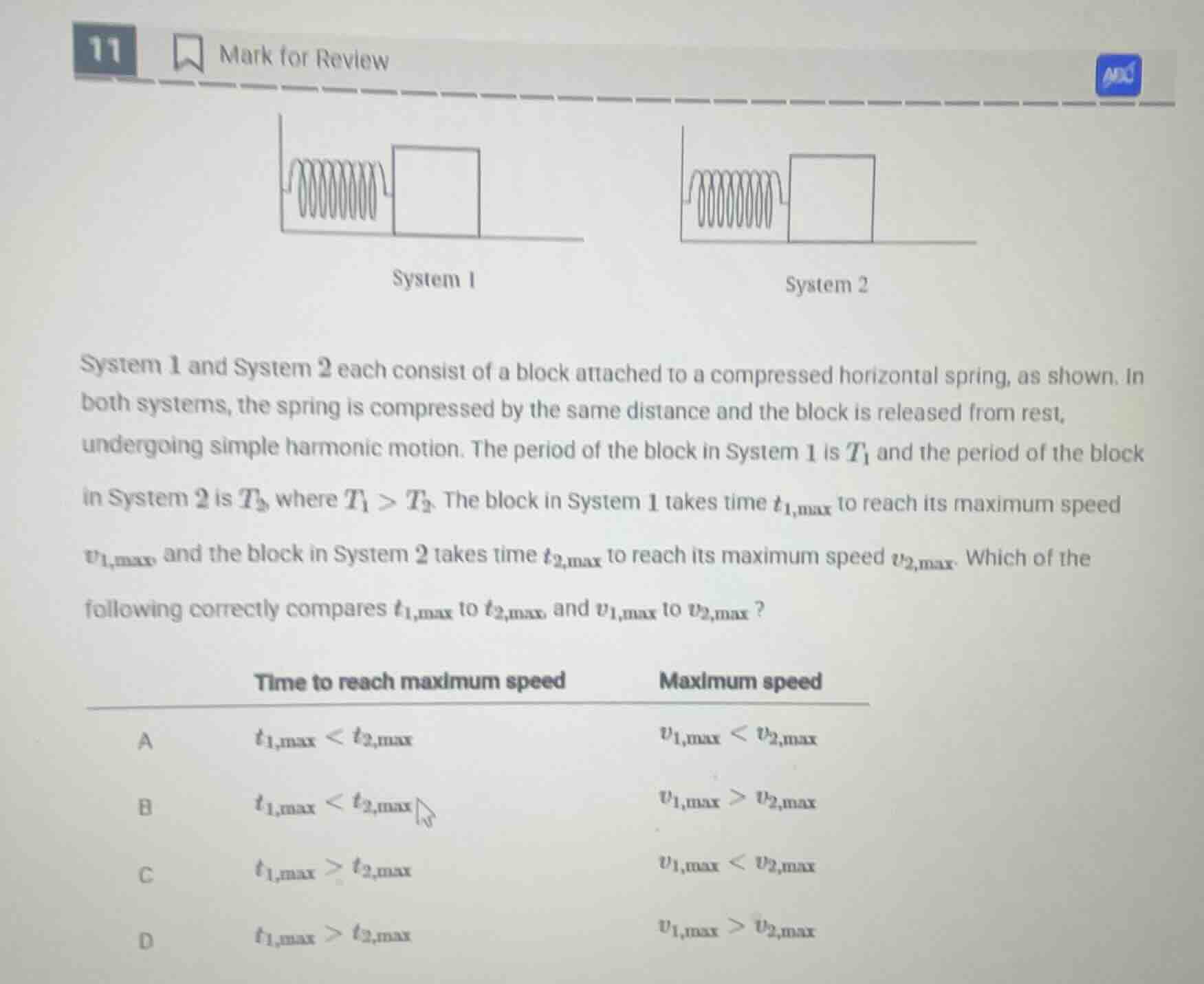
system 1 and system 2 each consist of a block attached to a compressed horizontal spring, as shown. in both systems, the spring is compressed by the same distance and the block is released from rest, undergoing simple harmonic motion. the period of the block in system 1 is ( t_1 ) and the period of the block in system 2 is ( t_2 ) where ( t_1 > t_2 ). the block in system 1 takes time ( t_{1,\text{max}} ) to reach its maximum speed ( v_{1,\text{max}} ), and the block in system 2 takes time ( t_{2,\text{max}} ) to reach its maximum speed ( v_{2,\text{max}} ). which of the following correctly compares ( t_{1,\text{max}} ) to ( t_{2,\text{max}} ) and ( v_{1,\text{max}} ) to ( v_{2,\text{max}} )?
| time to reach maximum speed | maximum speed | |
|---|---|---|
| b | ( t_{1,\text{max}} < t_{2,\text{max}} ) | ( v_{1,\text{max}} > v_{2,\text{max}} ) |
| c | ( t_{1,\text{max}} > t_{2,\text{max}} ) | ( v_{1,\text{max}} < v_{2,\text{max}} ) |
| d | ( t_{1,\text{max}} > t_{2,\text{max}} ) | ( v_{1,\text{max}} > v_{2,\text{max}} ) |
- Time to Maximum Speed: In simple harmonic motion (SHM) of a spring - block system, the time to reach maximum speed (from rest at maximum displacement) is a quarter of the period (\(t_{\text{max}}=\frac{T}{4}\)). Given \(T_1 > T_2\), then \(t_{1,\text{max}}=\frac{T_1}{4}\) and \(t_{2,\text{max}}=\frac{T_2}{4}\). So, \(t_{1,\text{max}}>t_{2,\text{max}}\).
- Maximum Speed: The maximum speed in SHM of a spring - block system is given by \(v_{\text{max}} = A\omega\), where \(\omega=\frac{2\pi}{T}\) and the elastic potential energy at maximum displacement is converted to kinetic energy at equilibrium (\(\frac{1}{2}kA^{2}=\frac{1}{2}mv_{\text{max}}^{2}\)), so \(v_{\text{max}}=A\sqrt{\frac{k}{m}}\). Also, \(\omega=\sqrt{\frac{k}{m}}\), so \(v_{\text{max}} = A\omega\). Since the springs are compressed by the same distance, the amplitude \(A\) is the same. The period \(T = 2\pi\sqrt{\frac{m}{k}}\), so \(T\) is related to the mass - spring constant ratio. A larger period (\(T_1>T_2\)) implies a larger \(\sqrt{\frac{m}{k}}\) (since \(T\propto\sqrt{\frac{m}{k}}\)). But from \(v_{\text{max}}=A\sqrt{\frac{k}{m}}\), a larger \(\sqrt{\frac{m}{k}}\) means a smaller \(\sqrt{\frac{k}{m}}\), so \(v_{1,\text{max}}

Snap & solve any problem in the app
Get step-by-step solutions on Sovi AI
Photo-based solutions with guided steps
Explore more problems and detailed explanations
C. \(t_{1,\text{max}} > t_{2,\text{max}}\), \(v_{1,\text{max}} < v_{2,\text{max}}\)