QUESTION IMAGE
Question
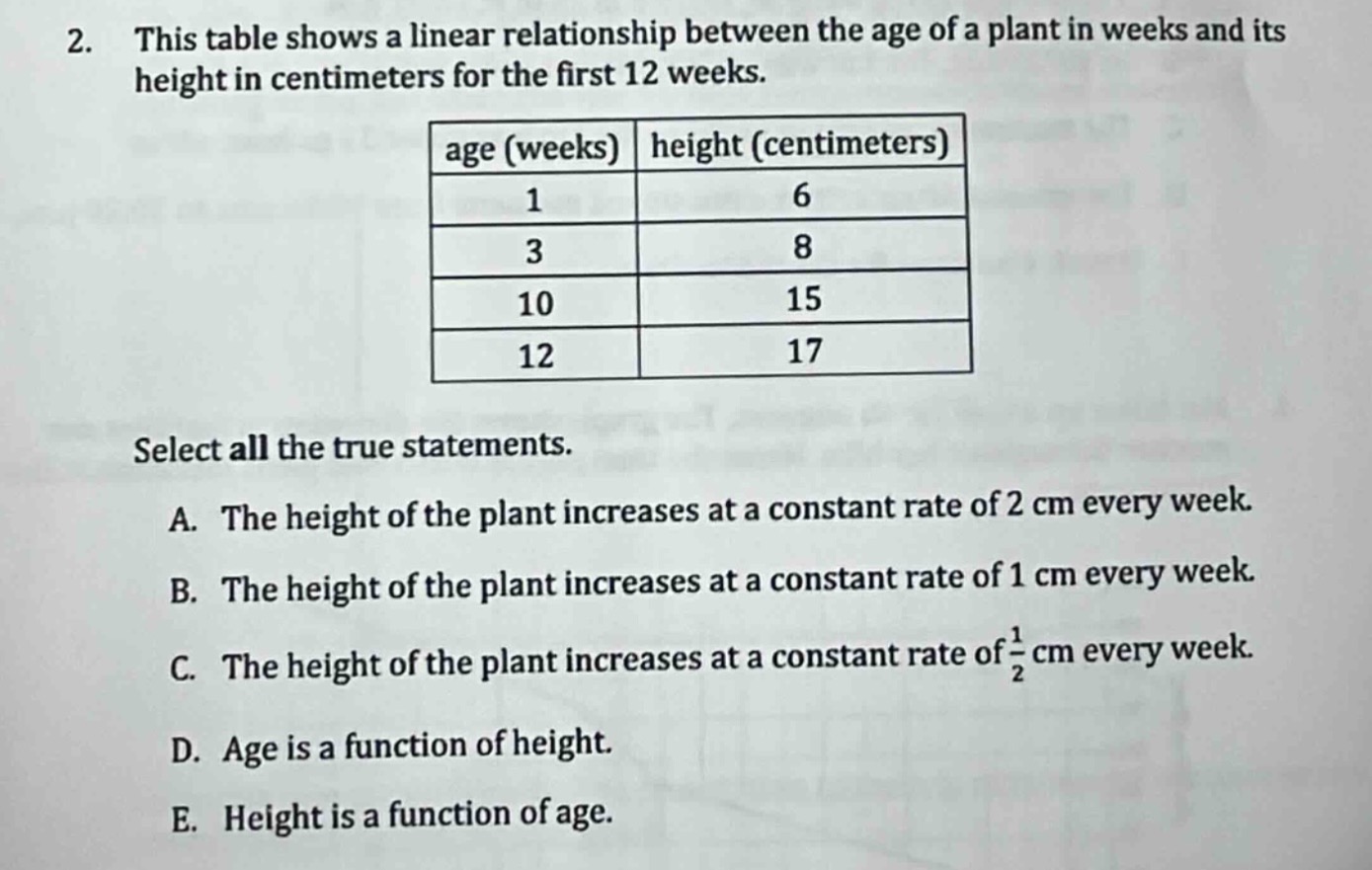
- this table shows a linear relationship between the age of a plant in weeks and its height in centimeters for the first 12 weeks.
| age (weeks) | height (centimeters) |
|---|---|
| 3 | 8 |
| 10 | 15 |
| 12 | 17 |
select all the true statements.
a. the height of the plant increases at a constant rate of 2 cm every week.
b. the height of the plant increases at a constant rate of 1 cm every week.
c. the height of the plant increases at a constant rate of \\(\frac{1}{2}\\) cm every week.
d. age is a function of height.
e. height is a function of age.
Step1: Calculate the rate of change between two points
To find the rate of change (slope) of height with respect to age, we use the formula for slope \( m=\frac{y_2 - y_1}{x_2 - x_1} \). Let's take the first two points \((1,6)\) and \((3,8)\). Here, \(x_1 = 1,y_1 = 6,x_2=3,y_2 = 8\).
\(m=\frac{8 - 6}{3 - 1}=\frac{2}{2}=1\)? Wait, no, wait. Wait, let's check another pair. Take \((3,8)\) and \((10,15)\). \(x_1 = 3,y_1 = 8,x_2 = 10,y_2=15\). \(m=\frac{15 - 8}{10 - 3}=\frac{7}{7}=1\). Wait, no, wait, \((10,15)\) and \((12,17)\): \(m=\frac{17 - 15}{12 - 10}=\frac{2}{2}=1\). Wait, no, wait, first pair \((1,6)\) and \((3,8)\): \(m=\frac{8 - 6}{3 - 1}=\frac{2}{2}=1\). Wait, but let's check the difference in age and height. From week 1 to week 3 (2 weeks difference), height goes from 6 to 8 (2 cm difference). So rate is \(\frac{2}{2}=1\) cm per week? Wait, no, wait, 2 cm over 2 weeks is 1 cm per week. Wait, let's re - calculate.
Wait, the formula for the rate of change (slope) when dealing with linear relationships (height as a function of age) is \( \text{rate}=\frac{\text{change in height}}{\text{change in age}} \).
For the points \((1,6)\) and \((3,8)\):
Change in height \(=8 - 6 = 2\) cm.
Change in age \(=3 - 1 = 2\) weeks.
Rate \(=\frac{2}{2}=1\) cm per week.
For the points \((3,8)\) and \((10,15)\):
Change in height \(=15 - 8 = 7\) cm.
Change in age \(=10 - 3 = 7\) weeks.
Rate \(=\frac{7}{7}=1\) cm per week.
For the points \((10,15)\) and \((12,17)\):
Change in height \(=17 - 15 = 2\) cm.
Change in age \(=12 - 10 = 2\) weeks.
Rate \(=\frac{2}{2}=1\) cm per week.
So the rate of increase of height with respect to age is 1 cm per week. So option B is correct, A and C are incorrect.
Step2: Determine if age is a function of height or height is a function of age
A relation is a function if for each input, there is exactly one output.
- For "Height is a function of age": For each age (input), there is exactly one height (output). Since it's a linear relationship (given), each age (x - value) has one height (y - value), so height is a function of age (E is correct).
- For "Age is a function of height": Let's see, if height is 6, age is 1. If height is 8, age is 3. If height is 15, age is 10. If height is 17, age is 12. But suppose we have a height value, say, can we have two different ages for the same height? In a linear relationship \(y=mx + b\) (height \(y\), age \(x\)), if we solve for \(x\) in terms of \(y\), \(x=\frac{y - b}{m}\). Since it's a linear function with non - zero slope, it is also a function (because for each \(y\), there is exactly one \(x\)). Wait, but let's check the data. For the given data, each height corresponds to one age. But is this always true? In a linear relationship \(y=x + 5\) (let's find the equation: using point \((1,6)\), \(y=mx + b\), \(6=m(1)+b\), and we found \(m = 1\), so \(b=5\), so \(y=x + 5\) (height \(y\), age \(x\)). Solving for \(x\), \(x=y - 5\). So for each \(y\), there is one \(x\). So age is a function of height (D is correct)? Wait, but wait, let's think again. In a function, for each input, there is exactly one output. If we consider age as a function of height, the input is height (y) and output is age (x). Since the relationship is linear with non - zero slope, it is a function. But wait, let's check the rate again.
Wait, earlier calculation: between \((1,6)\) and \((3,8)\): change in height 2, change in age 2, rate 1. Between \((3,8)\) and \((10,15)\): change in height 7, change in age 7, rate 1. Between \((10,15)\) and \((12,17)\): change in height 2, change in age 2, rate 1…

Snap & solve any problem in the app
Get step-by-step solutions on Sovi AI
Photo-based solutions with guided steps
Explore more problems and detailed explanations
B. The height of the plant increases at a constant rate of 1 cm every week.
D. Age is a function of height.
E. Height is a function of age.