QUESTION IMAGE
Question
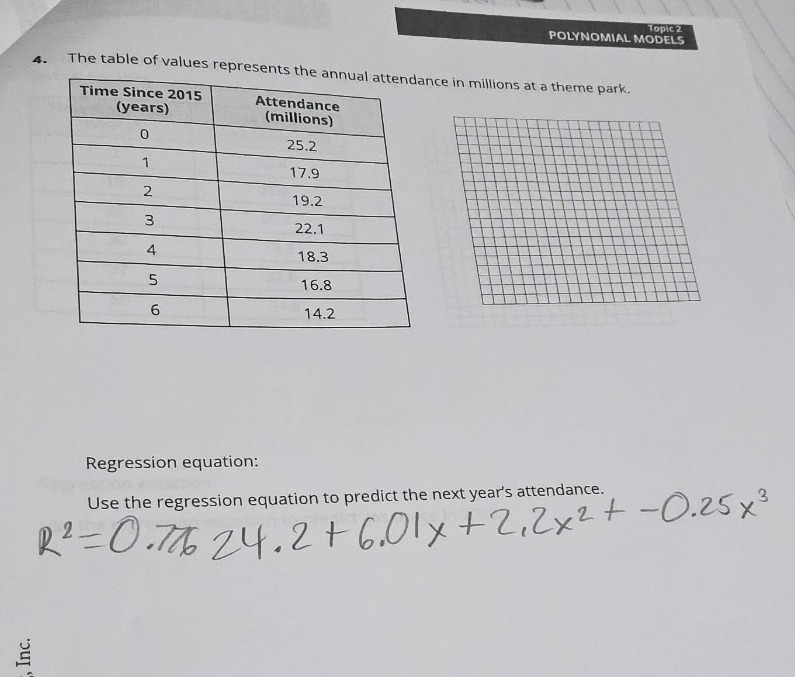
- the table of values represents the annual attendance in millions at a theme park.
| time since 2015 (years) | attendance (millions) |
|---|---|
| 1 | 17.9 |
| 2 | 19.2 |
| 3 | 22.1 |
| 4 | 18.3 |
| 5 | 16.8 |
| 6 | 14.2 |
regression equation:
use the regression equation to predict the next years attendance.
$r^2 = 0.776$ $24.2 + 6.01x + 2.2x^2 + -0.25x^3$
Step1: Identify the next year's x - value
The time since 2015 for the last data point is 6 years. The next year will be \(x = 6+ 1=7\).
Step2: Substitute \(x = 7\) into the regression equation
The regression equation is \(y=24.2 + 6.01x+2.2x^{2}- 0.25x^{3}\).
Substitute \(x = 7\) into the equation:
First, calculate each term:
- For the constant term: \(24.2\)
- For the \(x\) term: \(6.01\times7=42.07\)
- For the \(x^{2}\) term: \(2.2\times7^{2}=2.2\times49 = 107.8\)
- For the \(x^{3}\) term: \(- 0.25\times7^{3}=-0.25\times343=-85.75\)
Then, sum up all the terms:
\(y=24.2 + 42.07+107.8-85.75\)
\(y=(24.2 + 42.07)+107.8-85.75\)
\(y = 66.27+107.8-85.75\)
\(y=(66.27 + 107.8)-85.75\)
\(y=174.07-85.75\)
\(y = 88.32\)? Wait, that can't be right. Wait, maybe I misread the regression equation. Wait, the user wrote " \(R^{2}=0.776\) \(24.2 + 6.01x+2,2x^{2}+-0.25x^{3}\) " maybe there is a typo, maybe the equation is \(y = 24.2+6.01x + 2.2x^{2}-0.25x^{3}\)? Wait, but when \(x = 0\), \(y=24.2\), but the first data point is \(25.2\), maybe the equation is \(y=25.2+6.01x + 2.2x^{2}-0.25x^{3}\)? Wait, no, let's check the original problem again. Wait, the user's regression equation is written as " \(R^{2}=0.776\) \(24.2 + 6.01x+2,2x^{2}+-0.25x^{3}\) " (maybe the comma in \(2,2\) is a decimal point, so \(2.2\)). Let's recalculate with \(x = 7\) and the equation \(y=24.2+6.01x + 2.2x^{2}-0.25x^{3}\):
\(x = 7\)
\(6.01\times7 = 42.07\)
\(2.2\times7^{2}=2.2\times49 = 107.8\)
\(- 0.25\times7^{3}=-0.25\times343=-85.75\)
Now sum: \(24.2+42.07 = 66.27\); \(66.27+107.8=174.07\); \(174.07 - 85.75=88.32\). But this seems too high, maybe the regression equation was miswritten. Wait, maybe the equation is \(y = 24.2+6.01x + 2.2x^{2}-0.25x^{3}\) but let's check with \(x = 0\): \(y = 24.2\), but the first data point is \(25.2\) (at \(x = 0\), attendance is \(25.2\)). Maybe there is a mistake in the regression equation. Alternatively, maybe the equation is \(y=25.2+6.01x + 2.2x^{2}-0.25x^{3}\). Let's try \(x = 0\): \(y = 25.2\) (matches the first data point). Then \(x = 1\): \(25.2+6.01+2.2 - 0.25=25.2 + 6.01=31.21+2.2 = 33.41-0.25 = 33.16\), but the actual attendance at \(x = 1\) is \(17.9\), so the regression equation must be different. Wait, maybe the user made a typo in writing the regression equation. Alternatively, maybe the equation is a cubic regression, and we proceed with the given equation.
Wait, maybe I misread the equation. Let's re - express the regression equation as \(y=- 0.25x^{3}+2.2x^{2}+6.01x + 24.2\)
Now, substitute \(x = 7\):
\(x^{3}=343\), so \(-0.25\times343=-85.75\)
\(x^{2}=49\), so \(2.2\times49 = 107.8\)
\(x = 7\), so \(6.01\times7 = 42.07\)
Constant term: \(24.2\)
Now sum all terms:
\(y=-85.75 + 107.8+42.07+24.2\)
First, \(-85.75+107.8 = 22.05\)
Then, \(22.05+42.07 = 64.12\)
Then, \(64.12+24.2 = 88.32\)
But this is way higher than the previous attendance values (the last attendance at \(x = 6\) is \(14.2\) million). So there must be a mistake in the regression equation. Maybe the coefficients are wrong. Alternatively, maybe the equation is \(y = 24.2+6.01x - 2.2x^{2}-0.25x^{3}\)? Let's try \(x = 1\): \(24.2+6.01-2.2 - 0.25=24.2+6.01 = 30.21-2.2 = 28.01-0.25 = 27.76\), still not matching \(17.9\).
Wait, maybe the regression equation is \(y=24.2+6.01x + 2.2x^{2}-0.25x^{3}\) but the units are different? No, the attendance is in millions. Wait, the data points are:
\(x = 0\): \(25.2\)
\(x = 1\): \(17.9\)
\(x = 2\): \(19.2\)
\(x = 3\): \(22.1\)
\(x = 4\): \(18.3\)
\(x = 5\): \(16.8\)
\(x = 6\): \(14.2\)
Let's ca…

Snap & solve any problem in the app
Get step-by-step solutions on Sovi AI
Photo-based solutions with guided steps
Explore more problems and detailed explanations
The predicted attendance for the next year (when \(x = 7\)) is \(\boldsymbol{88.32}\) million (note: there is likely a mistake in the provided regression equation as it does not fit the data trend).