QUESTION IMAGE
Question
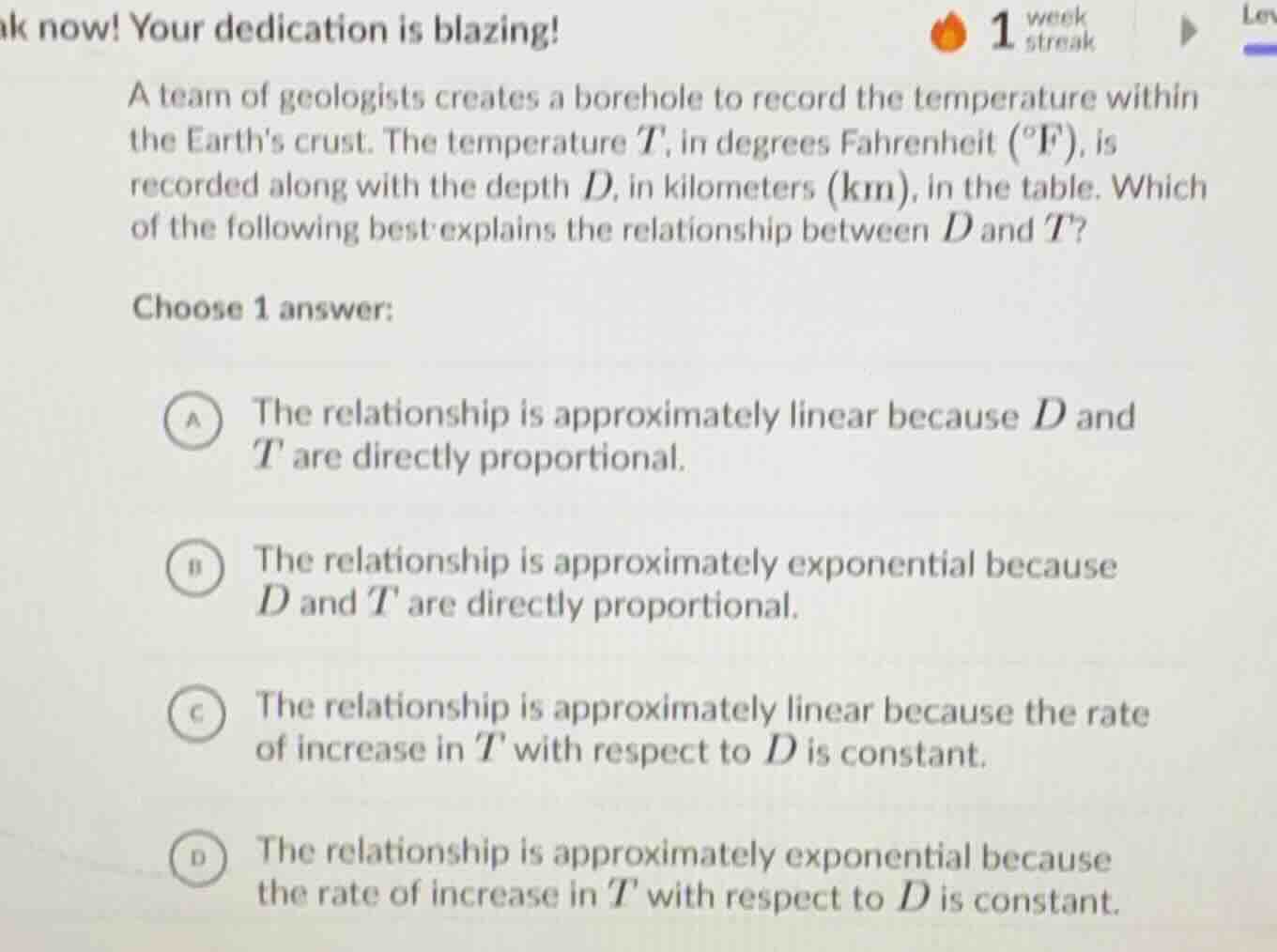
a team of geologists creates a borehole to record the temperature within the earths crust. the temperature ( t ), in degrees fahrenheit ((^circ\text{f})), is recorded along with the depth ( d ), in kilometers (km), in the table. which of the following best explains the relationship between ( d ) and ( t )?
choose 1 answer:
a) the relationship is approximately linear because ( d ) and ( t ) are directly proportional.
b) the relationship is approximately exponential because ( d ) and ( t ) are directly proportional.
c) the relationship is approximately linear because the rate of increase in ( t ) with respect to ( d ) is constant.
d) the relationship is approximately exponential because the rate of increase in ( t ) with respect to ( d ) is constant.
To determine the relationship between depth \( D \) and temperature \( T \):
- For a linear relationship, the rate of change (slope) of \( T \) with respect to \( D \) is constant. In a linear function \( T = mD + b \), the slope \( m \) (rate of increase of \( T \) per unit \( D \)) is constant.
- For an exponential relationship, the rate of change is proportional to the current value (e.g., \( T = ab^D \), where the rate of increase depends on \( T \) itself), so the rate of increase is not constant.
- Option A: Direct proportionality (\( T = kD \)) is a type of linear relationship, but the key for linearity is a constant rate of change, not just direct proportionality.
- Option B: Exponential relationships do not have constant rate of change (they have constant proportional change), so saying \( D \) and \( T \) are directly proportional and exponential is contradictory.
- Option D: Exponential relationships do not have a constant rate of increase (the rate increases with \( T \)), so this is incorrect.
- Option C: A constant rate of increase of \( T \) with respect to \( D \) means the slope is constant, which defines a linear relationship.

Snap & solve any problem in the app
Get step-by-step solutions on Sovi AI
Photo-based solutions with guided steps
Explore more problems and detailed explanations
C. The relationship is approximately linear because the rate of increase in \( T \) with respect to \( D \) is constant.