QUESTION IMAGE
Question
temperature and energy
as discussed in a prior lesson, we know because of the ideal gas model that the average kinetic energy of gasses is related to the pressure and volume of gasses. therefore, we can conclude that temperature is also related to pressure and volume. the higher the temperature, the greater average kinetic energy of the particles.
two containers, one smaller and one larger, hold identical gases. the average kinetic energy per particle is the same for both gases. how would the temperatures of the gases in the two containers compare? how would the thermal energies compare?
absolute zero
the theoretical temperature at which the individual particles of matter that make up a substance have zero kinetic energy is called absolute zero. it is the lowest possible temperature, the zero point on the kelvin scale. physicists have constructed devices to cool samples to 50 microkelvins. that’s only 0000050 k above absolute zero.
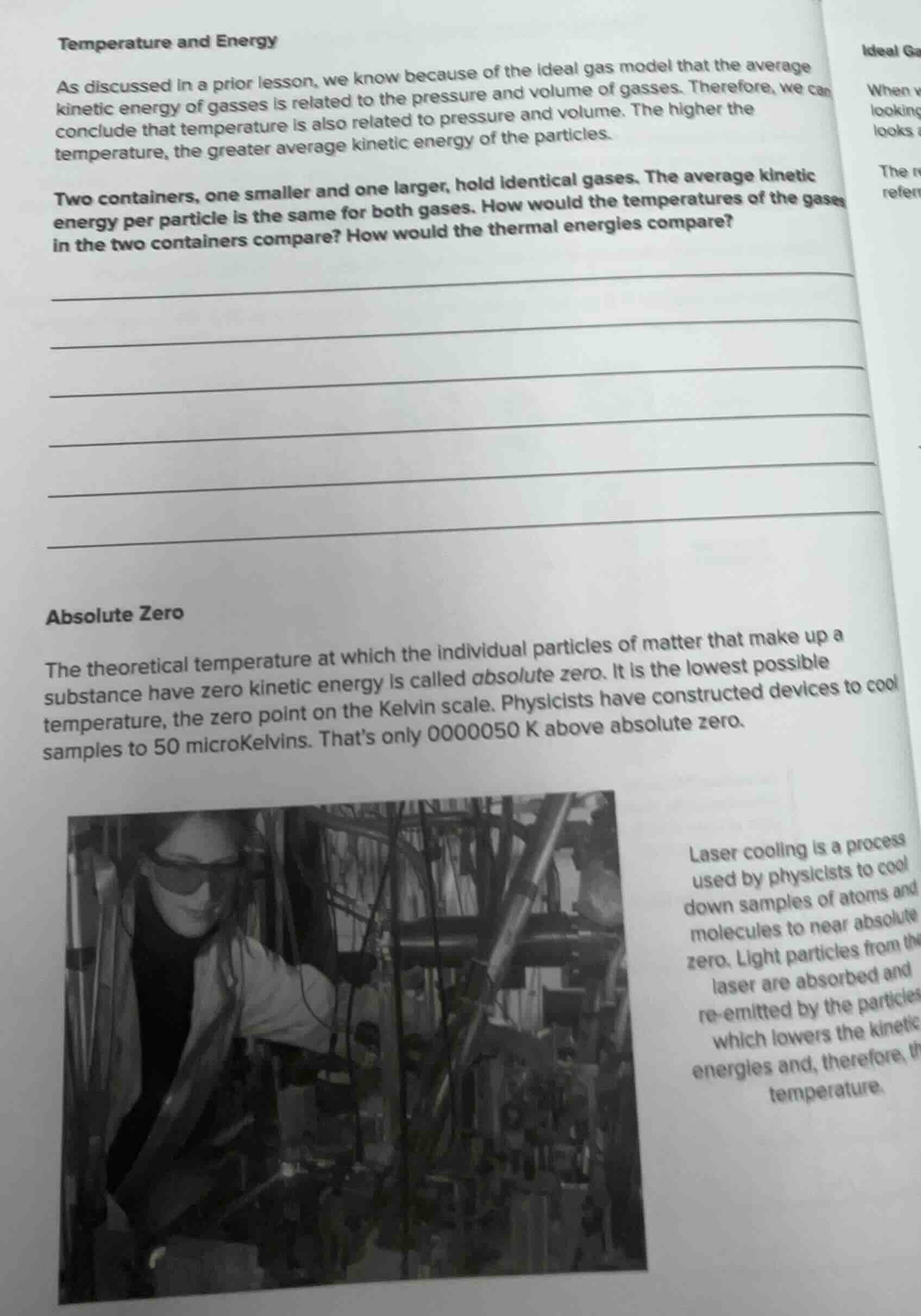
laser cooling is a process used by physicists to cool down samples of atoms and molecules to near absolute zero. light particles from the laser are absorbed and re - emitted by the particles which lowers the kinetic energies and, therefore, the temperature.
- For temperature comparison: The average kinetic energy per particle of a gas is directly related to its temperature (from the ideal gas model and kinetic theory of gases). Since the average kinetic energy per particle is the same for both gases, their temperatures must be equal.
- For thermal energy comparison: Thermal energy (or internal energy for a gas) depends on the number of particles (amount of substance) and the average kinetic energy per particle. The larger container can hold more gas particles (since it's larger and the gases are identical, implying same density or pressure - volume considerations, but more volume with same gas means more moles/particles). Since average kinetic energy per particle is the same, the gas in the larger container has more total thermal energy (as thermal energy is total kinetic energy of all particles, so more particles mean more total energy).

Snap & solve any problem in the app
Get step-by-step solutions on Sovi AI
Photo-based solutions with guided steps
Explore more problems and detailed explanations
- Temperature comparison: The temperatures of the gases in the two containers are equal. This is because the average kinetic energy per particle is directly proportional to the temperature (from kinetic theory of gases), and the average kinetic energy per particle is the same for both gases.
- Thermal energy comparison: The gas in the larger container has greater thermal energy. Thermal energy depends on the total number of particles (and average kinetic energy per particle). The larger container can hold more gas particles (due to its larger volume, for identical gases), so with the same average kinetic energy per particle, the total thermal energy (sum of kinetic energies of all particles) is greater in the larger container.