QUESTION IMAGE
Question
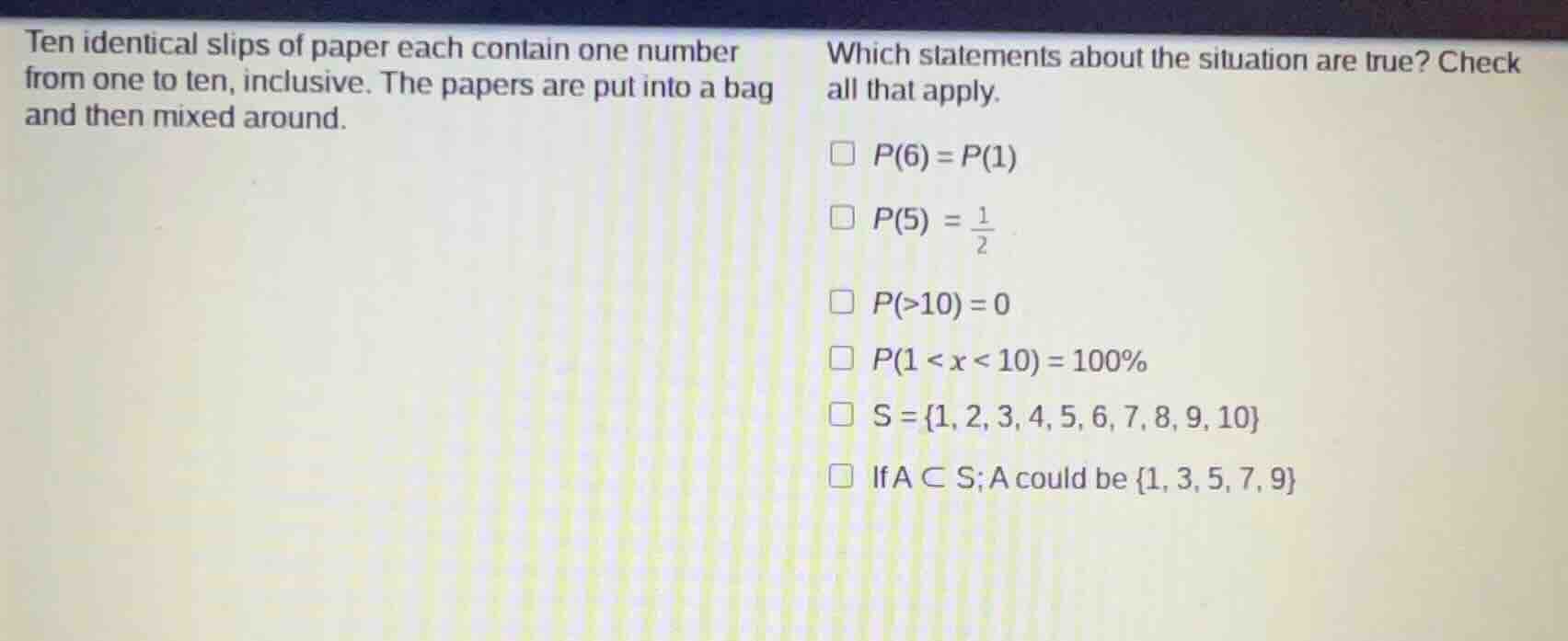
ten identical slips of paper each contain one number from one to ten, inclusive. the papers are put into a bag and then mixed around. which statements about the situation are true? check all that apply. \\(\square\\) \\(p(6) = p(1)\\) \\(\square\\) \\(p(5) = \frac{1}{2}\\) \\(\square\\) \\(p(>10) = 0\\) \\(\square\\) \\(p(1 < x < 10) = 100\\%\\) \\(\square\\) \\(s = \\{1, 2, 3, 4, 5, 6, 7, 8, 9, 10\\}\\) \\(\square\\) if \\(a \subset s\\); a could be \\(\\{1, 3, 5, 7, 9\\}\\)
Step1: Analyze \( P(6) = P(1) \)
There are 10 slips, each with a unique number from 1 to 10. The probability of drawing 6, \( P(6) \), is the number of slips with 6 (which is 1) divided by total slips (10), so \( P(6)=\frac{1}{10} \). Similarly, \( P(1)=\frac{1}{10} \). So \( P(6) = P(1) \) is true.
Step2: Analyze \( P(5)=\frac{1}{2} \)
The number of slips with 5 is 1, total slips 10. So \( P(5)=\frac{1}{10}
eq\frac{1}{2} \). This statement is false.
Step3: Analyze \( P(>10) = 0 \)
Since the numbers on the slips are from 1 to 10, there are no slips with a number greater than 10. So the probability of drawing a number greater than 10 is 0. This statement is true.
Step4: Analyze \( P(1 < x < 10) = 100\% \)
The numbers satisfying \( 1 < x < 10 \) are 2 - 9, which is 8 numbers. The probability is \( \frac{8}{10}=0.8 = 80\%
eq100\% \). This statement is false.
Step5: Analyze \( S = \{1, 2, 3, 4, 5, 6, 7, 8, 9, 10\} \)
The sample space \( S \) consists of all possible outcomes, which are the numbers on the slips (1 to 10). So \( S = \{1, 2, 3, 4, 5, 6, 7, 8, 9, 10\} \) is true.
Step6: Analyze "If \( A\subset S \); \( A \) could be \( \{1, 3, 5, 7, 9\} \)"
A subset \( A \) of \( S \) must contain elements only from \( S \). The set \( \{1, 3, 5, 7, 9\} \) has elements from \( S \), so it is a valid subset. This statement is true.

Snap & solve any problem in the app
Get step-by-step solutions on Sovi AI
Photo-based solutions with guided steps
Explore more problems and detailed explanations
- \( P(6) = P(1) \) (true)
- \( P(>10) = 0 \) (true)
- \( S = \{1, 2, 3, 4, 5, 6, 7, 8, 9, 10\} \) (true)
- If \( A\subset S \); \( A \) could be \( \{1, 3, 5, 7, 9\} \) (true)
So the correct statements are:
\( \boldsymbol{P(6) = P(1)} \), \( \boldsymbol{P(>10) = 0} \), \( \boldsymbol{S = \{1, 2, 3, 4, 5, 6, 7, 8, 9, 10\}} \), \( \boldsymbol{\text{If } A\subset S; A \text{ could be } \{1, 3, 5, 7, 9\}} \)