QUESTION IMAGE
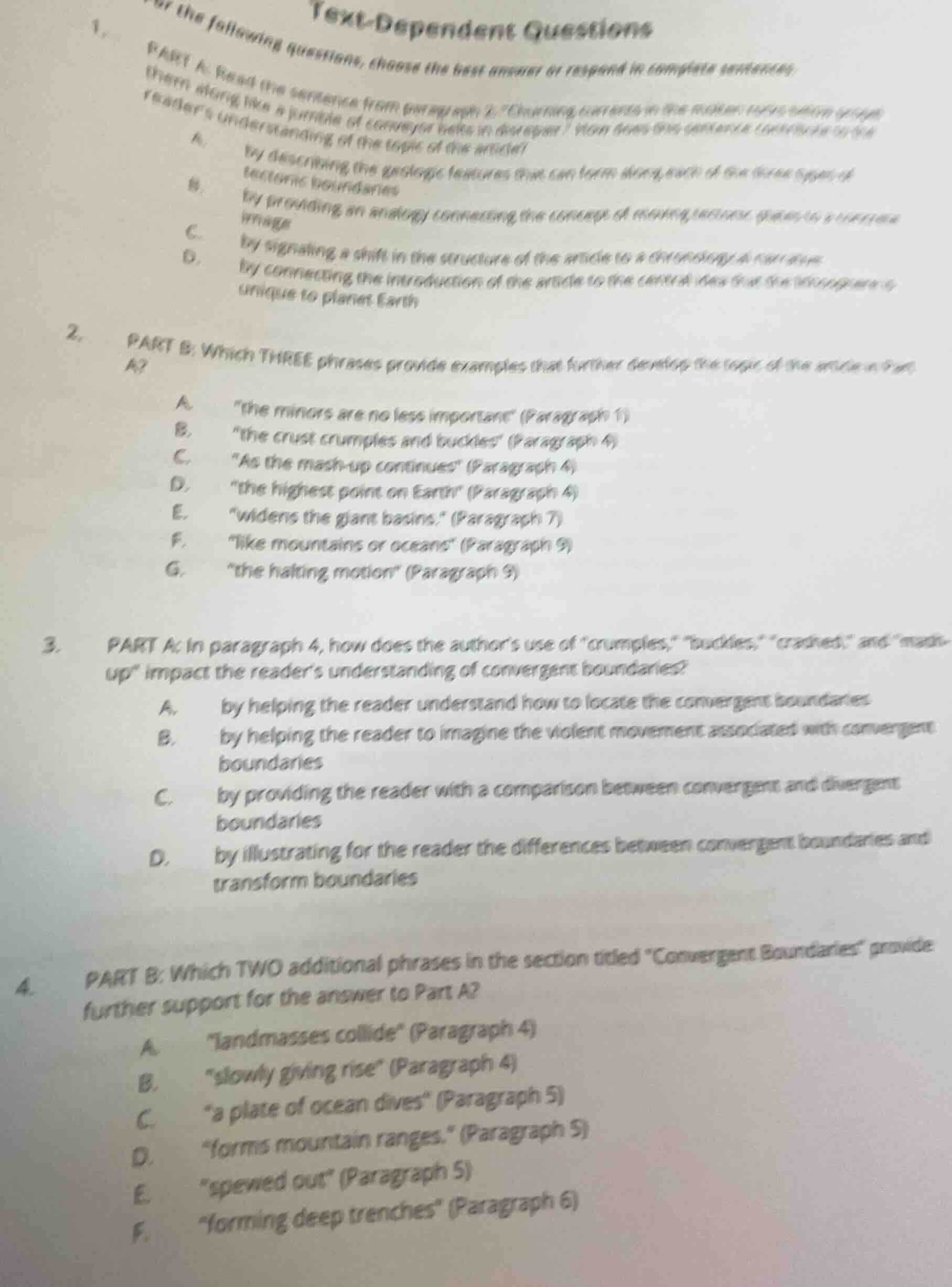
Question
text-dependent questions
for the following questions, choose the best answer or respond in complete sentences.
- part a: read the sentence from paragraph 2: “churning, curving, in the molten, liquid region, them along like a jumble of conveyor belts in disrepair.” how does this sentence contribute to your reader’s understanding of the topic of the article?
a. by describing the geologic features that can form along each of the three types of tectonic boundaries
b. by providing an analogy connecting the concept of moving tectonic plates to a concrete image
c. by signaling a shift in the structure of the article to a chronological narrative
d. by connecting the introduction of the article to the central idea that the lithosphere is unique to planet earth
- part b: which three phrases provide examples that further develop the topic of the article in part a?
a. “the minors are no less important” (paragraph 1)
b. “the crust crumples and buckles” (paragraph 4)
c. “as the mash - up continues” (paragraph 4)
d. “the highest point on earth” (paragraph 4)
e. “widens the giant basins.” (paragraph 7)
f. “like mountains or oceans” (paragraph 9)
g. “the halting motion” (paragraph 9)
- part a: in paragraph 4, how does the author’s use of “crumples,” “buckles,” “crashed,” and “mash - up” impact the reader’s understanding of convergent boundaries?
a. by helping the reader understand how to locate the convergent boundaries
b. by helping the reader to imagine the violent movement associated with convergent boundaries
c. by providing the reader with a comparison between convergent and divergent boundaries
d. by illustrating for the reader the differences between convergent boundaries and transform boundaries
- part b: which two additional phrases in the section titled “convergent boundaries” provide further support for the answer to part a?
a. “landmasses collide” (paragraph 4)
b. “slowly giving rise” (paragraph 4)
c. “a plate of ocean dives” (paragraph 5)
d. “forms mountain ranges.” (paragraph 5)
e. “spewed out” (paragraph 5)
f. “forming deep trenches” (paragraph 6)
- For question 1, the sentence uses a comparison (conveyor belts) to explain tectonic currents, which is an analogy.
- For question 2, phrases that describe geological features/processes from tectonic activity develop the topic: "the crust crumples and buckles" (convergent boundary action), "widens the giant basins" (divergent boundary action), and "like mountains or oceans" (end features of plate movement).
- For question 3, words like "crumples," "buckles," and "crash" are vivid, action-oriented terms that help readers picture the forceful movement of convergent boundaries.
- For question 4, phrases that reinforce the violent/forceful movement of convergent boundaries are "landmasses collide" (direct forceful action) and "spewed out" (violent volcanic activity from plate convergence).

Snap & solve any problem in the app
Get step-by-step solutions on Sovi AI
Photo-based solutions with guided steps
Explore more problems and detailed explanations
- B. by providing an analogy connecting the concept of moving tectonic plates to a concrete image
- B. "the crust crumples and buckles" (Paragraph 4)
E. "widens the giant basins." (Paragraph 7)
F. "like mountains or oceans" (Paragraph 9)
- B. by helping the reader to imagine the violent movement associated with convergent boundaries
- A. "landmasses collide" (Paragraph 4)
E. "spewed out" (Paragraph 5)