QUESTION IMAGE
Question
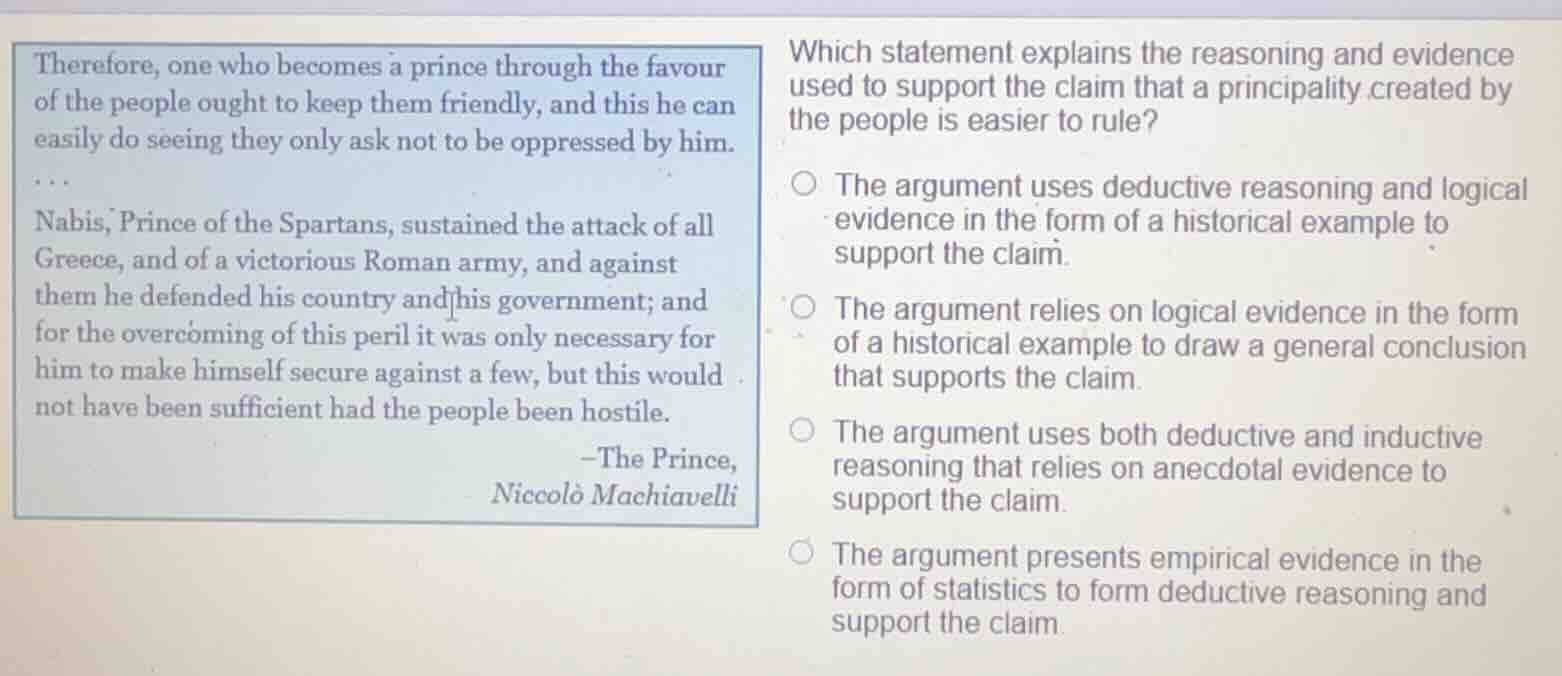
therefore, one who becomes a prince through the favour of the people ought to keep them friendly, and this he can easily do seeing they only ask not to be oppressed by him.... nabis, prince of the spartans, sustained the attack of all greece, and of a victorious roman army, and against them he defended his country and his government; and for the overcoming of this peril it was only necessary for him to make himself secure against a few, but this would not have been sufficient had the people been hostile. —the prince, niccolò machiavelli which statement explains the reasoning and evidence used to support the claim that a principality created by the people is easier to rule? ○ the argument uses deductive reasoning and logical evidence in the form of a historical example to support the claim. ○ the argument relies on logical evidence in the form of a historical example to draw a general conclusion that supports the claim. ○ the argument uses both deductive and inductive reasoning that relies on anecdotal evidence to support the claim. ○ the argument presents empirical evidence in the form of statistics to form deductive reasoning and support the claim.
The text first states a general claim (a prince made by the people can easily keep them friendly as they only ask not to be oppressed), then uses the historical example of Nabis of Sparta to illustrate that having the people's support let him fend off major attacks. This uses a specific historical example (logical evidence) to support the general claim, which aligns with inductive reasoning (specific to general). The first option incorrectly cites deductive reasoning, the third incorrectly claims both deductive and inductive with anecdotal evidence, and the fourth mentions statistics which are not present.

Snap & solve any problem in the app
Get step-by-step solutions on Sovi AI
Photo-based solutions with guided steps
Explore more problems and detailed explanations
The argument relies on logical evidence in the form of a historical example to draw a general conclusion that supports the claim.