QUESTION IMAGE
Question
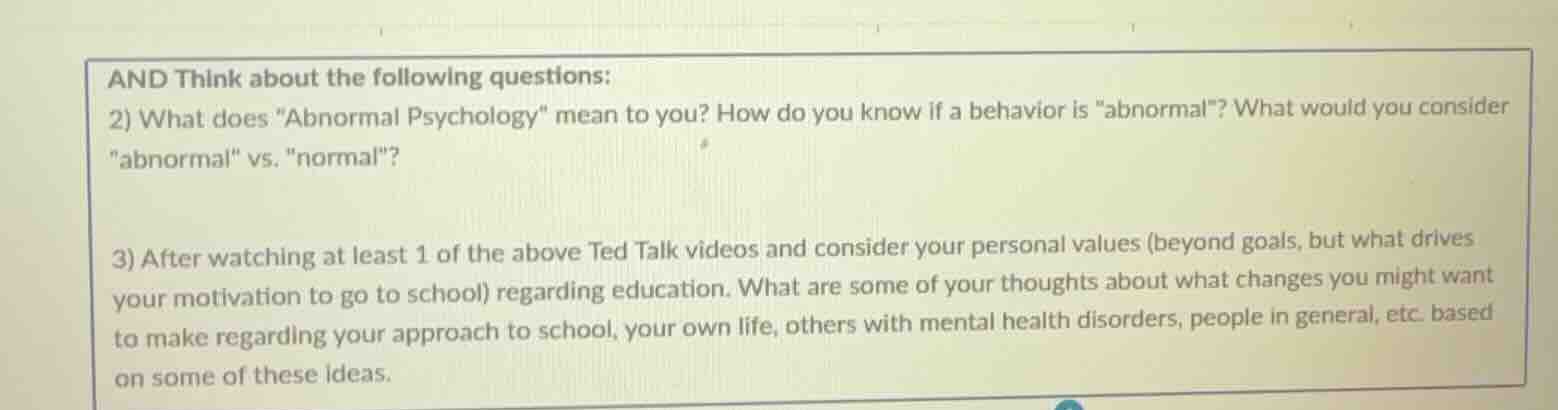
and think about the following questions: 2) what does \abnormal psychology\ mean to you? how do you know if a behavior is \abnormal\? what would you consider \abnormal\ vs.
ormal\? 3) after watching at least 1 of the above ted talk videos and consider your personal values (beyond goals, but what drives your motivation to go to school) regarding education. what are some of your thoughts about what changes you might want to make regarding your approach to school, your own life, others with mental health disorders, people in general, etc. based on some of these ideas.
Response
Question 2
Brief Explanations
- Abnormal Psychology: It's the study of atypical behaviors, emotions, and thoughts that deviate from societal norms or cause distress/impairment.
- Identifying Abnormal Behavior: Use criteria like statistical rarity (e.g., extreme IQ), deviance from cultural norms (e.g., unusual rituals), personal distress (e.g., severe anxiety), and functional impairment (e.g., inability to work).
- Normal vs. Abnormal: Normal behavior aligns with cultural expectations, is adaptive (helps daily life), and causes no distress. Abnormal behavior is maladaptive, causes distress, deviates from norms, or is statistically uncommon.
Brief Explanations
- Personal Values & Education: Values like empathy, growth, or well - being shape educational approach. After a Ted Talk (e.g., on mental health in education), one might reflect on self - care, reducing stigma, or inclusive learning.
- Changes: For school, adopt self - compassionate study habits. In life, prioritize mental health (e.g., mindfulness). For others with mental health disorders, advocate for support. For people in general, promote empathy and mental health awareness.

Snap & solve any problem in the app
Get step-by-step solutions on Sovi AI
Photo-based solutions with guided steps
Explore more problems and detailed explanations
- "Abnormal Psychology" studies behaviors, thoughts, or emotions that are atypical, distressing, or impairing. A behavior is abnormal if it’s statistically rare, deviates from cultural norms, causes personal distress, or impairs functioning. "Normal" behavior is adaptive, culturally appropriate, and non - distressing; "abnormal" is maladaptive, distressing, or norm - deviating.