QUESTION IMAGE
Question
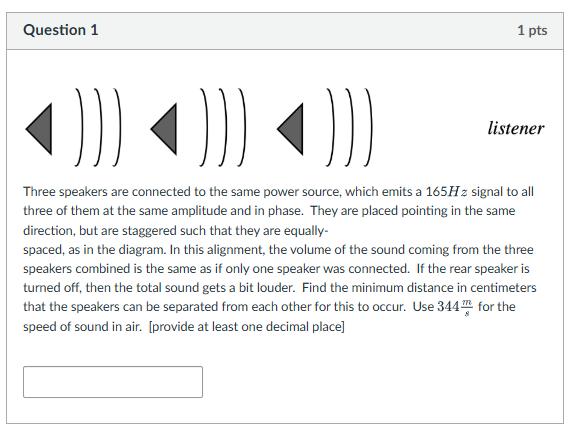
three speakers are connected to the same power source, which emits a 165hz signal to all three of them at the same amplitude and in phase. they are placed pointing in the same direction, but are staggered such that they are equally - spaced, as in the diagram. in this alignment, the volume of the sound coming from the three speakers combined is the same as if only one speaker was connected. if the rear speaker is turned off, then the total sound gets a bit louder. find the minimum distance in centimeters that the speakers can be separated from each other for this to occur. use 344\\(\frac{m}{s}\\) for the speed of sound in air. provide at least one decimal place
Step1: Find the wavelength of the sound
The formula for the wavelength \(\lambda\) is \(\lambda=\frac{v}{f}\), where \(v = 344\frac{m}{s}\) is the speed of sound and \(f = 165Hz\) is the frequency.
\(\lambda=\frac{344}{165}\approx2.0848m = 208.48cm\)
Step2: Analyze the interference condition
When three speakers are on, the total volume is same as one speaker, meaning destructive interference (net amplitude zero). When the rear speaker is off, the interference changes to constructive (louder). For three equally - spaced speakers (let the distance between adjacent speakers be \(d\)), the path difference between the front - most and middle speaker is \(d\), and between front - most and rear - most is \(2d\).
For destructive interference with three sources (in - phase initially), the condition for the net amplitude to be zero (when three are on) and then constructive when one is off (rear) implies that the path difference should be such that when three are on, the interference is destructive, and when two are on (middle and front), it is constructive.
The condition for destructive interference for three in - phase sources leading to constructive when one is removed: The path difference \(d\) should satisfy that for three sources, the phase difference due to path difference causes cancellation, and for two sources, the phase difference causes reinforcement.
The key is that the path difference \(d\) should be half of the wavelength for the interference change. Wait, more precisely, when three speakers are on, the interference is destructive (so the resultant amplitude is zero), and when we turn off the rear speaker, we have two speakers (middle and front) with path difference \(d\). For the sound to get louder, the two remaining speakers should be in constructive interference. But initially, with three speakers, the rear and middle interfere with the front.
Let's think in terms of phase difference. The phase difference \(\Delta\phi\) due to path difference is \(\Delta\phi=\frac{2\pi}{\lambda}\Delta x\), where \(\Delta x\) is the path difference.
For three in - phase sources, the condition for destructive interference (net amplitude zero) when combined, and constructive when one is removed: The path difference between adjacent speakers \(d\) should be such that when three are on, the rear speaker's wave has a path difference of \(2d\) from the front, and the middle has a path difference of \(d\) from the front.
The condition for the three - speaker destructive interference: The sum of the amplitudes from three speakers is zero. Let the amplitude of each speaker be \(A\). The amplitude from front is \(A\), middle is \(Ae^{i\frac{2\pi}{\lambda}d}\), rear is \(Ae^{i\frac{2\pi}{\lambda}(2d)}\). The sum \(A + Ae^{i\frac{2\pi}{\lambda}d}+Ae^{i\frac{2\pi}{\lambda}(2d)} = 0\). Dividing by \(A\), we get \(1 + e^{i\frac{2\pi}{\lambda}d}+e^{i\frac{4\pi}{\lambda}d}=0\).
This is a geometric series. The sum of a geometric series \(S = \frac{1 - r^{n}}{1 - r}\), where \(r = e^{i\frac{2\pi}{\lambda}d}\) and \(n = 3\). \(1 + r+r^{2}=0\), the solutions for \(r\) are the cube roots of unity except \(r = 1\), so \(r = e^{i\frac{2\pi}{3}}\) or \(r = e^{i\frac{4\pi}{3}}\). So \(\frac{2\pi}{\lambda}d=\frac{2\pi}{3}\) or \(\frac{4\pi}{3}\). But we want the minimum \(d\), so we take the smaller angle.
\(\frac{2\pi}{\lambda}d=\frac{2\pi}{3}\), then \(d=\frac{\lambda}{3}\)? Wait, no. Wait, when we turn off the rear speaker, we have two speakers (middle and front) with path difference \(d\). For the sound to get louder, the two speakers should be in con…

Snap & solve any problem in the app
Get step-by-step solutions on Sovi AI
Photo-based solutions with guided steps
Explore more problems and detailed explanations
\(69.5\) (or more precisely, if we calculate \(\frac{344}{3\times165}\times100=\frac{34400}{495}\approx69.5\))