QUESTION IMAGE
Question
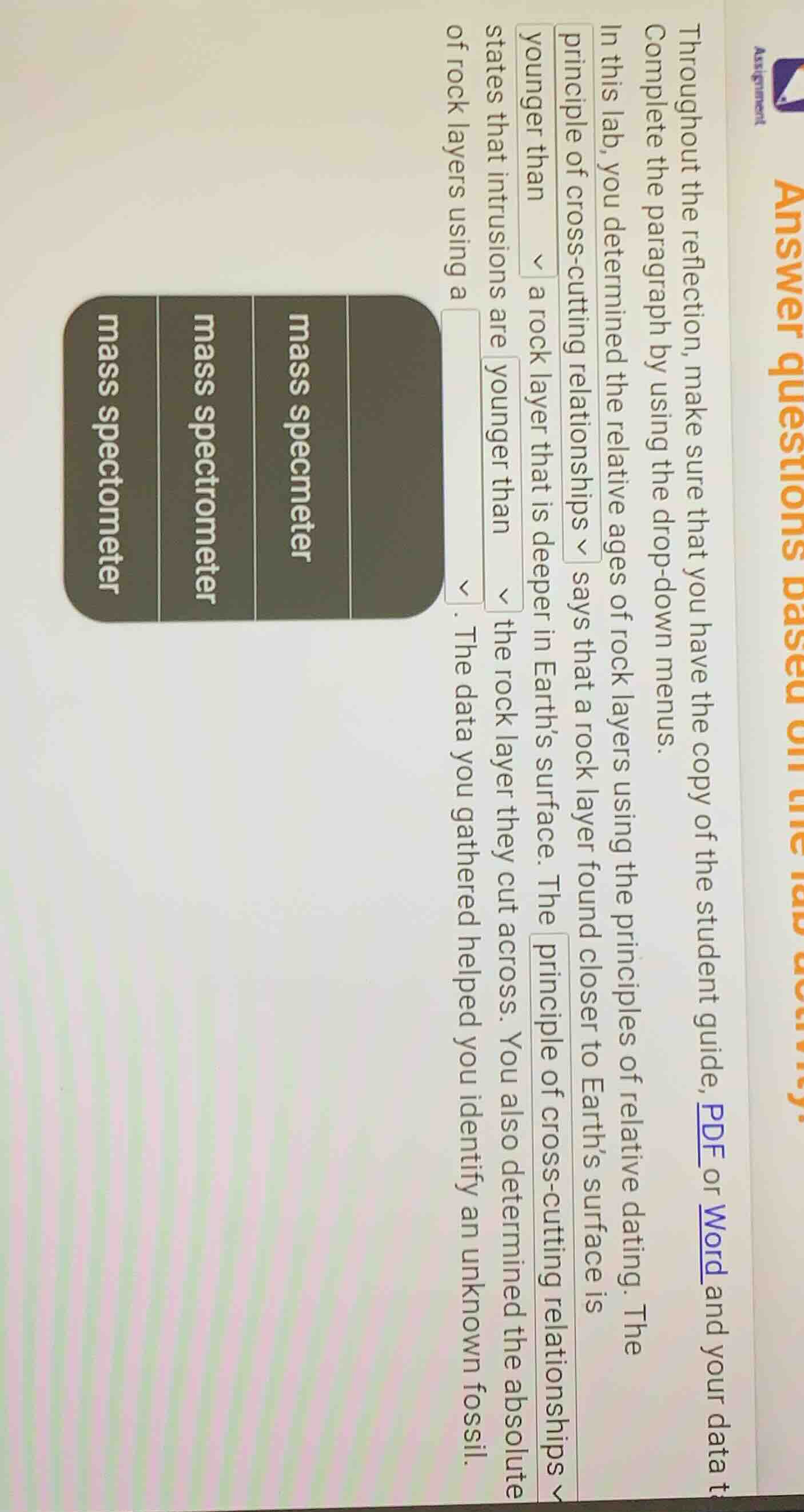
throughout the reflection, make sure that you have the copy of the student guide, pdf or word and your data t complete the paragraph by using the drop - down menus. in this lab, you determined the relative ages of rock layers using the principles of relative dating. the principle of cross - cutting relationships says that a rock layer found closer to earth’s surface is younger than a rock layer that is deeper in earth’s surface. the principle of cross - cutting relationships states that intrusions are younger than the rock layer they cut across. you also determined the absolute of rock layers using a. the data you gathered helped you identify an unknown fossil.
Part 1: Relative Age of Rock Layers (Principle of Superposition)
The principle that a rock layer closer to the Earth’s surface is younger than a deeper one is the principle of superposition (this fills the first blank, but since the first dropdown is about cross - cutting, we focus on the next parts).
Part 2: Principle of Cross - Cutting Relationships
The principle of cross - cutting relationships states that an intrusion (like a dike or a fault) is younger than the rock layer it cuts across. Also, a rock layer that is cut by an intrusion is older than the intrusion. So for the first cross - cutting blank (about the rock layer closer to the surface being younger than the deeper one), the principle of superposition is related, but the cross - cutting part: a rock layer found closer to Earth’s surface is younger than a rock layer that is deeper in Earth’s surface (this is the principle of superposition, but the cross - cutting principle says intrusions are younger than the rock layers they cut).
Part 3: Absolute Age Determination and Fossil Identification
To determine the absolute age of rock layers, methods like radiometric dating are used. For identifying an unknown fossil, a mass spectrometer (the correct spelling is “mass spectrometer”) can be used in techniques like radiocarbon dating or other isotopic analysis. The correct spelling among the options is “mass spectrometer”.
For the blanks in the paragraph (assuming the first dropdown for the rock layer age relation is “younger than” (principle of superposition), the cross - cutting part: “intrusions are younger than the rock layer they cut across”, and the instrument is “mass spectrometer”.
- For the relative age of rock layers (closer to surface vs deeper), the principle of superposition tells us the closer (shallower) layer is younger.
- The principle of cross - cutting relationships states intrusions are younger than the rock layers they cut.
- For absolute age and fossil identification, a mass spectrometer (correct spelling) is used in isotopic analysis techniques.

Snap & solve any problem in the app
Get step-by-step solutions on Sovi AI
Photo-based solutions with guided steps
Explore more problems and detailed explanations
- First (rock layer age relation): younger than (principle of superposition context)
- Second (cross - cutting intrusions): younger than the rock layer they cut across
- Instrument: mass spectrometer