QUESTION IMAGE
Question
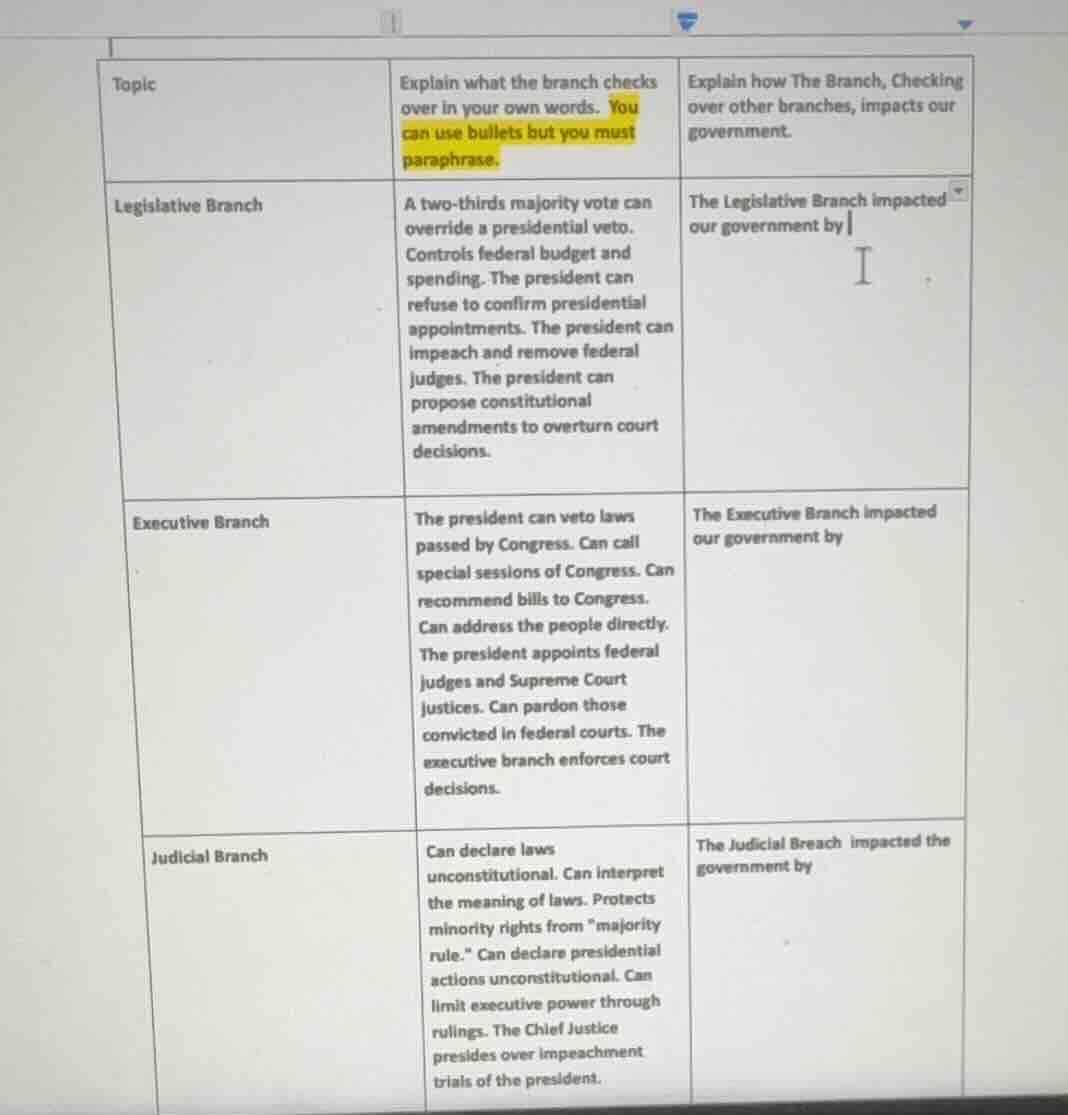
topic | explain what the branch checks over in your own words. you can use bullets but you must paraphrase. | explain how the branch, checking over other branches, impacts our government.
legislative branch | a two - thirds majority vote can override a presidential veto. controls federal budget and spending. the president can refuse to confirm presidential appointments. the president can impeach and remove federal judges. the president can propose constitutional amendments to overturn court decisions. | the legislative branch impacted our government by
executive branch | the president can veto laws passed by congress. can call special sessions of congress. can recommend bills to congress. can address the people directly. the president appoints federal judges and supreme court justices. can pardon those convicted in federal courts. the executive branch enforces court decisions. | the executive branch impacted our government by
judicial branch | can declare laws unconstitutional. can interpret the meaning of laws. protects minority rights from \majority rule.\ can declare presidential actions unconstitutional. can limit executive power through rulings. the chief justice presides over impeachment trials of the president. | the judicial breach impacted the government by
Each branch's impact is tied to its checking power, ensuring balance, preventing overreach, and shaping governance:
- Legislative Branch: Its checks prevent executive overreach, set fiscal priorities, and correct judicial or executive actions that conflict with legislative will.
- Executive Branch: Its checks shape legislative priorities, enforce court rulings, and control federal judicial appointments to align the judiciary with executive priorities.
- Judicial Branch: Its checks limit legislative/executive overreach, protect minority rights, and ensure all government actions follow the Constitution.

Snap & solve any problem in the app
Get step-by-step solutions on Sovi AI
Photo-based solutions with guided steps
Explore more problems and detailed explanations
- Legislative Branch: preventing presidential overreach through veto overrides, setting federal spending priorities, holding federal officials (including judges) accountable via impeachment, and adjusting constitutional rules to counteract judicial decisions, which ensures legislative priorities and accountability are central to governance.
- Executive Branch: blocking unwanted congressional laws via veto, driving legislative agendas through bill recommendations, shaping the federal judiciary through appointments, ensuring court rulings are enforced, and using direct public addresses to rally support for executive priorities, which centralizes administrative and agenda-setting power in the executive.
- Judicial Branch: striking down unconstitutional laws and presidential actions, clarifying legal meaning to guide governance, protecting minority groups from unfair majority policies, and overseeing presidential impeachment trials, which acts as a neutral referee to ensure all government actions align with the U.S. Constitution.