QUESTION IMAGE
Question
topic 1 patterns in bivariate data
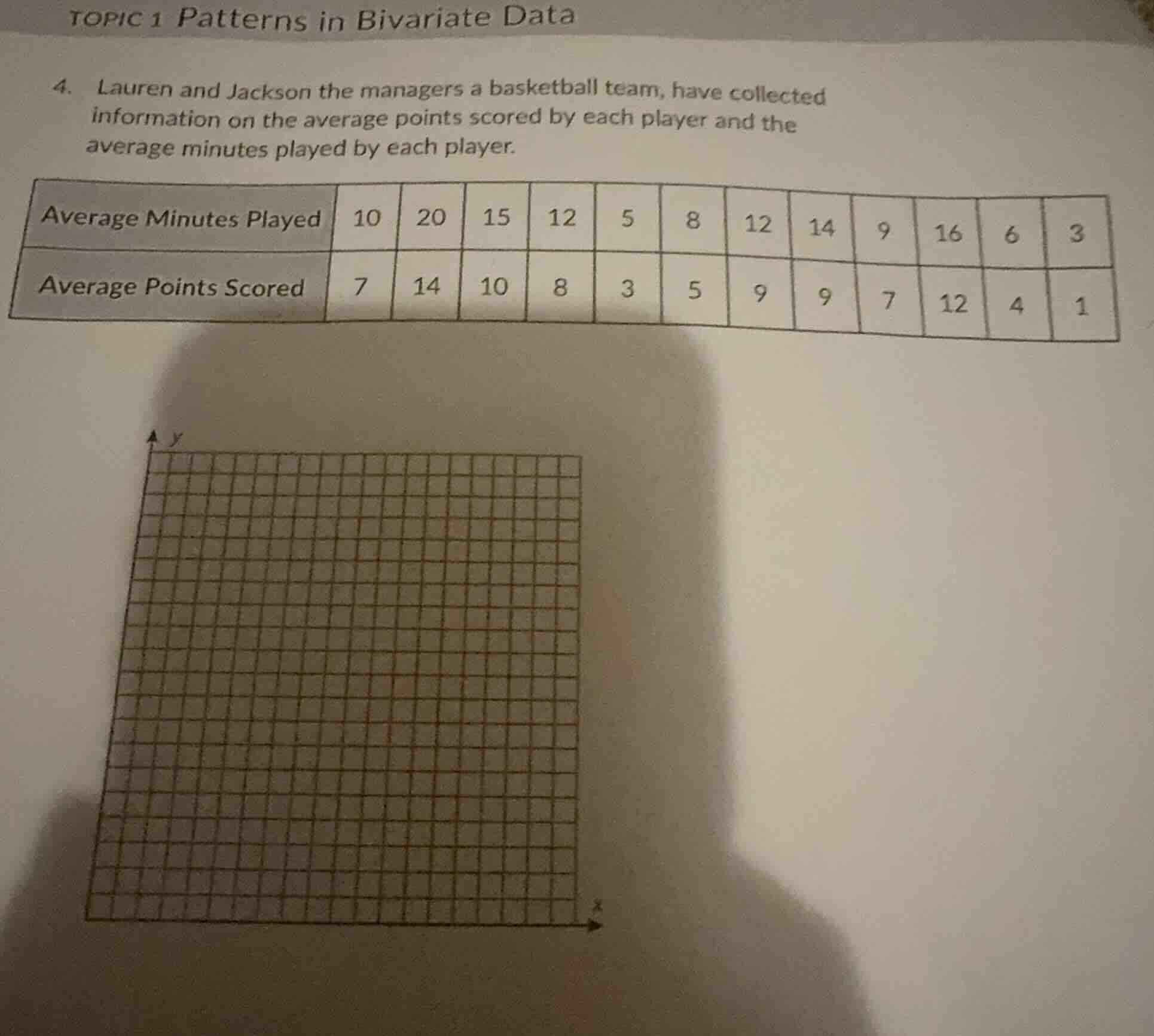
- lauren and jackson the managers a basketball team, have collected
information on the average points scored by each player and the
average minutes played by each player.
| average minutes played | 10 | 20 | 15 | 12 | 5 | 8 | 12 | 14 | 9 | 16 | 6 | 3 |
|---|
(grid for plotting)
To solve the problem of creating a scatter plot for the given bivariate data (average minutes played and average points scored), we follow these steps:
Step 1: Identify the variables
- The independent variable (x - axis) is the average minutes played.
- The dependent variable (y - axis) is the average points scored.
Step 2: List the data points
We have the following pairs of (average minutes played, average points scored):
- (10, 7)
- (20, 14)
- (15, 10)
- (12, 8)
- (5, 3)
- (8, 5)
- (12, 9)
- (14, 9)
- (9, 7)
- (16, 12)
- (6, 4)
- (3, 1)
Step 3: Plot the points on the scatter plot
- For each data point, locate the x - value (average minutes played) on the x - axis and the y - value (average points scored) on the y - axis. Then mark the intersection of these two values with a dot.
For example:
- For the point (10, 7), find 10 on the x - axis and 7 on the y - axis, then mark the point.
- For the point (20, 14), find 20 on the x - axis and 14 on the y - axis, then mark the point.
- Continue this process for all 12 data points.
After plotting all the points, the scatter plot will show the relationship between the average minutes played and the average points scored for each basketball player.
(Note: Since we can't draw the actual plot here, the above steps describe how to create it. If you were to analyze the scatter plot, you would likely see a positive correlation, meaning that as the average minutes played increase, the average points scored also tend to increase.)

Snap & solve any problem in the app
Get step-by-step solutions on Sovi AI
Photo-based solutions with guided steps
Explore more problems and detailed explanations
To solve the problem of creating a scatter plot for the given bivariate data (average minutes played and average points scored), we follow these steps:
Step 1: Identify the variables
- The independent variable (x - axis) is the average minutes played.
- The dependent variable (y - axis) is the average points scored.
Step 2: List the data points
We have the following pairs of (average minutes played, average points scored):
- (10, 7)
- (20, 14)
- (15, 10)
- (12, 8)
- (5, 3)
- (8, 5)
- (12, 9)
- (14, 9)
- (9, 7)
- (16, 12)
- (6, 4)
- (3, 1)
Step 3: Plot the points on the scatter plot
- For each data point, locate the x - value (average minutes played) on the x - axis and the y - value (average points scored) on the y - axis. Then mark the intersection of these two values with a dot.
For example:
- For the point (10, 7), find 10 on the x - axis and 7 on the y - axis, then mark the point.
- For the point (20, 14), find 20 on the x - axis and 14 on the y - axis, then mark the point.
- Continue this process for all 12 data points.
After plotting all the points, the scatter plot will show the relationship between the average minutes played and the average points scored for each basketball player.
(Note: Since we can't draw the actual plot here, the above steps describe how to create it. If you were to analyze the scatter plot, you would likely see a positive correlation, meaning that as the average minutes played increase, the average points scored also tend to increase.)