QUESTION IMAGE
Question
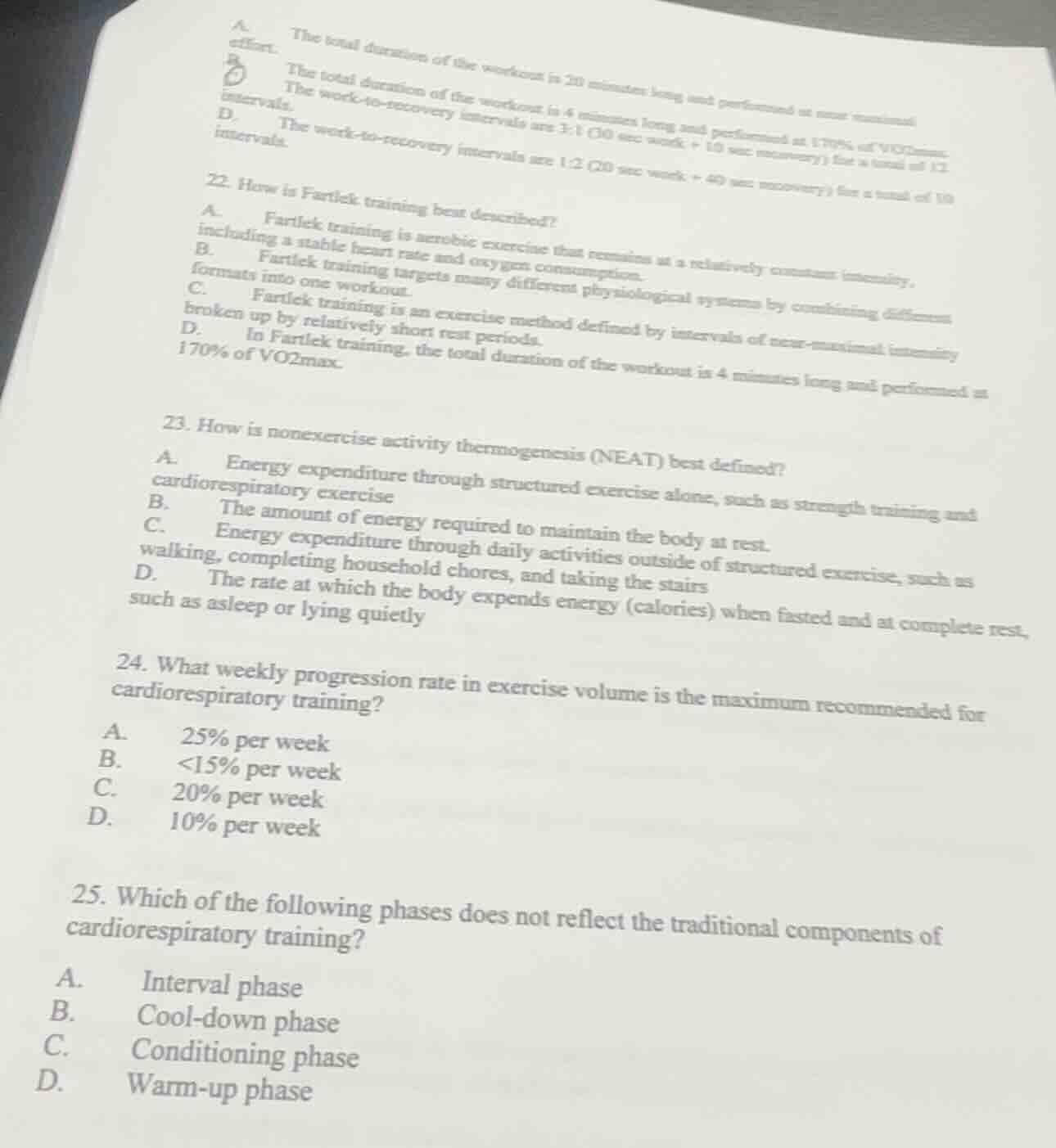
a. the total duration of the workout is 20 minutes long and performed at near maximal effort.b. the total duration of the workout is 4 minutes long and performed at 170% of vo2max.c. the work-to-recovery intervals are 3:1 (30 sec work + 10 sec recovery) for a total of 12 intervals.d. the work-to-recovery intervals are 1:2 (20 sec work + 40 sec recovery) for a total of 10 intervals.22. how is fartlek training best described?a. fartlek training is aerobic exercise that remains at a relatively constant intensity, including a stable heart rate and oxygen consumption.b. fartlek training targets many different physiological systems by combining different formats into one workout.c. fartlek training is an exercise method defined by intervals of near-maximal intensity broken up by relatively short rest periods.d. in fartlek training, the total duration of the workout is 4 minutes long and performed at 170% of vo2max.23. how is nonexercise activity thermogenesis (neat) best defined?a. energy expenditure through structured exercise alone, such as strength training and cardiorespiratory exerciseb. the amount of energy required to maintain the body at rest.c. energy expenditure through daily activities outside of structured exercise, such as walking, completing household chores, and taking the stairsd. the rate at which the body expends energy (calories) when fasted and at complete rest, such as asleep or lying quietly24. what weekly progression rate in exercise volume is the maximum recommended for cardiorespiratory training?a. 25% per weekb. <15% per weekc. 20% per weekd. 10% per week25. which of the following phases does not reflect the traditional components of cardiorespiratory training?a. interval phaseb. cool-down phasec. conditioning phased. warm-up phase
- Fartlek training blends various exercise formats and intensities in one session, targeting multiple physiological systems.
- NEAT is energy burned during unstructured daily activities outside formal exercise.
- To avoid injury and overtraining, the maximum safe weekly progression for cardiorespiratory training volume is 10%.
- Traditional cardiorespiratory training includes warm-up, conditioning, and cool-down phases; interval training is a type within conditioning, not a standalone core phase.

Snap & solve any problem in the app
Get step-by-step solutions on Sovi AI
Photo-based solutions with guided steps
Explore more problems and detailed explanations
- B. Fartlek training targets many different physiological systems by combining different formats into one workout.
- C. Energy expenditure through daily activities outside of structured exercise, such as walking, completing household chores, and taking the stairs
- D. 10% per week
- A. Interval phase